Looking for the best Builder.ai alternatives? You’re not alone.
Builder.ai is a popular no-code platform. However, it’s not ideal for everyone.
Some users find it expensive. Others feel limited by the lack of control or tech options. That’s why many businesses are now switching to platforms that offer more flexibility and value.
Some tools are great for quick MVPs. Others are better suited for teams that want full control over app development.
It can also help you build faster and scale easier. In this blog, we’ll explore top Builder.ai alternatives that suit different needs and budgets.
Ready to explore? Let’s begin!
Need Assistance with Your Dream Project?
You can reach to Our App Development Business while Considering Builder.ai Alternative!
Table Of Contents
Which Builder.ai Alternative Is Right for You?
Choosing the right Builder.ai alternative depends on what you’re building, your technical skills, and your long-term goals. Here’s a quick guide to help you decide which tool fits your use case best:
Use Cases
Best Alternatives
For fully custom solutions
Trango Tech – Ideal for scalable, tailor-made web or mobile app development.
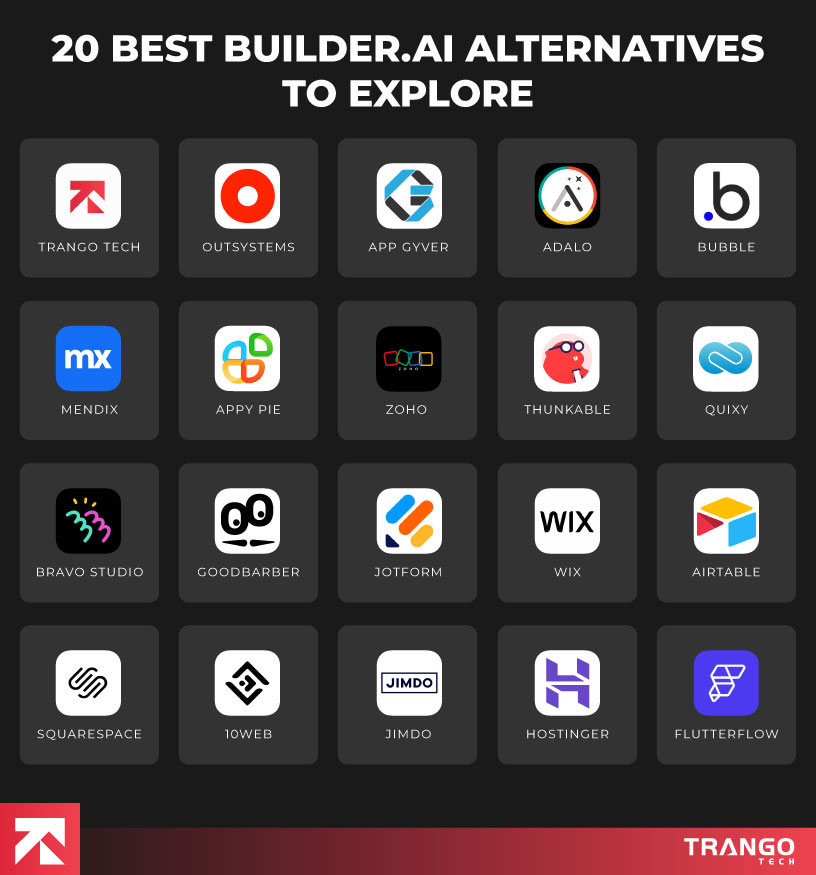
20 Best Builder.ai Alternatives for Developing Your Dream App Effortlessly!
Many no-code and low-code platforms offer similar or overlapping functionalities to Builder.ai.
Here are some of the popular 20 affordable yet cheap Builder.ai alternatives, categorized based on their strengths & target audience:
To avoid any challenges later, you can directly partner with our experts at Trango Tech.
Best Full-Code Alternatives to Builder.ai for Custom App Development
1. Trango Tech
When we talk about the best Builder.ai alternatives, Trango Tech is the name you can out your trust on.
They feature a dynamic low-code and custom development platform. It helps businesses build scalable, high-performance apps quickly.
The platform combines visual development tools with expert-led engineering. Besides, it supports web, mobile, and enterprise-grade apps.
Powerful backend support and third-party integrations come built-in. Additionally, they follow a hybrid approach. This enables speed and flexibility in development.
As an efficient Builder.ai alternative, Trango Tech stands out with intuitive customization, expert guidance, and transparent pricing.
Key Features:
• Flexible low-code + custom development approach
• End-to-end support – planning, design, development, QA, and launch
• Support for complex workflows and API integrations
• Transparent and scalable pricing with no vendor lock-in
Pricing:
Trango Tech offers flexible pricing based on project needs. Basic app development is affordable for startups and small businesses. Enterprise projects are priced based on features, integrations, and long-term support. Plus, you may find custom quotes that assures clients pay only for what they need.
Pros & Cons:
Pros
Cons
Custom solutions with expert guidance
Requires some collaboration during planning
Competitive pricing for high-quality builds
Not a pure drag-and-drop tool like some no-code platforms
Scalable architecture and integrations
Strong UX/UI focus with full-cycle development
Why Businesses Choose Trango Tech:
Trango Tech is a strong alternative to Builder.ai. It combines speed with flexibility. Ideal for startups, SMBs, and enterprises needing tailored solutions. It offers greater control, better support, and lasting value compared to other traditional platforms.
Want a Quick Estimate for Your Dream App Project?
Use our App Development Cost Calculator
2. Wix
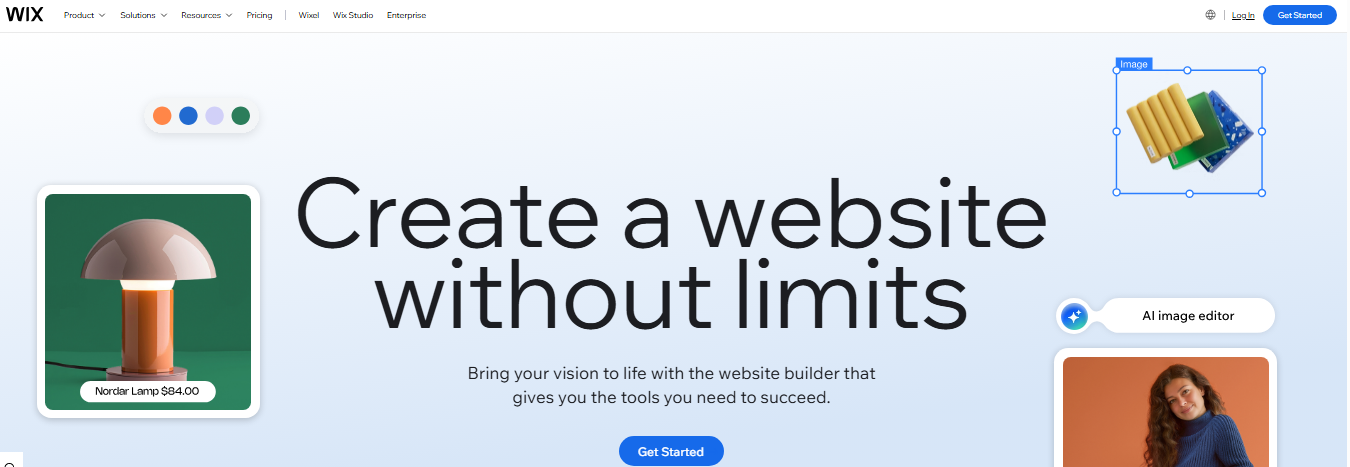
Wix is a popular all-in-one website builder with drag-and-drop capabilities to create websites and web applications.
Offers hundreds of customizable templates and an extensive App Market to add features like booking systems, chatbots, and e-commerce.
It works well for small businesses, freelancers, and startups that need quick and visually appealing web apps.
Its scalable plans and ease of use make Wix one of the best Builder.ai alternatives for creative and service-focused projects.
Key Features:
Drag-and-drop website and web app builder
Extensive template library and App Market
SEO tools and mobile optimization
Built-in e-commerce and booking systems
Pricing:
Wix offers a free plan with Wix branding and limited features. Paid plans start at $16 per month and vary based on bandwidth, storage, and e-commerce capabilities. Enterprise solutions are available with custom pricing.
Pros & Cons:
Pros
Cons
Beginner-friendly with flexible design options
Free plan includes Wix ads and branding
Large selection of templates and apps
Advanced features can be costly
Supports e-commerce and online bookings
Limited backend customization options
Mobile-optimized and SEO friendly
What Makes Wix a Standout Builder.ai Alternative
Wix is perfect for users looking for a versatile and easy-to-use platform. It allows quick creation of web apps with rich design freedom. Small businesses and creatives find it an economical and scalable Builder.ai alternative.
3. Squarespace
Squarespace is a comprehensive platform for building stunning websites, portfolios, and online stores with no coding needed.
It offers sleek, professionally designed templates and an intuitive drag-and-drop editor.
Includes built-in e-commerce features, blogging tools, and marketing options such as email campaigns and SEO enhancements.
Squarespace’s all-in-one features and focus on design make it a premium Builder.ai alternative for users prioritizing aesthetics & ease of use.
Marketing integrations including email campaigns and SEO
Easy drag-and-drop editing with style customization
Pricing:
Squarespace pricing starts at $16 per month. Plans are billed annually or monthly. There is no free plan, but a 14-day free trial is available.
Pros & Cons:
Pros
Cons
Beautiful, responsive designs and templates
No free plan, only trial available
Integrated e-commerce and marketing tools
Limited backend customization options
Easy-to-use editing and style options
Pricing is higher than some competitors
Excellent customer support
Why Squarespace Is a Leading Builder.ai Alternative:
Squarespace is perfect for users focused on professional design and simple site building. For a reliable, visually stunning, and all-in-one Builder.ai alternative, it is a reliable choice.
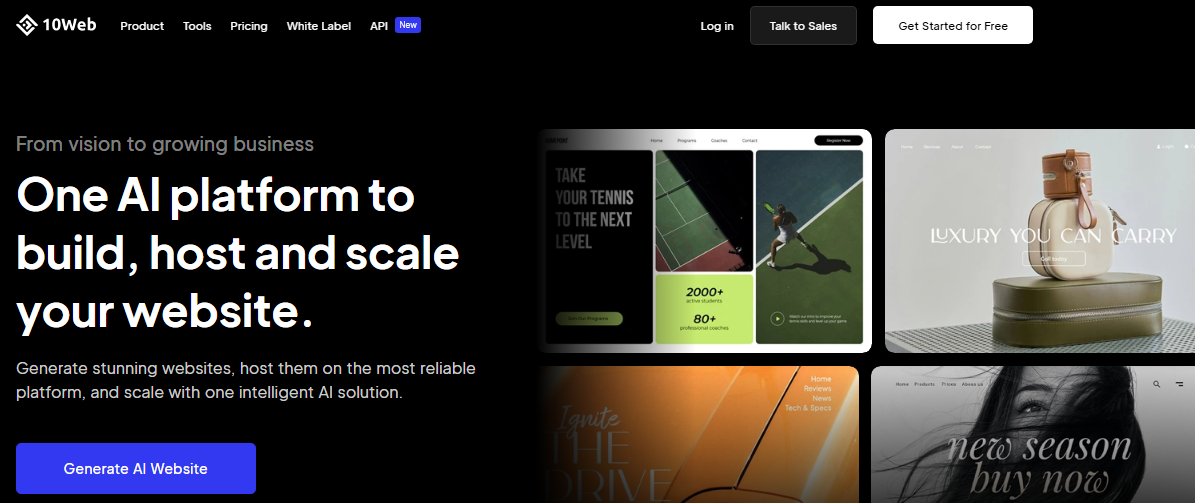
4. 10Web
10Web is an AI-powered website builder and hosting platform designed to automate website creation & management.
It offers a powerful drag-and-drop builder combined with AI tools that generate entire websites in minutes.
Supports WordPress integration. That makes it perfect for users who want both ease of use and control.
Its automated backups, security, and optimization features make it a reliable and scalable Builder.ai alternative.
Key Features:
AI-powered website creation and design automation
Drag-and-drop builder with WordPress compatibility
Automated backups, security, and speed optimization
Managed cloud hosting with 24/7 support
Pricing:
10Web offers a free trial to explore its features. Paid plans start at $10 per month with varying storage, bandwidth, and site management capabilities. Enterprise and agency plans with custom pricing are available.
Pros & Cons:
Pros
Cons
Fast AI-driven website building
AI-generated sites may require manual tweaks
WordPress compatibility and flexibility
Limited design customization compared to pure builders
Reliable managed hosting with security
Advanced features require higher plans
Excellent automation and backups
Why 10Web Is an Innovative Builder.ai Alternative?
Its managed hosting and security make it a trustworthy and scalable Builder.ai alternative for businesses who wants quick deployment and easy management.
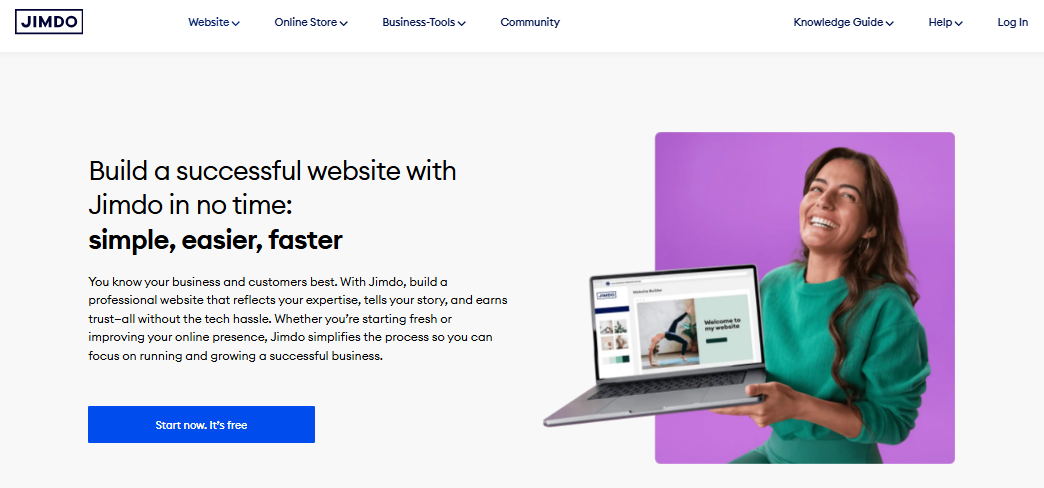
5. Jimdo
Jimdo is a straightforward website builder.ai alternative for small businesses and individuals who want to launch a website quickly.
It features an intuitive AI assistant that helps create websites by asking simple questions.
This tremendous platform is a budget-friendly Builder.ai alternative with basic e-commerce, SEO tools, and mobile responsiveness.
Ideal for freelancers, startups, and users with limited technical knowledge who need reliable, no-fuss websites without coding.
Key Features:
AI-driven website creation assistant
Mobile-optimized and responsive templates
Basic e-commerce and SEO tools
Simple drag-and-drop editor
Pricing:
Jimdo offers a free plan with basic features. Paid plans start at $9 per month and increase with storage, domain connection, and e-commerce features.
Pros & Cons:
Pros
Cons
Very beginner-friendly with AI guidance
Limited design and feature customization
Affordable pricing plans
Basic e-commerce capabilities only
Mobile responsive websites
Not suitable for complex apps or large sites
Fast setup and deployment
Why Jimdo Stands Out as a Cost-Effective Builder.ai Alternative?
Jimdo is perfect for users looking for a simple, affordable website builder. Its AI assistant and ease of use make it ideal for quick site launches.
For those seeking a cheap yet reliable Builder.ai alternative focused on small businesses and freelancers, Jimdo is a solid pick.
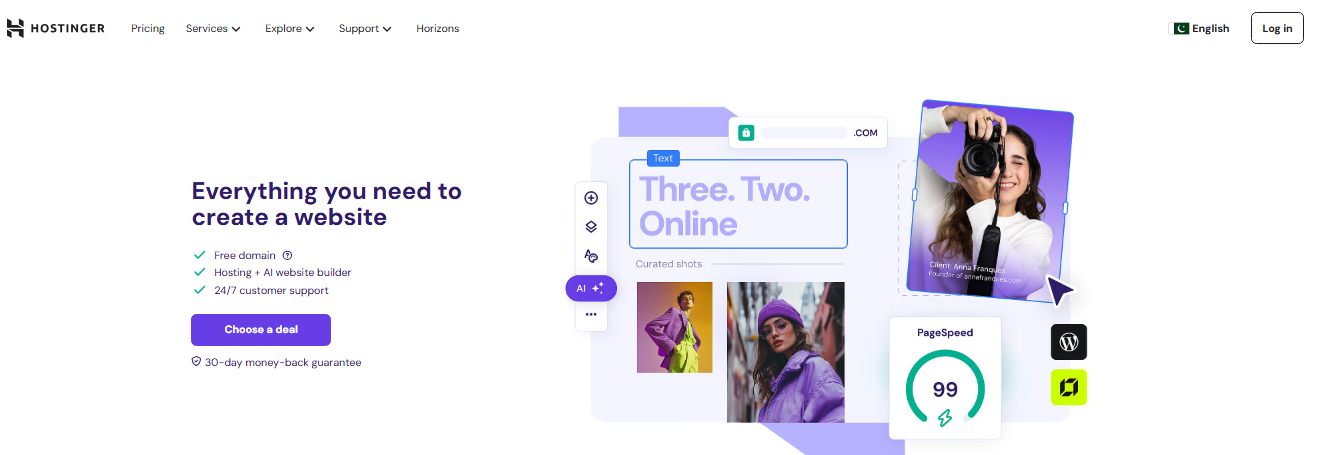
6. Hostinger
Hostinger is a web hosting provider with a website builder that offers great performance and affordability.
It combines shared hosting, cloud hosting, and a drag-and-drop website builder under one platform.
Amazingly, it is a budget-friendly Builder.ai alternative suitable for startups and small businesses. Particularly for those who need fast, reliable hosting and website creation tools.
Its integrated SSL, speed optimizations, and 24/7 support enhance security and uptime.
The platform supports multiple CMSs, including WordPress that provides flexibility and better scalability.
Key Features:
Affordable shared and cloud hosting plans
Easy drag-and-drop website builder included
SSL, daily backups, and performance optimization
24/7 customer support and multi-CMS support
Pricing:
Hostinger’s website builder and hosting packages start at $2.99 per month, depending on plan and contract length. Higher-tier plans offer more storage, bandwidth, and advanced features.
Pros & Cons:
Pros
Cons
Very affordable hosting with website builder
Website builder less advanced than dedicated platforms
Strong uptime and security features
Limited design flexibility compared to pure builders
Why Hostinger Is a Reliable Budget Builder.ai Alternative?
Hostinger offers an unbeatable price-performance ratio combining hosting and website building. For a cheap and dependable Builder.ai alternative that covers hosting and website creation, it is a trusted choice.
Low-Code Platforms (for more Advanced Users or Complex Needs)
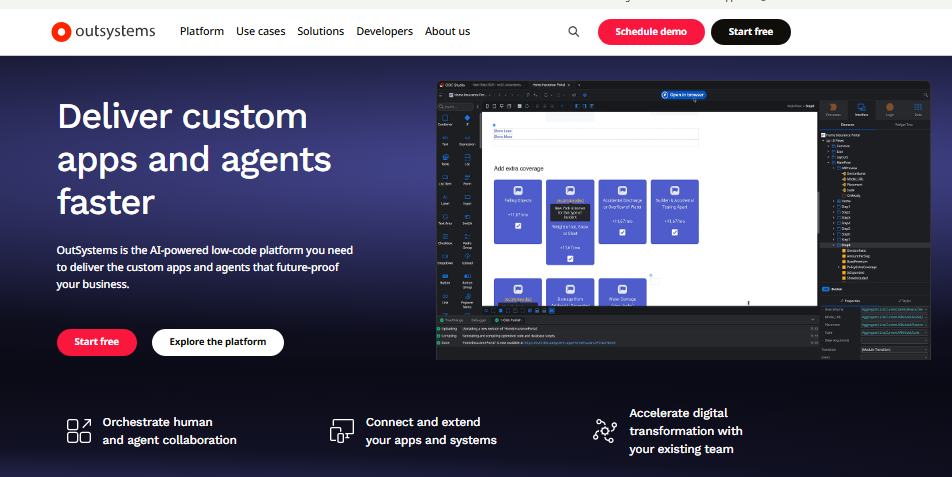
7. OutSystems
OutSystems is a leading low-code platform tailored for enterprise-grade app development.
Rapid application creation is enabled through a visual interface, supporting complex integrations with systems like SAP and Salesforce.
Scalability and robust security are prioritized. It makes the following Builder.ai alternative suitable for large organizations.
Deployment across web, mobile, and cloud environments is streamlined for efficiency.
AI-assisted tools and automated testing are included to accelerate development cycles.
Overall, OutSystems is ideal for businesses seeking long-term digital transformation solutions.
Key Features:
Visual development for fast app creation
Extensive integrations with enterprise systems
AI-assisted tools for streamlined workflows
Strong governance for compliance needs
Pricing
Pricing starts at around $4,000/year for the basic plan. Enterprise-level solutions are available with custom pricing, depending on business needs and usage volume.
Pros & Cons:
Pros
Cons
Scalable for large enterprise apps
High cost for smaller businesses
Seamless integration with existing systems
Requires some technical expertise
Rapid deployment with automated testing
No free tier available
Strong security for regulated industries
Why Choose OutSystems:
OutSystems is purpose-built for enterprises that demand rapid development, high scalability, and seamless integration with existing systems.
With strong security, AI-enhanced tools, and support for complex applications, it’s an ideal for organizations which are undergoing digital transformation. Not suitable for startups as its quite pricey.
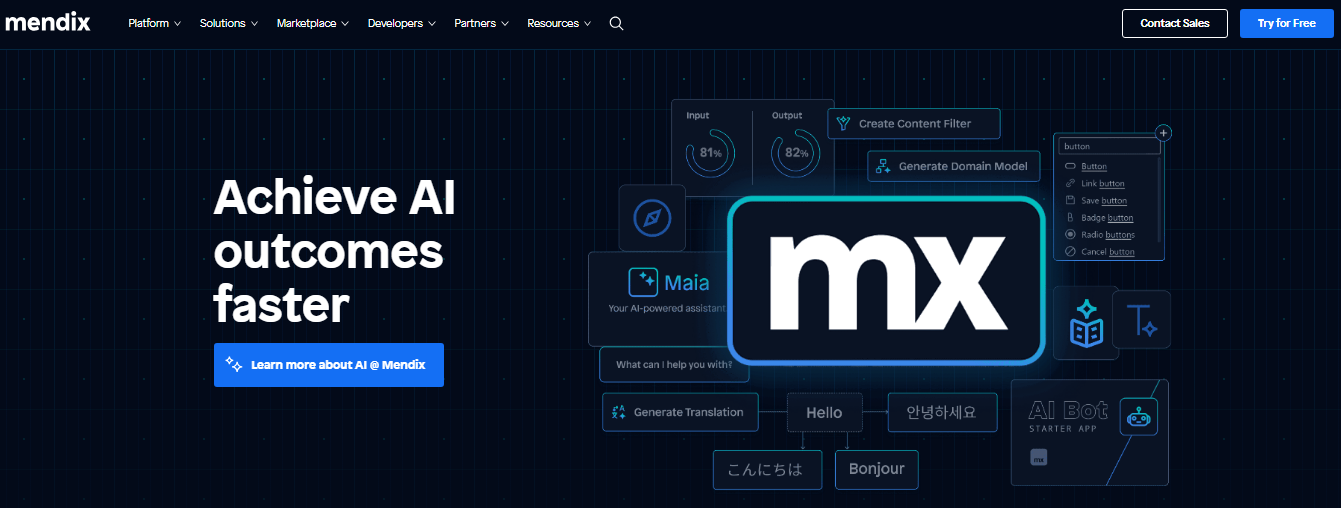
8. Mendix
Mendix is a low-code platform focused on collaborative app development for enterprises.
Visual modeling tools are provided in this which enables both technical and non-technical users to build apps.
Multi-cloud deployment and native mobile support are offered for versatile applications.
It’s widely used for IoT and enterprise software, backed by Siemens.
Team collaboration is enhanced through built-in tools for feedback and version control.
Integrations with SAP, Oracle, and other systems ensure seamless connectivity. Ideal for businesses needing complex, secure apps.
Key Features:
Visual modeling for collaborative development
Multi-cloud and native mobile support
AI-assisted tools for faster prototyping
Robust integrations with enterprise systems
Pricing:
Mendix has a free tier for individual use. Paid plans begin around $50/month. Enterprise plans are available with pricing based on app complexity, user count, and integration depth.
Pros & Cons:
Pros
Cons
Strong collaboration for team projects
High cost for small businesses
Scalable for enterprise-grade apps
Complex UI styling requires CSS knowledge
Secure with multi-cloud deployment
Less suited for solo developers
AI tools enhance development speed
Tailored for Enterprises:
The following builder.ai platform supports both no-code and low-code development. It’s designed for large teams needing collaboration, compliance, and scalability. Ideal for industries like finance, healthcare, and manufacturing.
General No – Code/ Low – Code Builder.ai Platforms
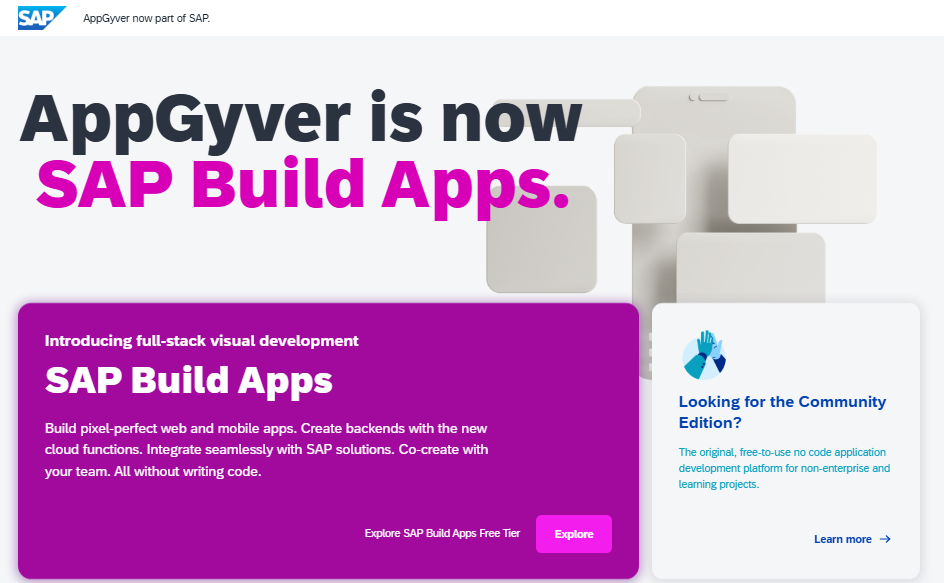
9. AppGyver
AppGyver, now SAP Build Apps, is a no-code platform focused on creating enterprise-level apps.
Complex logic and backend integrations are supported in this. It is deal for startups and large businesses. Ownership over app data and logic is provided in the following reliable builder.ai alternative.
Pixel-perfect UI design and real-time previews are offered for precise app development.
The platform integrates with SAP ecosystems and other enterprise tools.
A free Community version is available. However, paid plans offer advanced features.
In a nutshell, it’s a cost-effective choice for considering Builder.ai alternatives for rapid app creation.
Key Features:
Visual builder for intuitive app design
Cross-platform support for web and mobile
Backend integration with SAP and APIs
Free Community version for startups
Pricing:
AppGyver is free for developers and businesses with revenue under $10 million. Custom enterprise pricing is available for organizations with advanced integration and support needs.
Pros & Cons:
Pros
Cons
Affordable with free plan option
Limited features in free version
Flexible for startups and enterprises
SAP integration may feel restrictive
Precise UI design capabilities
Advanced logic needs technical know-how
Full ownership of app data
Ideal for:
AppGyver is best suited for startups, hobbyists, and small teams. It offers powerful features at no cost. Great for building prototypes and production-ready apps.
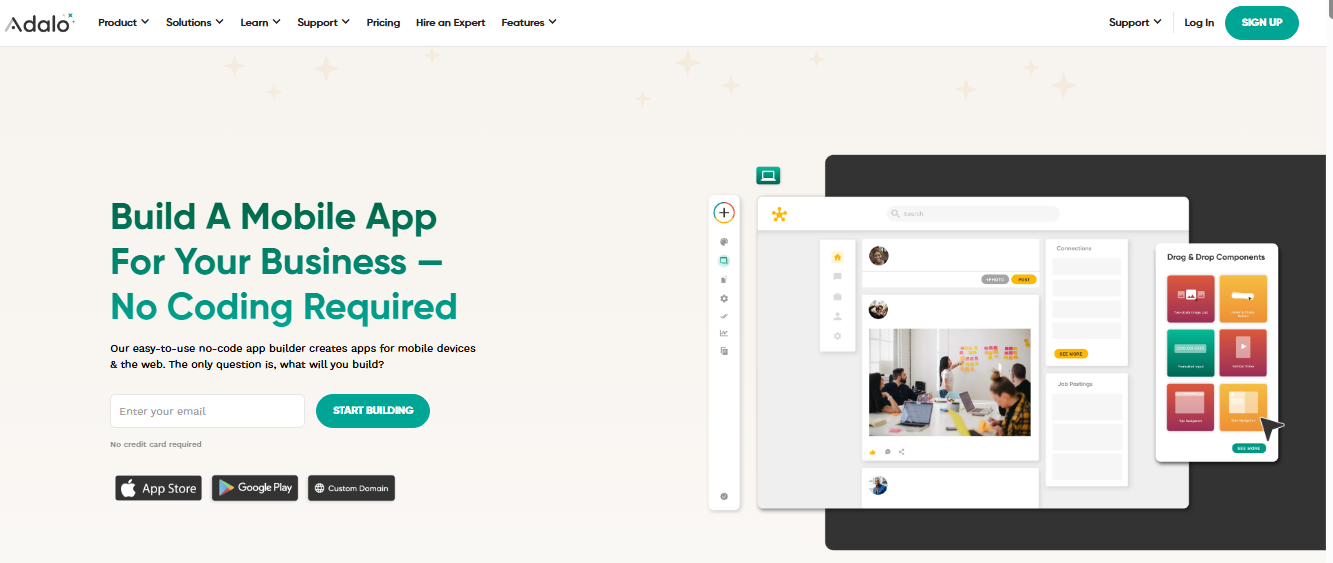
10. Adalo
When assessing the best Builder.AI alternatives, consider Adalo.
It is a no-code platform focused on building native mobile apps with ease.
A user-friendly interface is offered, which allows app creation quickly without technical expertise.
Customizable components ensure visually appealing designs tailored to user needs.
External data sources are integrated in the following platform which help connecting apps to APIs and databases.
Pre-built templates speed up development for common app types like marketplaces.
Real-time testing is supported, ensuring functionality before launch.
Overall, Adalo’s focus on mobile makes it ideal for consumer-facing apps when considering best builder.ai alternatives.
Key Features:
User-friendly interface for quick app building
Native mobile app publishing for iOS and Android
Customizable components for unique designs
API integration for external data connectivity
Pricing:
Adalo offers a free plan with limited features. Paid plans start at $36/month for solo creators. Team and business plans are available, with custom pricing for enterprise users.
Pros & Cons:
Pros
Cons
Fast app creation with intuitive tools
Limited support for complex backend logic
Native publishing simplifies deployment
Premium plans are costly for startups
Attractive templates for quick starts
Fewer features for web app development
Strong focus on mobile app aesthetics
Best Suited for:
Adalo works well for startups and small teams focused on mobile-first apps. Its simple interface and built-in database are ideal for rapid development. While it’s not tailored for complex backend logic, it’s a solid choice for MVPs & consumer-facing projects.
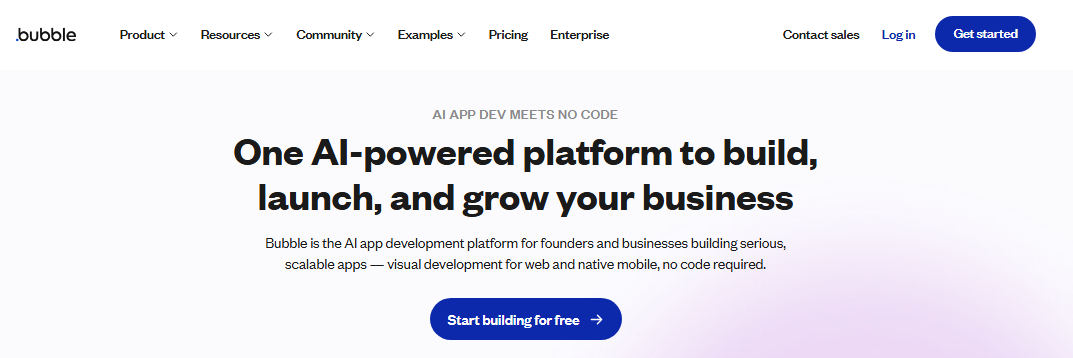
11. Bubble
If you’re in the search of best builder.ai alternatives, Bubble is a name you can rely on.
It is a no-code platform tailored for building dynamic web applications.
A drag-and-drop editor is provided in this app. It enables users to design responsive apps without coding.
Complex workflows and databases are supported, which is ideal for startups and SaaS products.
Also, Plugins and APIs with external tools are added for better versatility.
Custom designs are crafted with pixel-perfect precision for professional outcomes.
Scalability is ensured, supporting apps from prototypes to full-scale solutions.
In a nutshell, Bubble is a reliable marketplace that offers intuitive templates and plugins to accelerate development.
Key Features:
Drag-and-drop editor for responsive designs
Robust database and workflow management
Extensive plugin marketplace for customization
Team collaboration tools for efficient workflows
Pricing:
Bubble includes a free plan for personal use and testing. Paid tiers begin at $32/month and scale based on features and performance. Enterprise-grade solutions are custom-priced. It depends on infrastructure and support needs.
Pros & Cons:
Pros
Cons
Highly customizable for unique web apps
Steeper learning curve for beginners
Scalable for growing business needs
Hosting costs can increase with scale
Large plugin ecosystem enhances functionality
Limited native mobile app support
Collaboration tools streamline team projects
When to Use Bubble:
Bubble is great for building powerful web apps without code. It allows flexible logic and workflow customization. Startups and growing teams choose Bubble for complex MVPs, SaaS products, and internal tools.
12. Zoho Creator
Zoho Creator is a low-code platform focused on business apps and internal tools. It allows users to create workflows, automate processes, and build data-driven applications.
The platform is part of the larger Zoho ecosystem, which includes CRM, HR, finance, and more. It makes it especially useful for companies already using related products.
Besides, it supports scripting with Deluge – Zoho’s own programming language.
If you’re thinking what to use instead of Builder.ai , you can check out Zoho.
Key Features:
Low-code builder with workflow automation
Tight integration with Zoho ecosystem
Support for mobile and web deployment
Custom scripting with Deluge
Built-in analytics and user access control
Pricing:
Zoho Creator offers a free tier with basic features. Paid plans start at $8/user/month, with higher tiers for more users, app limits, and advanced features.
Pros & Cons:
Pros
Cons
Excellent for business automation
Learning curve with scripting (Deluge)
Affordable per-user pricing
Not ideal for consumer-facing mobile apps
Strong integration with Zoho apps
Limited visual design flexibility
Scalable for internal tools
Feature-rich but complex for beginners
Who It’s for:
Zoho Creator is built for businesses that need to automate workflows and manage internal operations. Ideal for SMBs and enterprises looking to digitize internal processes without full custom development.
13. Appy Pie
Appy Pie is a beginner-friendly no-code platform related to builder.ai alternative for fast app creation.
It uses a drag-and-drop interface that makes building apps simple for non-technical users.
Apps can be deployed across iOS, Android, and the web with minimal setup.
The platform supports a wide range of use cases—from small business apps to e-commerce, customer service, and booking systems.
Integrations with tools like PayPal, Google Sheets, and social media make it versatile. However, customization and design flexibility are limited compared to more advanced platforms.
As a Builder.ai alternative, it is reliable for users who want to launch simple apps quickly without coding or hiring developers.
Key Features:
Drag-and-drop builder for quick app creation
Cross-platform deployment (iOS, Android, Web)
Templates for business, e-commerce, and more
Basic integrations with third-party tools
App publishing assistance and cloud hosting
Pricing:
Appy Pie offers a free trial with limited features. Paid plans start at around $18/month and scale based on app type and platform.
Pros & Cons:
Pros
Cons
Easy for beginners with no coding needed
Limited customization and design flexibility
Affordable entry-level pricing
Advanced features cost extra
Wide range of use-case templates
Performance may vary with complex apps
Supports iOS, Android, and PWA
Who It’s for:
Appy Pie is perfect for small businesses, solopreneurs, and non-tech users. It helps users build functional apps without learning to code. Best suited for quick deployment of simple apps like booking tools, e-commerce, and internal tools.
14. Quixy
Regarding the discussion of affordable builder.ai alternatives, Quixy is another big name.
It is a powerful no-code platform designed to build enterprise-grade business applications.
The platform supports advanced data management and enables users to create custom logic visually.
This makes it one of the most reliable and scalable Builder.ai alternatives available today.
It offers deployment across both mobile and web environments. Additionally, it features strong governance and compliance tools to meet enterprise security standards.
Key Features:
Robust workflow automation and process digitization
Scalable deployment for web and mobile apps
Strong compliance and security controls
Pricing:
Quixy does not have fixed pricing published openly. Instead, it provides custom quotes based on the number of users, app complexity, and integrations. This approach makes Quixy an affordable Builder.ai alternative for medium to large businesses.
Pros & Cons:
Pros
Cons
Robust workflow automation capabilities
Pricing details require consultation
Highly scalable for enterprise-grade apps
Some features have a learning curve
Strong compliance and security features
Not ideal for very simple consumer apps
Supports no-code with advanced customization
What Makes Quixy Stand Out?
Quixy stands out as a top-tier Builder.ai alternative thanks to its ability to automate and digitize complex business processes. If you want a trustworthy and economical solution for custom workflows and enterprise automation, it is a good choice.
15. Bravo Studio
Regarding the discussion of the top builder.ai alternatives, you can rely on Bravo Studio.
It is a no-code development platform that transforms design files into fully functional mobile applications.
It caters especially to designers and creators who want to quickly convert Figma or Adobe XD prototypes into native iOS and Android apps.
The platform also provides a smooth and intuitive interface. That makes it a favorite among startups and creative teams. Enables rapid prototyping as well which speeds up the overall development process.
Key Features:
Converts Figma and Adobe XD designs into native apps
Supports API integration for dynamic content
Fast prototyping and deployment with live previews
Pricing:
Bravo Studio offers a free plan suitable for learning and basic testing. Paid subscriptions start at $49 per month.
Pros & Cons:
Pros
Cons
Ideal for designers and creative professionals
Limited backend and complex logic support
Fast prototyping and quick app deployment
Pricing is higher compared to some other no-code tools
Outputs native apps for both iOS and Android
Less suitable for enterprise-level applications
Intuitive visual editor with live preview
Why Bravo Studio Could Be Your Go-To?
Bravo Studio is a trusted Builder.ai alternative for anyone who wants to bridge the gap between design and app development. It empowers designers to bring their visions to life with minimal technical effort. Startups and creative professionals will find it an affordable and efficient.
16. GoodBarber
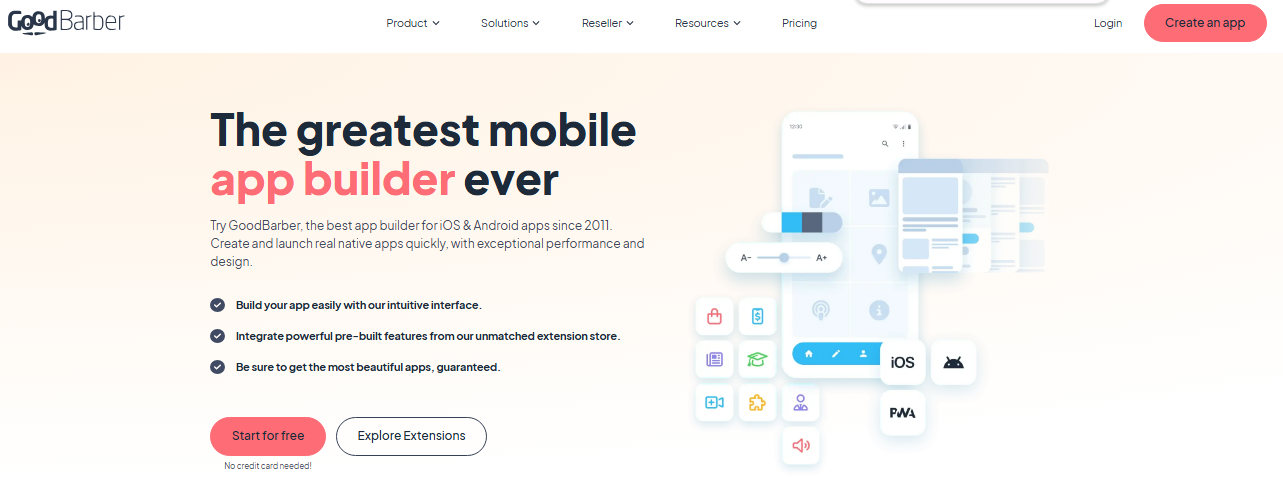
GoodBarber is a user-friendly no-code platform specializing in the creation of mobile apps and progressive web apps (PWAs).
It is known for its professional templates and rich native features like push notifications and offline mode.
WWidely regarded as a cheap and reliable Builder.ai alternative. Suitable for small businesses, media companies, and community organizations.
Its multilingual support and built-in SEO tools help apps reach wider audiences.
Key Features:
Professional templates with easy customization
Native features like push notifications and offline mode
Multilingual support and built-in SEO tools
Pricing:
GoodBarber plans start at $25 per month for basic app creation. More advanced tiers include options such as white-labeling and extra features. Its pricing model makes it an economical Builder.ai alternative for startups and small enterprises.
Pros & Cons:
Pros
Cons
Easy to use with no coding required
Backend customization is limited
Affordable plans that suit small budgets
Focused on mobile and PWA apps only
Wide selection of industry-specific templates
Not designed for complex enterprise needs
Reliable customer service and support
Reasons to Pick GoodBarber:
GoodBarber is an excellent choice if you want a cheap but dependable Builder.ai alternative. Small businesses and individual creators seeking value and ease will appreciate the platform’s capabilities.
17. Airtable
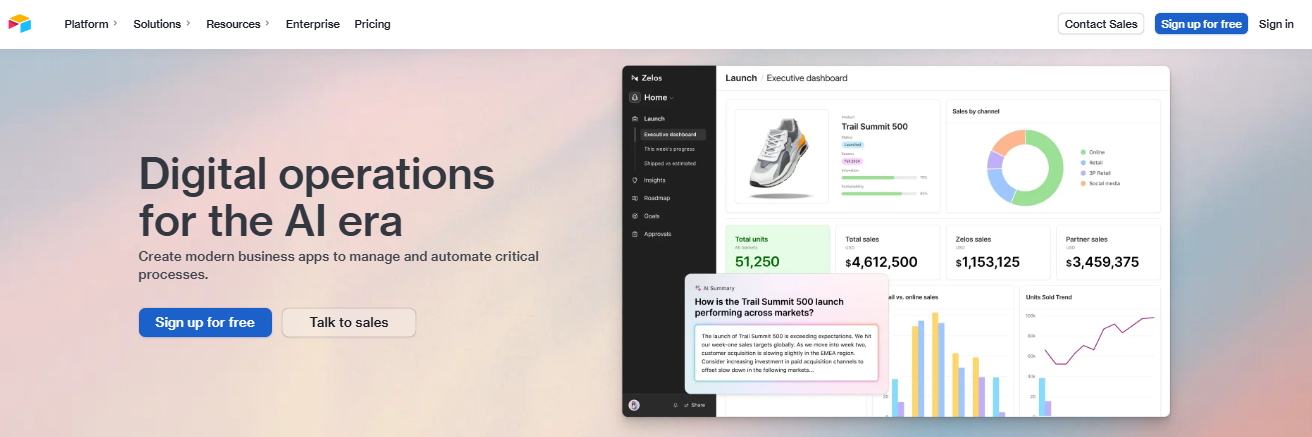
If you’re on the hunt for builder.ai alternatives, Airtable is a good option.
It enables teams to organize data and build simple internal applications with no coding. Besides, it supports relational data linking, custom views, and task automation.
Easily integrated with popular business apps like Slack, Zapier, and Google Workspace. It means it is useful for startups & project managers who need flexible workflows.
It is top Builder.ai alternative for teams that want to centralize data, track projects, and automate repetitive tasks without complex programming.
Key Features:
Relational database combined with spreadsheet interface
Custom views and collaborative workspaces
Automation of workflows and notifications
Integrations with major business tools
Pricing:
Airtable has a free tier with limited records and essential features. Paid plans start at $10 per user per month, with increased records, blocks, and advanced automation. Enterprise plans offer custom pricing with enhanced security and support.
Pros & Cons:
Pros
Cons
Powerful data organization and flexibility
Costs rise significantly with more users
Easy-to-use automation features
Limited for building fully functional apps
Excellent collaboration tools
Some setup required to maximize potential
Integrates well with many external apps
Why Airtable Is a Smart Choice Among Builder.ai Alternatives?
Airtable excels at helping teams manage data and workflows efficiently. It’s ideal for businesses seeking simple, collaborative, no-code apps. For flexible, data-driven app development, it is a cost-effective Builder.ai alternative.
Platforms for Specific Use Cases:
18. FlutterFlow
FlutterFlow is another amazing builder.ai alternative. It is a no-code app builder focused on creating high-performance mobile & web apps using Google’s Flutter framework.
Supports backend integrations, Firebase connectivity, and exportable clean code. It is a robust Builder.ai alternative for developers and businesses seeking customizable, production-ready apps.
Its strong developer tools and community support add to its appeal for startups and enterprises alike.
Key Features:
Drag-and-drop app builder powered by Flutter
Backend and Firebase integration support
Export clean, production-ready Flutter code
Real-time collaboration and testing tools
Pricing:
FlutterFlow offers a free tier with basic features and app export restrictions. Paid plans start at $30 per month & include unlimited app exports and collaboration features. Custom enterprise pricing is available.
Pros & Cons:
Pros
Cons
Powerful app builder with Flutter framework
Steeper learning curve than basic no-code tools
Exportable clean code for developers
Advanced features require paid plans
Real-time collaboration and testing
Not ideal for simple websites or blogs
Strong backend and Firebase integrations
Why FlutterFlow Is a Top-Tier Builder.ai Alternative for Developers?
FlutterFlow is perfect for users wanting no-code app development with full control and scalability.
For those seeking a robust and customizable Builder.ai alternative for mobile and web apps, it is an excellent choice.
19. Thunkable
Looking for better than builder.ai for startups? Check out Thunkable. It is a no-code platform focused on building native mobile apps for iOS and Android.
A drag-and-drop interface is provided. It allows users to create apps without coding knowledge.
Supports third-party API integrations, too. Great for prototyping and educational purposes. Also, Live testing app functionality is verified during development.
Key Features:
Drag-and-drop interface for intuitive app building
Cross-platform support for iOS and Android
Live testing to check app functionality instantly
Community-driven tutorials and support
Pricing:
Thunkable offers a free tier with basic features. Paid plans start at $15/month. Custom plans are available for enterprises that require advanced functionality and support.
Pros & Cons:
Pros
Cons
High customization for unique app designs
Free plan lacks private project options
Supports native app publishing
Paid plans are relatively expensive
Strong community for learning resources
Limited templates compared to competitors
Easy integration with third-party APIs
Who It’s for:
It is a good fit for creators, educators, and small businesses. It’s easy to use and great for building native mobile apps. Best suited for simple projects, learning environments, or quick app testing.
20. Jotform
If you’re after apps that can replace builder.ai alternative, you should defiantly check out Jotform.
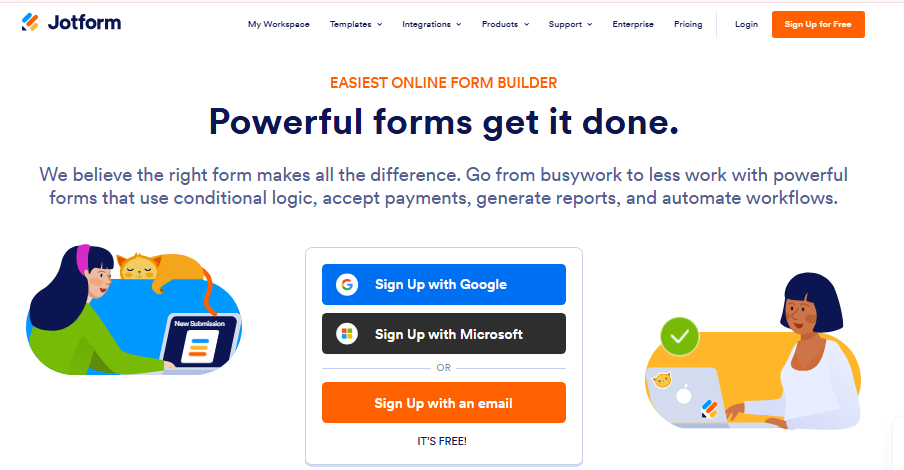
It is a versatile no-code platform primarily focused on creating online forms, surveys, and lightweight web applications.
It enables users to collect data efficiently while automating simple workflows without coding.
Their exclusive features include intuitive drag-and-drop builder, extensive templates, and integration with over 100 third-party apps such as Google Sheets, Salesforce, and PayPal.
Additionally, it supports conditional logic and approval workflows.
Key Features:
Drag-and-drop form and survey builder
Conditional logic and approval workflows
Integration with 100+ third-party applications
Mobile-friendly forms and offline data collection
Pricing:
Jotform offers a free plan with limited monthly submissions and basic features. Paid plans start at $34 per month. Enterprise-grade plans are available with customized pricing tailored to organizational needs.
Pros & Cons:
Pros
Cons
Easy to use with no coding required
Limited functionality beyond forms and surveys
Wide range of app integrations
Pricing increases with submission volume
Supports automation and approvals
Not suited for complex app development
Mobile-ready with offline data capture
Why Jotform Is a Go-To Builder.ai Alternative
Jotform is ideal for users seeking a simple, affordable, and reliable no-code tool focused on data collection and workflow automation. For form-based apps and automation, it is a budget-friendly Builder.ai alternative.
Ready to Begin Your App Development Journey?
Collaborate with our Experienced App Developers!
Top 20 Builder.ai Alternatives – Comparison Table
Platform
Ease of Use
Starting Price
Best For
Tech Flexibility
Support Quality
Trango Tech
⭐⭐⭐⭐☆
Custom pricing
Scalable apps, MVPs, enterprise clients
High – multi-stack
⭐⭐⭐⭐⭐ (personalized)
OutSystems
⭐⭐☆☆☆
~$4,000/year
Enterprise-grade apps
Low – fixed stack
⭐⭐⭐⭐
AppGyver
⭐⭐⭐⭐☆
Free (for most users)
Prototypes, small teams
Moderate – some code
⭐⭐⭐☆
Adalo
⭐⭐⭐⭐☆
$36/month
Simple mobile apps, MVPs
Low – mobile-focused
⭐⭐⭐☆
Bubble
⭐⭐⭐☆
$32/month
SaaS, internal tools
Moderate – visual logic
⭐⭐⭐⭐
Mendix
⭐⭐☆☆☆
~$50/month
Large orgs, compliance-heavy industries
Moderate to high
⭐⭐⭐⭐
Appy Pie
⭐⭐⭐⭐☆
$18/month
Mobile apps for non-tech users
Low
⭐⭐⭐☆
Zoho Creator
⭐⭐⭐⭐☆
$10/month
Business apps, internal tools
Moderate – integration-rich
⭐⭐⭐⭐
Thunkable
⭐⭐⭐⭐☆
$15/month
Educational and basic apps
Low – mobile-focused
⭐⭐⭐☆
Quixy
⭐⭐⭐☆
Custom pricing
Enterprise workflow automation
Moderate – process-based
⭐⭐⭐⭐
Bravo Studio
⭐⭐⭐⭐☆
Free (with limits)
Designers turning Figma into apps
Low to moderate
⭐⭐⭐☆
GoodBarber
⭐⭐⭐⭐☆
$25/month
Content and eCommerce mobile apps
Moderate
⭐⭐⭐⭐
Jotform
⭐⭐⭐⭐⭐
Free / $34/month
Form-based apps and surveys
Low – data-driven only
⭐⭐⭐⭐
Wix
⭐⭐⭐⭐⭐
$16/month
Small business websites, creatives
Low
⭐⭐⭐⭐
Airtable
⭐⭐⭐⭐☆
$10/user/month
Internal tools, databases
Limited to no-code
⭐⭐⭐⭐
Squarespace
⭐⭐⭐⭐⭐
$16/month
Designers, portfolios, online stores
Low
⭐⭐⭐⭐
10Web
⭐⭐⭐⭐☆
$10/month
AI website generation, WP hosting
Moderate – WordPress
⭐⭐⭐⭐
Jimdo
⭐⭐⭐⭐⭐
$9/month
Beginners, freelancers
Low
⭐⭐⭐☆
Hostinger
⭐⭐⭐⭐☆
$2.99/month
Hosting + site building combo
Moderate – CMS-friendly
⭐⭐⭐⭐
FlutterFlow
⭐⭐⭐⭐☆
$30/month
Dev teams building native mobile apps
High – Flutter + Firebase
⭐⭐⭐⭐
Why Look for a Builder.ai Alternative?
Not every business fits into the one-size-fits-all model that Builder.ai offers.
While their managed development process works well for some, others may find it restrictive—especially those looking for more hands-on control.
At Trango Tech, we understand that flexibility, transparency, and cost-efficiency often top the list when choosing a no-code or low-code development platform.
Here are some of the reasons which shows why you should consider Builder.ai alternative
Budget Constraints
Builder.ai starts at a price point that may not work for startups or small teams.
With no free plan available and monthly costs beginning at $200, many businesses find it high.
Trango Tech offers scalable solutions that adapt to your growth.
If you’re building an MVP or scaling an enterprise-grade platform, we provide flexible pricing that won’t drain your budget.
Why affordability matters:
No free tier with Builder.ai
Starting prices often out of reach for early-stage businesses
We offer custom plans to match your budget
Transparent pricing without hidden fees
Freedom to Build on Your Terms
Builder.ai focuses on a managed approach—you share your idea, and their team does the rest.
We give you more control, which allows you to experiment, test, and iterate in real time.
You can adjust your app structure, features, and flow without waiting on external dev teams.
Trango Tech empowers you to:
Tweak designs and UX in real time
Build apps your way—at your pace
Get hands-on without needing deep technical skills
Launch and iterate faster with less friction
More Tech Stack Flexibility
Builder.ai uses React Native and Ruby on Rails by default. While that keeps things simple, it can be a limitation if you want to use a different language or tech stack.
It supports a wider range of technologies and integrations. It means giving your development team the freedom to choose the best tools for your project’s goals.
With Trango Tech, you get:
Compatibility with modern front-end and back-end stacks
Integration with 3rd-party APIs and services
Full-stack flexibility to match your development preferences
Ability to scale across platforms with ease
Collaboration When You Need It
Builder.ai relies on constant collaboration with product managers and developers. Some users love that hand-holding. Others just want to build.
Trango Tech strikes a balance.
You can work independently using our intuitive platform or tap into expert support when needed. It’s your call.
Your workflow, your rules:
Full autonomy or hands-on support—your choice
Build solo or with our in-house tech team
Launch faster with on-demand help, not constant check-ins
Ideal for founders, agencies, and internal product teams
How to Choose the Best Builder.ai Alternatives?
Not every Builder.ai alternative will suit your business goals, budget, or technical skill level.
The right platform should match your development needs.
No matter if you’re building an MVP, a full-scale enterprise solution, or simply want more hands-on control.
To make an informed decision, evaluate each option based on functionality, flexibility, cost, and long-term scalability.
Some of the tips that can help you decide the best builder.ai alternative;
Compare pricing tiers carefully to ensure the platform fits your current and future budget.
Look for platforms that support your preferred tech stack or offer exportable code.
Choose tools that balance ease of use with customization—especially if you’re a non-technical user.
Evaluate integration capabilities with services like Firebase, Stripe, Shopify, or Zapier.
If speed is critical, opt for tools with templates, automation, or AI-assisted workflows.
Make sure the platform can scale with your project, especially for enterprise or growing apps.
Always try free plans or demos first to test usability and core features before committing.
Read customer reviews or case studies to understand how real teams use the platform.
Alternatives to Builder.ai – Why Trango Tech Stands Out?
When searching for a dependable Builder.ai alternative, Trango Tech should be high on your list. Unlike many general no-code platforms, it combines ease of use with powerful customization.
Its intuitive interface empowers users with limited coding skills to rapidly build enterprise-grade applications.
With competitive pricing and responsive customer support, it’s an excellent choice. Especially for businesses seeking an efficient, affordable, and trustworthy Builder.ai alternative.
Frequently Asked Questions (FAQs)
1. What is the best alternative to Builder.ai for custom app development?
Trango Tech is a leading alternative to Builder.ai, especially for businesses that need scalable and customizable app solutions. They offer greater flexibility in tech choices and development processes. Plus, their pricing is often more competitive for long-term projects.
2. Are there any affordable Builder.ai alternatives for startups?
Yes, several platforms provide budget-friendly options perfect for startups. Trango Tech, AppGyver, Thunkable, and Adalo offer free or low-cost plans. These platforms allow small teams to build and launch apps quickly without large upfront investments. They’re ideal if you want to test ideas or create MVPs on a budget.
3. Why choose Trango Tech over Builder.ai?
Trango Tech gives you more control over the development process compared to Builder.ai’s managed service model. You can customize features, choose your tech stack, and scale at your own pace. It also offers personalized support and affordable pricing. Overall, it is a better fit for businesses that want flexibility and hands-on involvement.
4. Which Builder.ai competitor supports both web and mobile apps?
Many alternatives like Trango Tech, FlutterFlow, and Bubble support building apps for both web and mobile platforms. The cross-platform capability helps you reach a wider audience. You don’t need to build separate apps for different devices.
5. Does Trango Tech offer more tech flexibility than Builder.ai?
Absolutely. Builder.ai mostly sticks to React Native and Ruby on Rails. It means limiting tech choices. Trango Tech supports a broader range of technologies and frameworks. It lets you pick the best tools for your app’s requirements and future growth. More tech options mean better adaptability and opportunities.
Mariam Amin is an Electronics Engineering graduate and a passionate content marketer specializing in tech and SaaS. At Trango Tech, a leading mobile app development company, she creates easy-to-understand content on mobile app development, using her technical background to support practical digital strategies. Outside of work, Mariam enjoys exploring new food trends, staying active, and relaxing with documentaries or movies.