Innovation comes with a price, especially when you are disrupting the financial industry, projected to reach $556.58 billion by 2030.
You’ve seen apps like Revolut, Robinhood, or PayPal revolutionize the finance industry. Now you want in.
But what does it actually cost to build a fintech app from scratch?
On average, the cost to develop a fintech app goes from $30,000 to over $300,000, which depends on the type of app, its complexity, and the app development services team you partner with.
Unlike an average app, fintech applications require ironclad security, strict regulatory compliance, flawless performance, and a top-notch user experience.
That’s why fintech development is more complex—and often more expensive—than your average app.
In this guide, we’ll break down everything you need to know about fintech app development costs, from the biggest cost drivers to smart budgeting tips.
Are you unsure of the cost of your fintech app development?
Use our app development calculator to get instant, accurate estimates.
Table Of Contents
How Much Does It Cost to Build a Fintech App?
Fintech application development requires a higher level of investment than basic apps, as it involves additional effort and time.
To be real, we don’t have a one-size-fits-all price tag.
However, based on market research, we can provide you with a nearly accurate guess that still can go up or down based on:
The type of your app
App features
Project duration
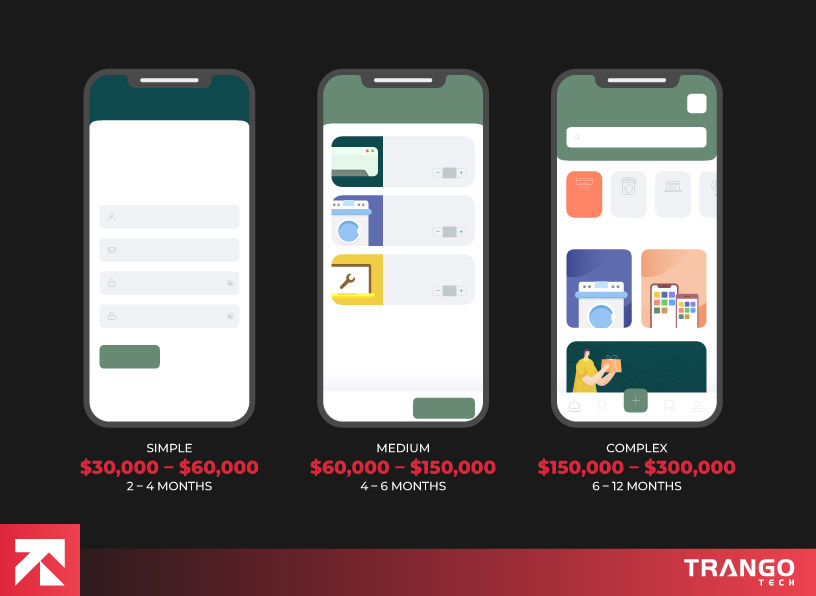
Here’s a quick overview:
App Complexity
Estimated Cost
Development Time
Simple
$30,000 – $60,000
2 – 4 months
Medium
$60,000 – $150,000
4 – 6 months
Complex
$150,000 – $300,000+
6 – 12 months+
As mentioned earlier, these are rough estimates that can fluctuate based on your app’s complexity, design, and features.
Outlining compliance requirements and legal implications in your region.
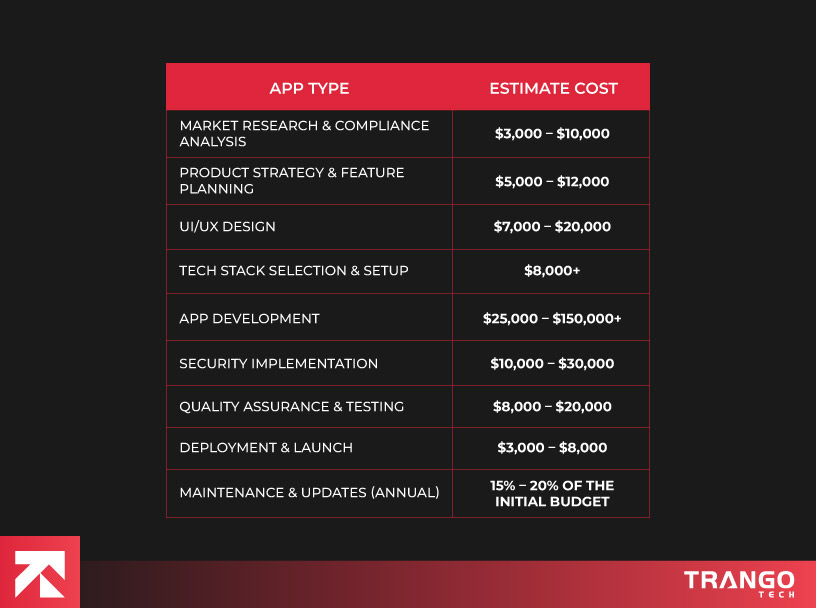
Estimated Cost: $3,000 – $ 10,000 for research and legal purposes to avoid fines, lawsuits, and shutdowns.
Those who cut corners here will face severe losses in both money and reputation ahead.
To save millions of dollars in penalties and data breaches, you can hire a legal advisor or compliance consultant for early success.
2. Product Strategy & Feature Planning
Here, mobile app developers set your fintech app’s overall strategy and functionality.
It starts with understanding the actual purpose your app will serve and how it will address user problems.
Whether you’re building a digital wallet, a P2P payment app, a trading platform, or a personal finance tool, your app’s type and features will drive complexity and cost.
Each of these options comes with its own technical requirements, user expectations, and compliance considerations.
Here are the features that directly impact the cost of fintech application development:
Core Features
Advanced Features
● User Registration & Login
● KYC Verification
● Account Dashboard
● Transaction History
● Fund Transfers
● Push Notifications
● Settings & Preferences
● Customer Support
● Security & Encryption
● Biometric Authentication
● Real-Time Analytics
● AI-Powered Chatbot
● Investment & Budgeting Tools
● Multi-Currency Support
● Card Management
● QR Code Payments
● Third-Party Integrations
● Personalized Offers & Rewards
Estimated Cost: $5,000 – $12,000
To stay efficient and focused, go with a Minimum Viable Product (MVP)—a basic version of your app with just enough functionality to launch.
Just get in touch with any of the MVP development companies available to enter the market faster and avoid over-investing in features users may not even need.
3. UI/UX Design
UI/UX design is simply creating an interface that feels intuitive, builds trust, and keeps users engaged.
In fintech mobile app development, a design involves:
Wireframing: Structuring user flows and screens.
Prototyping: Designing clickable mockups for navigation testing.
Final UI design: Branding, colors, typography, icons, and interactions.
For the fintech industry, your app design must reflect simplicity, clarity, and credibility.
Hiring skilled professionals makes a significant difference here — platforms listing UX designer jobs can help you find experts who create secure, intuitive user experiences that build trust.
Estimated Cost: $7,000 – $20,000
4. Tech Stack Selection
When it comes to fintech app development pricing, your tech stack choice has a significant influence on it.
You have several choices for the frontend, backend, data, and payment process. Each of their choices affects app speed, scalability, security, and future maintenance.
Below are a few common technologies you can go for:
Component
Popular Technologies
Estimated Cost (License/Setup)
Frontend Framework
React Native, Flutter, Swift (iOS), Kotlin (Android)
Free (open-source)
Backend Framework
Node.js, Django, Ruby on Rails, Spring Boot
Free (open-source)
Cloud Hosting
AWS, Google Cloud, Microsoft Azure
$100–$1,000/month (depending on usage)
Database
PostgreSQL, MongoDB, MySQL, Firebase
Free to $500/month (based on scale)
Payment Gateway API
Stripe, PayPal, Razorpay, Checkout.com
~2.9% per transaction + setup (if any)
KYC/Banking APIs
Plaid, Jumio, Onfido, Yodlee
$500–$3,000/month (depends on volume)
DevOps Tools
Docker, Jenkins, GitHub Actions, Kubernetes
Free–$1,000/month (based on usage & tools)
Monitoring & Logs
Datadog, Sentry, Prometheus, New Relic
$200–$1,000/month
Estimated Setup Cost: $8,000+
Choosing widely adopted and well-supported technologies helps you scale your team more easily and minimize long-term maintenance challenges.
As a result, you will ensure your app grows, adapts, and performs reliably under real-world conditions.
Cut your fintech app development costs by up to 40% with cross-platform tech.
We utilize Flutter and React Native to maximize your ROI.
5. App Development
We are now in a daunting yet most time-consuming step in Fintech app design and development.
You have to code the apps’ frontend and backend, ensuring that everything behind the scenes is up to the market.
It is also necessary here to connect your fintech app to other services that add important
features.
Frontend Development
It’s kind of the face of your app.
Mobile app developers develop here everything that users directly use and interact with.
Designs you preferred earlier will now be coded into the actual screens, buttons, and menus.
Backend Development
The backend ensures that your app product runs behind the scenes to deal with the heavy lifting.
It handles various tasks, including managing data, executing business logic, and maintaining security.
You have to set up servers that host your app’s data and logic, as well as databases to store user accounts and transactions.
API Integration
Often, you don’t have to build every feature from scratch — many apps connect to third-party services through APIs, which are like digital bridges.
For example, to accept payments, your app might connect to Stripe or PayPal. To access bank data, it could use services like Plaid or Yodlee.
These integrations allow your app to offer powerful features quickly and securely.
App Type
Timeframe
Total Estimated Cost
Basic Wallet App (MVP)
3–4 months
$25,000 – $40,000
Mid-Level App (P2P Payments, Budgeting)
4–6 months
$40,000 – $80,000
Advanced App (Crypto, Trading, Neo-Banking)
6–9 months
$80,000 – $150,000+
Each of these figures includes frontend, backend, and API efforts.
This fintech development app estimate might shift slightly based on your app’s complexity, integrations, and feature set.
A study by the University of Maryland estimates that there are 2,244 cyberattacks per day.
It makes stringent security non-negotiable for mobile application development for fintech. To achieve this, many businesses consult the best penetration testing companies to identify vulnerabilities before attackers can exploit them.
You must integrate multiple layers of security to ensure world-class security for users. It includes:
Data tokenization and encryption
Biometric and two-factor authentication
Real-time fraud detection and alerts
Secure session and identity management
Estimated Cost: $10,000 – $30,000
7. Quality Assurance & Testing
Quality testing is responsible for making sure everything works the way it’s supposed to — reliably, securely, and smoothly.
You have to identify and fix issues associated with the app before it reaches users’ hands.
Mobile app developers here test it under different scenarios, keep user data safe, and meet legal standards.
Here’s what you should check for:
Does the app work as expected?
Can it handle the load?
Is the data protected?
Is it legally safe?
It does impact your budget for the fintech application, which is up to the complexity of your app, the number of features, and the depth of testing required.
Estimated cost:
Manual Testing: $8,000
Automation Scripts: $16,000
Full Security Audits: $20,000
8. Deployment & Launch
You are almost done here.
It’s time to shift your focus to preparing your app for public release and ensuring it performs reliably post-launch.
There are several tasks here to be performed, including: deploy the app on the app playstore, host it on the cloud platforms, and final checklist.
A thorough final security audit is conducted to identify and fix any vulnerabilities.
Additionally, proper legal documentation—such as terms and conditions and a privacy policy—must be in place to ensure compliance with app store policies and data protection laws.
Estimated Cost: $5,000 – $8,000
9. Maintenance, Updates & Scaling
App maintenance and updates are crucial to keeping it functional, relevant, and capable of growing with your user base.
When it comes to fintech apps, there are several possible ways to do it:
Fixing bugs and performance issues
Updating for OS versions and security patches
Scaling the backend as the user base grows
Adding new features and A/B testing
These tasks are quite complicated; they need extensive expertise and experience. Either you can hire monthly retainers or pay based on updates.
Estimated Cost: 15–20% of the initial budget per year
Mobile app development experts should perform regular maintenance to ensure stability and give you the agility to adapt, innovate, and outperform competitors.
Factors Influencing Fintech App Development Cost
Fintech apps have enhanced conventional methods of handling money, from sending payments and budgeting to investing and even buying crypto.
If you are considering getting a fintech app for business purposes, one big question usually arises: How much does a fintech app cost?
Budgeting for a fintech app can feel overwhelming. It can be made easier by breaking down the core cost drivers.
Let’s break them down in a way that’s easy to understand.
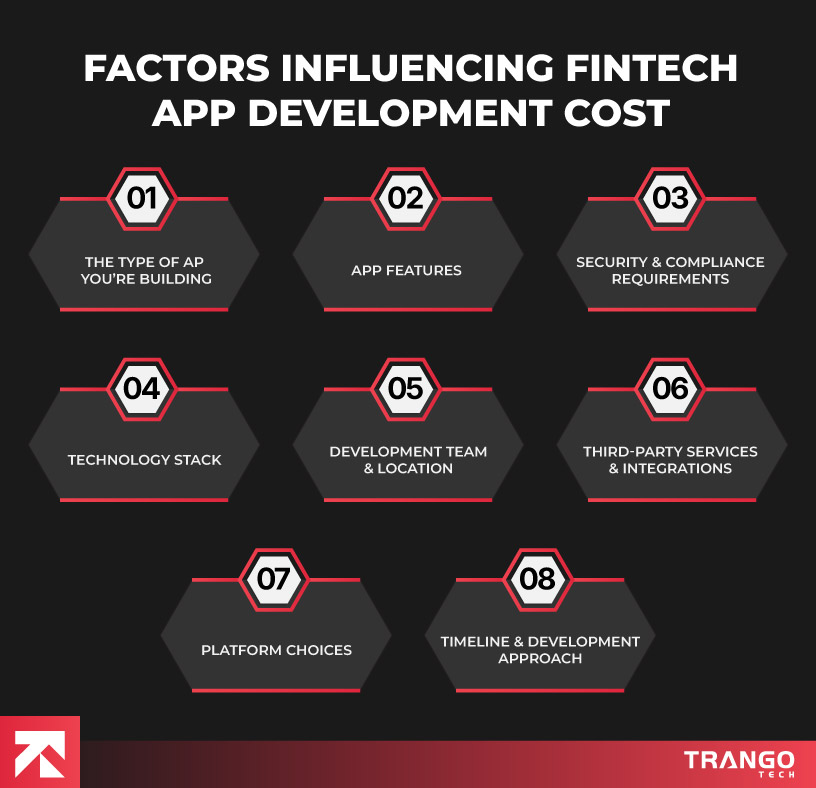
● The Type of App You’re Building
First things first — not all fintech apps are created equal.
A simple budgeting app will cost far less than a full-fledged mobile banking platform.
Here are a few examples:
Mobile Banking Apps (e.g., Revolut, Chime) – High cost due to extensive security and compliance requirements.
Investment Apps (e.g., Robinhood, Acorns) – Require sophisticated algorithms, trading APIs, and real-time data processing.
Digital Wallets & Payment Apps (e.g., PayPal, Venmo) – Include features like P2P transfers, QR payments, and NFC integration.
Lending Platforms – Need loan management systems, credit scoring algorithms, and user verification.
InsurTech Apps – May require integration with third-party underwriting or risk assessment tools.
AI-Powered Financial Apps – They require advanced machine learning models, real-time data analytics, and robust privacy safeguards.
The more complex the app, the higher the cost of building a fintech app.
● App Features
Every feature you add brings value, but also more development time and cost.
Here’s a quick idea of what common fintech features might cost:
Advanced Feature
Estimated Cost (USD)
Cost Impact
Blockchain Integration
$40,000 – $100,000+
Very High
Open Banking API Integration
$20,000 – $50,000
High
Embedded Finance (Lending, Insurance, etc.)
$30,000 – $70,000
High
RegTech Compliance Tools
$25,000 – $60,000
High
Digital Identity Verification (Biometrics, OCR)
$10,000 – $25,000
Moderate
Voice-Enabled Interface
$15,000 – $35,000
High
Generative AI for Financial Planning
$40,000 – $80,000+
Very High
Neobanking Platform Capabilities
$70,000 – $150,000+
Very High
Buy-Now-Pay-Later (BNPL) Integration
$25,000 – $50,000
High
A simple MVP with just the essentials will be more affordable than a feature-rich app packed with bells and whistles.
Bonus read: Don’t miss our in-depth guide on AI app development costs — it’s everything you need to budget smart.
● Security & Compliance Requirements
When it comes to fintech app development, there is no room for error in terms of security and regulatory compliance.
These apps deal with sensitive financial data, which means you’re operating in a high-stakes environment.
Your target users should trust hinges entirely on how securely you store and process their information.
To protect your app — and your business — you’ll need to adhere to a variety of security protocols and compliance.
Here is how much these enhancements influence fintech app development cost:
Security/Compliance Feature
Estimated Cost (USD)
KYC/AML Compliance Setup
$8,000 – $20,000
GDPR Implementation
$5,000 – $15,000
PCI-DSS Compliance
$10,000 – $25,000
End-to-End Encryption
$5,000 – $12,000
Secure API Development
$10,000 – $20,000
Security Audits & Pen Testing (ongoing)
$7,000 – $15,000+ per cycle
While these costs may seem high, cutting corners in security can be catastrophic, both financially and reputationally.
● Technology Stack
Experts in fintech development services use several programming languages, frameworks, and cloud services for scalability.
The tools and technologies they use have a direct impact on your overall costs. A few of the most common stacks include:
While open-source technologies reduce licensing fees, enterprise-grade infrastructure with scalability and failover mechanisms costs more.
● Development Team & Location
Where (and who) you hire matters — a lot.
If a team behind your app is from the US region, it could be expensive in comparison to those providing similar services in South Asia.
The average hourly rates by region are as follows:
Region
Hourly Rate (USD)
Expertise
North America
$100–$200/hr
High
Western Europe
$80–$150/hr
High
Eastern Europe
$40–$80/hr
Moderate–High
South Asia
$20–$60/hr
Moderate
Middle East
$40–$80/hr
Varies
You can also choose between:
In-house teams – high control, higher cost
Freelancers – more affordable, but may lack scalability.
Agencies / Dev partners – a solid middle ground with full-service support.
Want to launch your fintech app fast, without cutting corners?
We’ll break it down clearly — no tech jargon, no hidden fees.
● Third-Party Services & Integrations
Fintech apps rarely operate on their own.
They are often integrated with banks, credit bureaus, payment systems, and data aggregators like Plaid or Stripe.
These services usually come with:
Setup and development costs
Monthly or per-user fees
Charges based on data usage or transactions
It’s important to factor these into your initial and ongoing Fintech app development budget.
● Platform Choices
iOS, Android, or Both?
You can have a target audience on Android, iOS, or both.
Here’s how the cost usually breaks down:
One platform only = cheaper
Both iOS and Android, built natively = are more expensive but of higher quality.
Cross-platform (like Flutter or React Native) = efficient and cost-effective
Adding a web version = higher cost but broader reach
● Timeline & Development Approach
The time it takes to build your fintech app — and the development approach you choose — can significantly affect the overall cost.
Those aiming for a quick launch likely need to bring in more developers or pay for overtime, both of which can drive up your expenses.
On the other hand, choosing an Agile development approach gives you more flexibility to adapt as you go.
Still, it can also extend the project timeline and increase costs if not managed carefully.
On average, a shorter timeline with a dedicated team might increase your budget by 20–30%.
In comparison, an MVP-first approach can help reduce initial fintech app development costs by up to 60%.
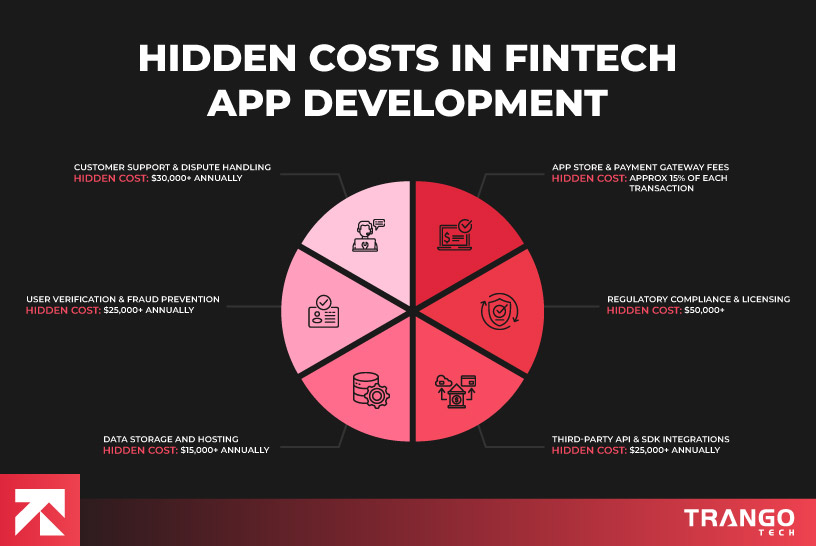
Hidden Costs in Fintech App Development
1. App Store & Payment Gateway Fees
When users make purchases through your app or you list it on the App Store, both Apple and Google take a cut, usually around 15–30%.
Payment processors like Stripe or PayPal also charge a fee per transaction.
It’s a quiet cost that adds up the more successful you get.
Hidden Cost: 2.9%–30% of each transaction
2. Regulatory Compliance & Licensing
Fintech is a tightly regulated space, and staying compliant with laws like GDPR, PCI DSS, KYC, and AML isn’t optional—it’s mandatory.
But here’s the catch: most people don’t realize how expensive this can get.
You’ll likely need legal advisors, pay for licenses, and maybe even undergo audits if you’re dealing with money or personal data.
Hidden Cost: $20,000 – $100,000+
3. Third-Party API and SDK Integrations
To speed things up, most fintech apps use third-party APIs for things like payments, user authentication, or connecting to banks.
While they might seem cheap or even free at first, costs go up quickly as your user base grows.
These services usually charge per API call or per transaction.
Hidden Cost: $5,000 – $50,000+ annually
4. Data Storage and Hosting
You’ll probably host your app on cloud platforms like AWS or Google Cloud.
These seem affordable at first, but can get pricey once you factor in high-availability servers, backup storage, and compliance-grade environments, especially when your data starts to grow.
Hidden Cost: $2,000 – $30,000+ annually
5. User Verification & Fraud Prevention
If you’re letting users make financial transactions, you’ll need to verify their identities and detect fraud.
Tools like Onfido or Jumio offer great services, but they charge per user or scan. These costs stack up quickly as your user base grows.
Hidden Cost: $5,000 – $50,000+ annually
6. Customer Support & Dispute Handling
People expect 24/7 support, especially when it comes to fintech customer support where money is involved
You’ll need customer service reps, chat systems, and maybe even support from call center companies to resolve disputes or handle complaints.
Hidden Cost: $8,000 – $60,000+ annually
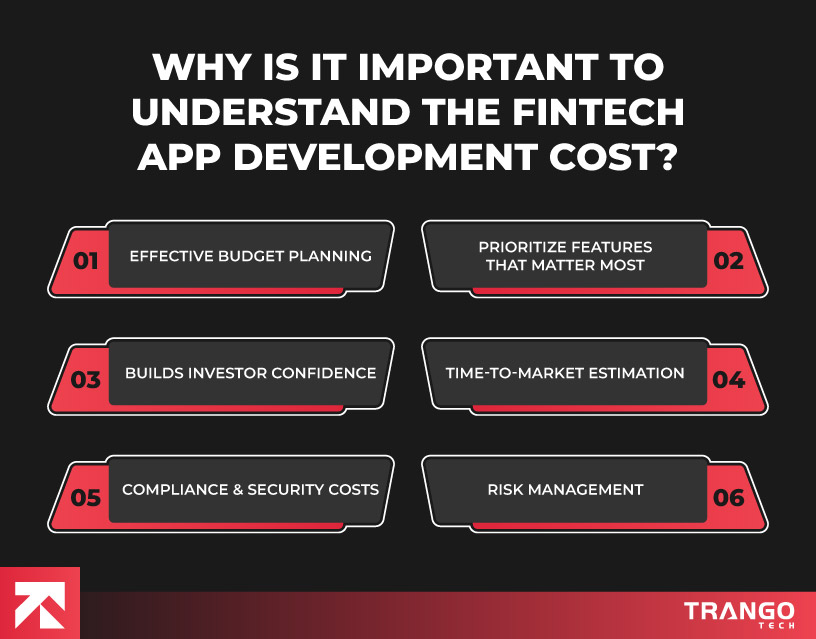
Why Is It Important to Understand the Fintech App Development Cost?
A fintech app solves real financial problems using smart technology, delivering an exceptional user experience, and ensuring airtight security.
To make sure you’re spending wisely, it’s crucial to understand where the biggest intech app development costs come from.
It helps you make smart decisions that save you time, money, and headaches down the road.
Besides that, there are several other compelling reasons for this, including:
● Effective Budget Planning
Knowing how much it costs to build a fintech app allows you to create a realistic budget from day one.
Fintech apps usually involve advanced features like secure logins, real-time payments, and user verification—all of which can get expensive.
By understanding the app development cost breakdown, you can decide what features to build now and what to save for later.
It also helps you plan for hidden expenses like compliance updates, security patches, or third-party API costs.
● Prioritize Features That Matter Most
The more complex your app is, the more it’s going to cost.
That’s why understanding the fintech app development cost helps you decide what’s essential and what’s nice to have.
Maybe you want to include biometric authentication or AI-powered investment suggestions, but the budget says otherwise.
Knowing the costs helps you create a Minimum Viable Product (MVP) with the right features to test your idea without draining your funds.
● Builds Investor Confidence
If you’re planning to raise funds, having a clear understanding of your app’s development cost can work in your favor.
Investors want to see that you’ve done your homework and know what it takes to bring your fintech product to life.
When you can show a well-thought-out budget and financial roadmap, you’re more likely to earn their trust—and their investment.
● Time-to-Market Estimation
Fintech app development cost isn’t just about dollars—it’s also about time.
These costs are often tied to timelines.
If you know how long each phase of development takes, from designing the interface to testing and deployment, you can better schedule your launch and marketing activities.
This is especially important in fintech, where timing can be everything when it comes to getting ahead of the competition.
● Compliance & Security Costs
One thing that sets fintech apps apart from regular apps is the need to follow strict rules and regulations.
Whether it’s GDPR in Europe, PCI-DSS for handling payments, or Know Your Customer (KYC) laws, compliance is non-negotiable and costly.
Understanding this from the start means you won’t be caught off guard by expenses related to legal consultations, audits, or advanced security measures like end-to-end encryption.
● Risk Management
Fintech apps are complex, and cost overruns are one of the biggest reasons projects fail or stall.
Having a solid understanding of the financial side of app development gives you the foresight to manage risks effectively.
It helps you prepare for future updates, maintenance, scaling, and user support—so your app can grow as your business does.
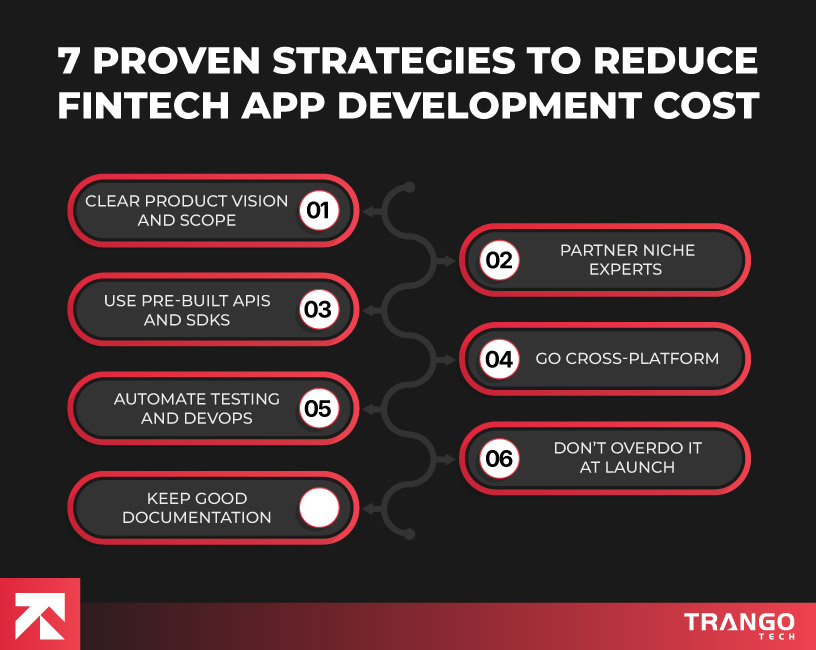
7 Proven Strategies to Reduce Fintech App Development Cost
Regardless of whether you are working on digital wallets, peer-to-peer lending apps, or neobanking solutions, the need for fintech applications is booming.
However, the fintech app development cost can be high if you are a startup or have a tight budget.
The good thing is that you can significantly cut costs without sacrificing quality, security, or performance, as long as you plan wisely.
Here are some practical tips to help you cut down on costs while still getting a solid, reliable product.
1. Clear Product Vision and Scope
One of the biggest reasons projects go over budget is because of adding too many features or changing plans halfway through.
To balance the cost of developing a fintech app, you should start with a clear purpose for your app.
Pen down the different tasks you would like to get performed through it and the requisite features that can’t be overlooked.
Create an MVP that portrays all necessary features to ensure you are on the right track.
Focus on solving one core problem well instead of trying to do everything at once. This helps keep the project simple and manageable.
Over 65% of fintech startups fail due to poor product-market fit.
We help you validate your idea with a cost-effective MVP Development.
Working with an in-house team sounds great, but it is usually expensive. You should work with an experienced development team that knows it all.
Going hybrid is also one of the most effective ways to reduce costs. You have to keep some roles in-house while outsourcing those you can’t manage alone.
Ensure that whoever you partner with is familiar with the fintech space and the important aspects related to security and compliance.
3. Use Pre-Built APIs and SDKs
Why waste effort on reinventing the wheel when you can use robust third-party services?
There are tons of APIs and SDKs available that can handle complex tasks like payments, identity verification, or bank integrations.
Instead of building separate apps for iOS and Android, use cross-platform frameworks like:
Flutter
React Native
Xamarin
Cross-platform development allows code reuse up to 90%, significantly reducing development time and cost.
Startups and entrepreneurs can make the most out of their app development budget and save team efforts.
5. Automate Testing and DevOps
Manual testing and releasing updates can slow things down and cost more.
To make this process smoother, it’s smart to use automation tools.
For example, test automation frameworks like Selenium or Appium help run tests automatically.
At the same time, CI/CD tools such as Jenkins, Bitrise, or GitHub Actions manage the build and deployment processes seamlessly.
You can also use cloud-based platforms like BrowserStack or Sauce Labs to test your app across different devices and browsers without hassle.
It helps catch bugs early and speeds up your releases.
6. Don’t Overdo It at Launch
Many fintech startups aim for perfection in the first launch. But the fact is, you really don’t have to aim for a no-error approach from day one.
It backfires with several unexpected technical overhauls and an increase in your fintech app development cost.:
The best approach in this regard is to:
Launch a lean product
Gather feedback
Iterate based on actual user behavior
This avoids spending on unnecessary features and focuses resources on what truly matters.
7. Keep Good Documentation
It might not be the most exciting part of development, but keeping clear and thorough documentation is a game-changer.
Good documentation helps your team quickly understand the code, fix issues faster, and add new features without any guesswork or confusion.
Studies show that developers spend up to 20% of their time just trying to understand code.
So, having solid documentation can save a significant amount of time and money by streamlining the whole process.
Wrapping Up
Developing a fintech app is a significant investment, but with careful planning and the right development partner, it can yield high returns.
However, the cost of developing a fintech application depends on factors such as the app’s complexity, feature set, and the development partner you choose.
If you are interested in being a part of this space, having a reliable tech partner who understands both technology and the financial ecosystem is necessary.
Trango Tech has over 20 years of experience building great app products without clients’ budgets.
We know the fintech space and can help you build a secure, scalable app without unnecessary costs.
Seeking a development partner to launch a fintech app that truly stands out?
Our skilled team combines innovation with compliance for unbeatable results.
Frequently Asked Questions
1. How much does fintech app development cost in 2025?
The cost of developing a fintech app usually ranges from $50,000 to $350,000 or more. It depends on your app’s complexity, features, tech stack, and security requirements.
2. How long does it take to develop a fintech app?
The timeline depends on complexity. A basic app might take 3 to 5 months, while a more advanced neobanking or trading app can take 6 to 12 months or longer to develop.
3. How to develop a fintech app?
You can follow the 10 steps below to get started with fintech app development:
Conduct market research
Define key features
Choose the tech
Design UI/UX
Develop the backend
Integrate third-party services
Ensure security & compliance
Test rigorously
Launch & maintain
Partner with an experienced firm like Trango Tech to navigate technical and regulatory hurdles while keeping your app secure and scalable.
4. Can I use a no-code platform to build a fintech app?
For very simple use cases, yes. But if you’re dealing with complex transactions, regulations, or scalability, it’s better to go with custom development to ensure full control and security.
5. Are there any hidden costs in fintech app development?
Yes—compliance audits, third-party API fees, server costs, and ongoing maintenance often add to the total cost. Make sure to budget for post-launch updates and security patches.
Daniyal is a passionate content writer & editor with 3+ years of experience crafting SEO-friendly blogs, web copies, and marketing content for an mobile app development company. He loves turning ideas into words that connect, engage, and deliver value. Currently working as a Senior Content Writer at Trango Tech, Daniyal holds a bachelor's degree in English Language and Literature.


 A fintech app solves real financial problems using smart technology, delivering an exceptional user experience, and ensuring airtight security.