Web application development is moving into the innovative era, where speed, intelligence, and smooth interactivity have taken over the place. Technologies are evolving rapidly, and businesses must keep pace with emerging trends to remain competitive, relevant, and user-focused.
According to Gartner, by 2025, over 70% of new web applications will use low-code or no-code tools. This signals a major shift toward faster development and more inclusive digital innovation. Meanwhile, AI-based applications are dominating the market, improving chatbots, recommendation systems, predictive UX, and code generation. To stand out in the market, it is essential to partner with a reputable web app development company.
At the same time, modern users are demanding experiences that feel as fluid and responsive as native apps. Technologies such as Progressive Web Apps (PWAs), serverless architecture, WebAssembly, and headless commerce are becoming mainstream, enabling businesses to scale faster and deliver lightning-fast and interactive applications. This blog covers web application development trends that are shaping the future of digital experiences.
Ready to build a cutting-edge web app?
Schedule a free consultation with Trango Tech to bring your vision to life!
Table Of Contents
Web Application Development Trends to Check Out
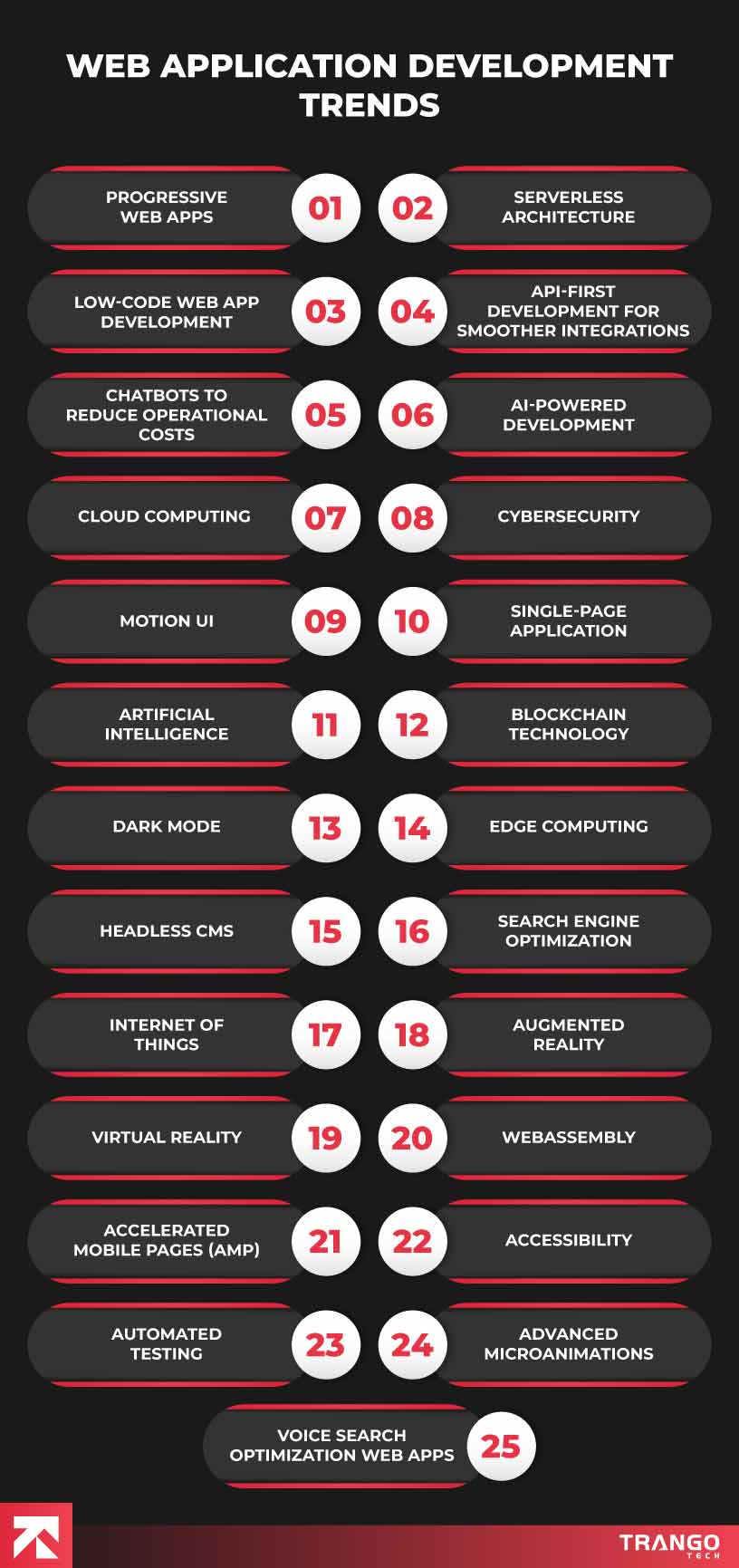
The web development space is evolving, and 2025 is proving to be a fruitful year for innovation. Businesses are now expected to build apps that are intelligent, lightning-fast, scalable, and deeply user-centric. Let’s dive into the top web application development trends worth watching (and using) this year:
1. Progressive Web Apps
Users today don’t have the patience for slow websites. They expect slow, app-like experiences, even if they’re just browsing from a mobile browser. PWAs are web apps that function like native mobile apps. They can work offline, send push notifications, and even be installed on a user’s homescreen without going through an app store. That means faster access for users and less friction for developers.
According to Emergen Research, the PWA market is expected to hit $10.44 billion by 2027. Big brands are already seeing serious benefits. For example, X (formerly Twitter) is a PWA that helped increase pages per session by 65% and tweets sent by 75%. Users received a faster, lighter version of X, and the platform experienced increased engagement. Google also notes that PWAs can lead to 137% higher engagement compared to traditional mobile websites. You can learn more about the growing adoption of Progressive Web Apps (PWAs) in our recent blog and how they’re reshaping the mobile web experience.
2. Serverless Architecture
Do you imagine building a web app without ever worrying about server maintenance, infrastructure provisioning, or managing uptime? Serverless architecture is becoming one of the top web application development trends for 2025. Contrary to its name, it doesn’t mean there are no servers. It’s just that you don’t have to manage them.
With platforms like AWS, Lambda, Google Cloud Functions, and Azure Functions, your code runs in response to events and automatically scales based on traffic. You only pay for the compute time you actually use, not for the idle server hours. According to a Datadog report, nearly 50% of organizations using AWS are already using serverless functions in some capacity.
One of the best things about serverless is speed to market. Developers can focus purely on writing business logic, rather than getting bogged down in server configuration. If you need to process payment, send an email, or trigger a webhook, write a function, deploy it, and you’re done.
3. Low-Code Web App Development
Web app development used to be something only seasoned developers could tackle. But in 2025, low-code platforms are flipping the script, making it easier for teams to build powerful web applications quickly.
For those who are wondering what low-code is, it is a development approach that uses drag-and-drop interfaces, pre-built components, and automated logic to help users build apps without writing tons of code. And the numbers back up the hype. According to recent studies, 70% of new web applications are built using a low-code or no-code platform. This has shown a significant jump from just 25% in 2020. This surge is supported by a growing demand for faster development cycles, cross-functional collaboration, and scalable digital transformation.
If you’re wondering how to monetize a web app, our blog explores the proven monetization models you can implement.
4. API-First Development for Smoother Integrations
API-first means you design and build your APIs before you build the actual application. Instead of treating APIs like a bolt-on feature, you build your whole app with the assumption that others (including your own teams) will need to interact with it. This approach saves time and reduces potential challenges.
With API-first, backend teams can build logic while frontend teams work with mock data. Additionally, your app is already built to interact with external systems and can be scaled easily. APIs allow you to avoid rewrites, making updates more predictable and scalable.
Frameworks and tools like OpenAPI (formerly Swagger), Postman, and GraphQL make API-first development easier to implement, test, and document. This is especially important as more companies adopt microservices and headless CMS platforms, where APIs are the glue that holds everything together. Want to know how to build a web app? Check out our blog, where we walk you through every step of the web app development process.
5. Chatbots to Reduce Operational Costs
Support teams are the unsung heroes of any business, but keeping them running 24/7? That gets expensive. That’s why more companies are turning to AI-powered chatbots to handle the bulk of customer interactions, and the savings are real.
According to Juniper Research, chatbots are expected to help businesses save over $11 billion annually by reducing the need for human agents in front-line support roles. Modern chatbots like Intercom, Drift, ManyChat, and Tidio are incredibly easy to integrate into your web applications. Some even offer drag-and-drop flows so your marketing or CX team can manage the bot.
Plus, thanks to advances in natural language processing (NLP), chatbots in 2025 aren’t just spitting out pre-written answers. They understand context, tone, and user intent, offering far more human-like interactions. In fact, a Zendesk survey revealed that 72% of users were satisfied with their chatbot interactions, particularly in terms of building brand identity.
6. AI-Powered Development
If there’s one trend redefining web app development in 2025, it’s AI-powered development. Developers can now use intelligent coding assistants to help them write code, fix errors, generate boilerplate, and even suggest entire functions.
According to GitHub’s Developer Productivity Study, teams using Copilot reported being 55% faster on repetitive coding tasks and 75% more satisfied with their overall workflow. Here’s how AI in web app development is driving innovation:
Code generation: Developers can generate frameworks, components, and data models instantly.
Bug detection: AI tools catch issues early in the development cycle and reduce time spent on debugging.
Automated testing: AI helps generate unit tests and spot edge cases you might overlook.
Code reviews: Tools offering sophisticated code analysis software are becoming central to maintaining quality, security, and consistency at scale.
If you’re integrating artificial intelligence into web apps, our blog covers about choosing the right AI models and implementing essential features.
7. Cloud Computing
Cloud hosting has changed the trends into the industry default for hosting, managing, and scaling web applications, If you’re a startup launching your MVP or an enterprise handling millions of users, cloud platforms like Amazon Web Services (AWS), Microsoft Azure, and Google Cloud Platform (GCP) have made it easier to build high-performing applications.
In fact, according to Flexera’s State of the Cloud Report, 50% of organizations are now using some form of cloud services, and over 60% use multi-cloud or hybrid cloud strategies to reduce risk and upgrade performance.
In 2025, users expect apps to load instantly, sync data in real time, and never crash. That level of reliability and speed is almost impossible to achieve without cloud infrastructure behind the scenes. Simply put, if you’re not on the cloud, you’re falling behind.
8. Cybersecurity
We’re living in a time where data breaches, ransomware attacks, and API vulnerabilities are dominating the headlines. If users even suspect your app isn’t secure, they’ll uninstall it, abandon their carts, or never come back.
Cybersecurity Ventures has stated that cybercrime is predicted to cost the world $10.5 trillion by the end of 2025. Moreover, Verizon DBIR has shown that nearly 43% of cyberattacks target small and mid-sized businesses, many of which rely heavily on web apps to serve their users.
It is recommended to secure APIs and microservices, encrypt data at rest and in transit, utilize AI to detect abnormalities, and ensure compliance with GDPR, HIPAA, and SOC 2 standards.
Users expect lightning-fast load times, and in this scenario, motion UI has become a major player in modern web app development. Research indicates that over 88% of users are less likely to visit a site with a poor user experience (UX) design.
Microinteractions, such as button bounces, loading spinners, or smooth page transitions, provide users with visual feedback and context. These elements help reduce cognitive load, guide attention, and create a natural flow from one action to the next.
In fact, Google’s Material Design guidelines emphasize motion as a key principle because it helps users build a mental model of how an app works. A study by the NNGroup also supports this, noting that animation enhances comprehension by showing the relationship between different UI elements.
10. Single Page Application
Nobody likes waiting, especially not for web pages to reload. That’s exactly why Single Page Applications (SPAs) have become popular over the past few years. Whether you’re using Gmail, Twitter, or Netflix, chances are you’re already interacting with an SPA without even realizing it.
A single-page application loads a single HTML page and dynamically updates its content without requiring a full-page refresh. That means users get faster navigation, smoother interactions, and a more app-like experience in the browser.
Speed and performance are the biggest reasons why developers and users love SPAs. Think with Google states that users are 32% more likely to bounce from a site if page load time goes from 1 to 3 seconds. SPAs drastically reduce load times by only fetching data that’s needed, rather than reloading every asset from scratch.
In fact, Gartner reports that by 2028, over 80% of web applications will be built as SPAs or use similar dynamic architectures. So if you’re launching a startup or modernizing your enterprise platform, SPAs can help deliver the fast, immersive experience today’s users expect.
11. Artificial Intelligence
Artificial Intelligence used to sound like science fiction. Today, it is shaping everything, from how we shop and scroll to how we drive and diagnose diseases. AI has become a core part of our daily lives and a key trend in web and app development.
According to PwC, AI is expected to contribute $15.7 trillion to the global economy by 2030. Moreover, 50% of companies have already adopted AI in at least one business function. The big win with AI is efficiency at scale. It automates repetitive tasks, uncovers patterns in massive data sets, enhances decision-making, and provides predictive insights that humans simply can’t process as quickly.
Moreover, AI is driving web app personalization trends, enabling businesses to tailor content, products, and services to individual user preferences. A Salesforce study found that 84% of customers say being treated like a person, not a number, is key to winning their business, and AI helps make that possible.
12. Blockchain Technology
When it comes to web apps, security and transparency are two things users expect by default now. That’s exactly where blockchain is starting to shine in web app development.
While most people still associate blockchain with Bitcoin or crypto, developers are now embracing it as a game-changing trend for building decentralized, secure, and tamper-proof web apps. According to Gartner, blockchain is expected to generate $3.1 trillion in new business value by 2030.
What makes blockchain a big deal in web apps? The short answer is decentralization, data integrity, and trust. In traditional web apps, data is stored in centralized databases, which can be vulnerable to breaches or manipulation. However, with blockchain, data is stored across a distributed ledger, where every transaction is verified and timestamped, and once it’s added, it can’t be altered.
This is particularly valuable in apps that handle:
Sensitive transactions (e.g., fintech or insurance apps)
Supply chain tracking (e.g., food traceability or luxury goods authentication)
In fact, many modern decentralized apps (dApps) are built on blockchain to give users more control over their data. This shift aligns with growing user expectations for privacy and transparency. Frameworks like Ethereum, Hyperledger, and even JavaScript SDKs for Web3.js and Ethers.js are making it easier for developers to integrate blockchain logic into the frontend of web apps.
13. Dark Mode
Dark mode has become a must-have feature in modern web applications, and it’s not just about aesthetics. It helps protect your eyes from strain and saves your battery life. In low-light environments, dark mode can help reduce blue light and glare. A study by the American Academy of Ophthalmology suggests that darker screens may reduce digital eye fatigue for some users during nighttime use.
On OLED and AMOLED screens, dark mode can save significant battery life. Google confirmed that dark mode on YouTube can use up to 60% less battery than the standard light theme on OLED screens.
According to a survey by Android Authority, 81.9% of users prefer using dark mode on their devices, while Google Trends data shows consistent year-over-year growth in searches for “dark mode” since 2019.
From a dev’s perspective, implementing dark mode is easier than ever thanks to CSS custom properties, prefers-color-scheme media queries, and frameworks like Tailwind CSS or Material UI that support them out of the box. Progressive web apps (PWAs) and modern single-page applications (SPAs) now often come with built-in theme toggles, giving users control.
14. Edge Computing
Edge computing moves processing power and data storage closer to the “edge” of the network, meaning right where the user is, instead of relying solely on a distant cloud server. As web applications become increasingly interactive, real-time, and data-intensive, this approach is gaining traction rapidly.
In fact, Gartner predicts that by 75% of enterprise data will be created and processed outside a traditional centralized data center or cloud, mostly at the edge. Meanwhile, a Statista report estimates the global edge computing market will reach $380 billion by 2028. That’s massive growth.
With tools like Cloudflare Workers, Vercel Edge Functions, and AWS Lambda@Edge, developers can now run serverless functions right at the edge, significantly reducing time-to-interaction and improving web app scalability.
15. Headless CMS
If your web app needs to be fast, flexible, and ready for anything, then a headless CMS web development might just be right for you. This trend has gained momentum in recent years as developers and businesses increasingly demand more freedom and control over how and where content is delivered.
A headless CMS is a content management system that separates the backend (content storage) from the frontend (how content is displayed). Instead of being locked into a rigid template like WordPress or Drupal’s traditional model, headless CMS platforms let you deliver content anywhere via APIs, web apps, mobile apps, wearables, you name it.
And the market is moving fast. It is being said that the headless CMS market is projected to grow from $497.6 million in 2021 to over $1.6 billion by 2027. That’s a clear sign that this isn’t just a passing trend, it’s a full-on shift in how we think about content delivery. Web apps that rely on real-time updates, localization, and multi-platform distribution are a perfect match for headless CMS. It is best for eCommerce platforms, news and media sites, and corporate intranets or portals.
Need help choosing the right tech stack?
Get a free quote from Trango Tech to build a scalable, future-ready web app!
Also Read: Web Application Development Cost
16. Search Engine Optimization
SEO is no longer about stuffing keywords into blog posts. Now, it is a full-stack concern, and it’s evolving rapidly. Whether you’re building a Single Page Application (SPA), a Progressive Web App (PWA), or a traditional multi-page site, search engine visibility is non-negotiable.
And here’s why: 68% of all online experiences begin with a search engine, and 53% of all trackable website traffic comes from organic search. If your app isn’t optimized to be found by Google (and other search engines), you’re leaving massive opportunities on the table.
To strengthen your site’s visibility even further, strategically using internal and external links in SEO helps search engines understand your site structure, distribute authority across pages, and build credibility through reputable sources, ultimately improving both rankings and user engagement.
Google’s ranking algorithm now favors websites that focus on Core Web Vitals optimization. It is a set of metrics that track real-world performance like loading speed (LCP), interactivity (FID), and layout stability (CLS). According to a Search Engine Journal report, sites that meet all three metrics have a 24% lower bounce rate and are more likely to be favored in search rankings.
17. Internet of Things
The Internet of Things (IoT) is no longer a futuristic idea, it’s an everyday reality. From smartwatches that track our health to industrial machines that report their performance metrics, IoT devices are everywhere. But what powers these interactions? More often than not, it’s a web application.
According to Statista, the number of connected IoT devices worldwide reached 19.8 billion in 2025 and is projected to surpass 40.6 billion by 2034. With this explosive growth comes an increased demand for web apps that can visualize, manage, and act on real-time data generated by these devices.
Web applications connected to IoT systems are responsible for presenting live data in an intuitive and user-friendly manner. Consider a logistics dashboard displaying real-time vehicle locations or a smart farming app showing soil moisture levels from various sensors across a field. IoT networks can consist of hundreds or thousands of devices. Web apps must be built to scale efficiently, handling high volumes of inbound/outbound messages while remaining responsive.
The Gartner report predicts that there will be over 75 billion IoT interactions per day, with many of these interactions being processed and monitored through web applications. As this space continues to grow, developers must build apps that are real-time, scalable, secure, and user-friendly.
18. Augmented Reality
Remember when augmented reality felt like something out of a sci-fi movie? Fast forward to today, and it’s powering everything from virtual makeup try-ons to interactive furniture placement tools, all within your browser. Yes, you read that right: AR isn’t limited to native mobile apps anymore. It’s now making waves in web app development, giving users immersive, real-world-enhanced experiences without ever leaving their browser.
And the numbers tell a compelling story. According to Statista, the AR market is projected to reach $62 billion by 2029. Meanwhile, a Google Consumer AR Survey revealed that 66% of people are interested in using AR to aid them in making better purchasing decisions, particularly in the areas of retail, fashion, home decor, and automotive.
Traditionally, AR lived inside native apps. However, with technologies like WebAR, WebXR, and libraries such as 8thWall, three.js, and AR.js, developers can now embed AR experiences directly into web browsers. This technology is particularly well-suited for platforms such as e-commerce, education, real estate, and events/marketing.
19. Virtual Reality
Virtual reality is a modern technology that has opened the door to immersive digital experiences. Statista report reveals that the global VR market worldwide aims to reach 3.7 billion users. Thanks to advancements in WebVR and the newer WebXR API, developers can now deliver VR experiences directly within the browser.
Surveys have found that employees in VR-enabled training programs are 4 times faster to train than those in classrooms and 275% more confident in applying skills after learning. Similarly, marketers using VR campaigns report higher engagement and recall rates compared to traditional digital ads. If you’re building a web app for your business, incorporating VR is a strategic approach to make a lasting impression. For more inspiring web app ideas, you can also read our recent blog that enlists futuristic options.
20. WebAssembly
WebAssembly is a low-level, binary instruction format that runs in modern browsers at near-native speed. Many developers have reported performance improvements in their web applications after integrating WebAssembly (Wasm). It is supported by all major browsers, including Chrome, Firefox, Safari, and Edge.
What makes WebAssembly development trends so popular? Wasm executes code faster than JavaScript because it’s compiled and not interpreted. That means your app can handle complex computations, process images, or render 3D graphics right in the browser without lag.
For example, Figma migrated parts of its codebase to Wasm and saw significant improvements in loading and rendering speed, especially for large design files. With WebAssembly, you’re no longer tied to JavaScript. You can write performance-critical parts of your app in C, C++, Rust, or Go, then compile them into Wasm and run them in the browser alongside your frontend.
Also Read: Modern Web Frameworks Expected to Lead in 2025
21. Accelerated Mobile Pages (AMP)
According to Google, 53% of mobile users abandon a site that takes more than 3 seconds to load. Accelerated Mobile App is an open-source framework that helps developers create ultra-fast loading web pages. While it initially started with publishers and news sites, AMP has evolved and is now being utilized in e-commerce, advertising, and web applications where speed and user retention are crucial.
AMP restricts JavaScript, streamlines CSS, and prioritizes asynchronous loading. This results in instant page loads. Google states that AMP pages load up to 85% faster than non-AMP equivalents. Additionally, AMP was built with mobile in mind. It automatically handles features such as image optimization, responsive layout, and lazy loading, ensuring your pages perform beautifully across all screen sizes.
If your web app includes content-driven pages or landing experiences where speed matters most, AMP is still a valuable trend worth exploring.
22. Accessibility
Did you know? Accessible websites are not only inclusive, but they’re also legally required in many countries under regulations such as the ADA (USA), EN 301 549 (EU), and WCAG 2.1 standards globally. Accessibility means ensuring your web app can be perceived, understood, and navigated by users with disabilities, including those who are blind, deaf, have limited mobility, or have cognitive impairments.
Key accessibility features include:
Keyboard navigability for users who can’t use a mouse
Screen reader compatibility using semantic HTML and ARIA roles
Sufficient color contrast and font size
Captioned videos and image alt text
According to the World Health Organization, over 1.3 billion people globally live with some form of disability. That’s nearly 1 in 6 people, a huge user base that can’t be ignored. Meanwhile, a WebAIM analysis found that 96.3% of homepages still have accessibility failures, such as missing alt text or poor contrast. Companies that use accessibility early are more likely to win user trust and loyalty. Additionally, building inclusive apps often results in cleaner code, improved performance, and more informed design decisions overall.
23. Automation Testing
Manual testing is slow, error-prone, and just doesn’t scale in today’s rapid development cycles. With modern web apps being updated weekly (or even daily), automation testing has become a must-have in the web developer’s toolkit.
In fact, GitLab’s DevSecOps report states that 62% of teams now automate at least half of their testing, and organizations that do are 3x more likely to release software faster and with fewer bugs.
Automated tests can run hundreds of test cases in minutes, reducing regression testing time from days to hours. This is crucial for fast-moving teams deploying multiple times per sprint. Automation tools like Selenium, Cypress, Playwright, and TestCafe integrate seamlessly with CI/CD platforms such as Jenkins, GitHub Actions, or GitLab CI, allowing tests to run with every pull request, merge, or deployment.
If your current testing process is slowing down your release cycles, now it’s time to ask, “What can I automate today to save time tomorrow?”
24. Advanced Microanimations
Ever hovered over a button and watched it bounce, fade, or slide ever so slightly? Advanced microanimations are a powerful UX tool that helps guide users to make interactions more intuitive and gives web apps a polished, professional feel.
Good UI states that even subtle interface feedback (like animated form field validation or button interactions) can improve task completion rates by up to 15-20%. With frameworks like Framer Motion, Lottie, and GSAP, developers can now implement microanimations smoothly without sacrificing performance.
Why do they matter in web app development? Microanimations can indicate hierarchy, transitions, or direction. For example, features such as sliding panels, animated breadcrumbs, or transitioning tabs help users maintain context during challenging tasks. Plus, brands that invest in motion often report higher engagement and a more “premium” perception of their app. A UXCam study found that apps using purposeful motion design had 17% longer session times compared to those with static designs.
25. Voice Search Optimization Web Apps
There are many technologies that are gaining prominence, especially Siri, Alexa, and Google Assistant. This led users to ditch keyboards in favor of voice commands. Google reports that 41% of adults and 55% of teenagers now use voice search daily. And with the global smart speaker market expected to reach $65.8 billion by 2027, it’s clear that hands-free interaction is shaping how users expect apps to work.
People speak differently from how they type. Voice queries are often longer, more specific, and conversational. That means web content needs to be structured to answer real questions, such as “How late is this store open tonight?” rather than just providing “store hours.” Voice assistants usually pull responses from featured snippets and structured data.
If your app is optimized for voice, you’re more likely to be the answer to that one spoken query, which can lead to massive traffic results.
Here’s a fun fact: Over 50% of voice searches are aimed at finding local businesses. That’s huge for apps with geo-based features, such as delivery, pickup, or local listings.
Want to implement these trends?
Book a free strategy session with Trango Tech to create a high-performance web app!
Web Technologies and Frameworks Leading the Trends
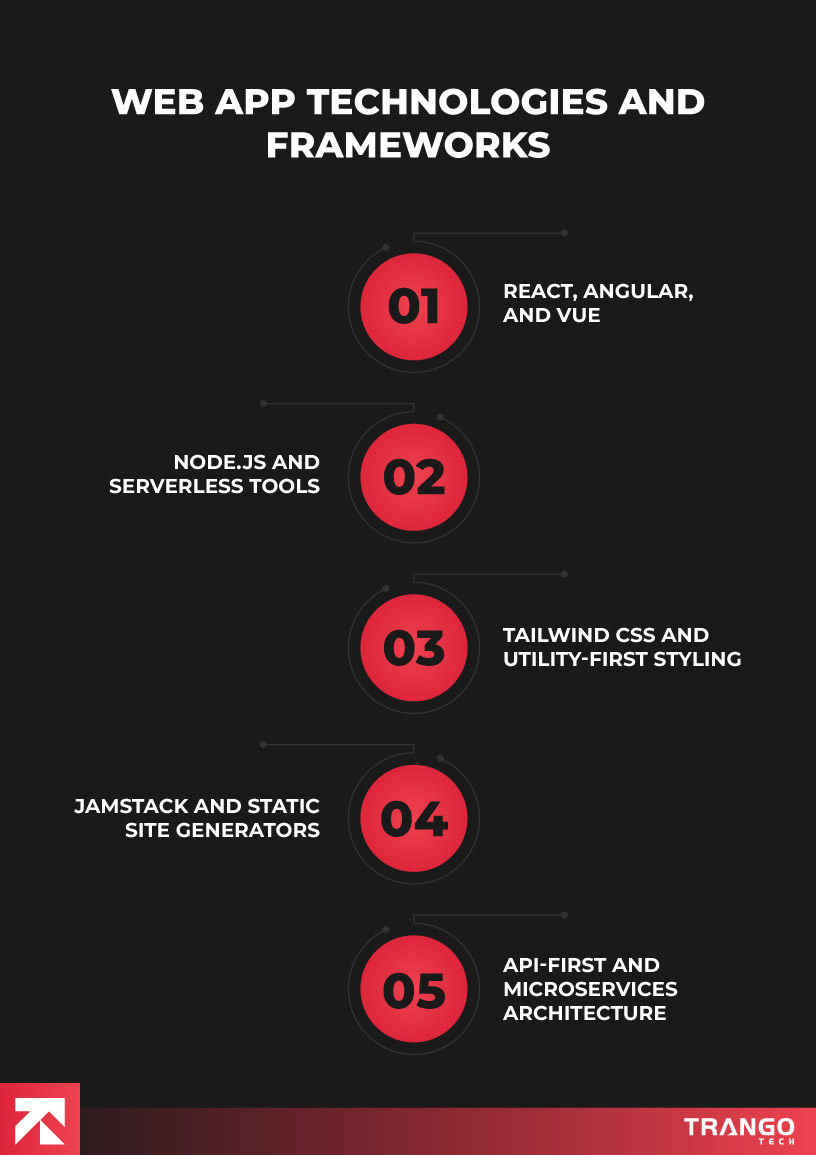
Honestly, keeping up with all the latest web frameworks and tools can feel like chasing a moving target. However, the truth is that the web is evolving rapidly, and the tools you choose directly impact your app’s performance, scalability, and maintainability. So, what technologies are leading the pack in 2025? Let’s dive into the frameworks and stacks that developers should go for:
1. React, Angular, and Vue: The Frontend Power Trio
When it comes to building modern, component-based user interfaces, these three still dominate:
React (by Meta): With its virtual DOM and massive ecosystem, React continues to lead the way. It’s loved for its flexibility and is often used in conjunction with Next.js to build high-performance, SEO-friendly applications.
Angular (by Google): A full-fledged framework that’s perfect for large-scale enterprise apps, Angular has stayed strong thanks to built-in tools for routing, forms, and state management.
js: The most approachable of the three, Vue offers a gentle learning curve with powerful capabilities. Its composition API and growing ecosystem (like Nuxt.js) make it a favorite among startups and solo developers.
According to the Stack Overflow Developer Survey, React was used by over 42% of professional developers, while Vue and Angular continue to hold strong positions in the top 10.
2. Backend: Node.js and the Rise of Serverless
While traditional backend frameworks, such as Django (Python) and Laravel (PHP), still have their place, Node.js continues to power a significant portion of modern web applications due to its non-blocking I/O and full-stack JavaScript capabilities.
Even more exciting is the growing adoption of serverless architectures using:
AWS Lambda
Google Cloud Functions
Netlify Functions
This shift enables developers to run backend logic without managing servers, scaling effortlessly, and reducing costs, particularly for event-driven applications.
3. Tailwind CSS and Utility-First Styling
Designers and developers are increasingly embracing Tailwind CSS, a utility-first CSS framework that enables faster and more maintainable styling. Instead of writing custom CSS, you use pre-defined classes like p-4, bg-blue-500, or rounded-xl.
It’s responsive, customizable, and integrates seamlessly with tools like React, Vue, and Next.js, making it a go-to choice for clean, responsive designs.
GitHub stars for Tailwind CSS crossed 75,000+ in 2025, highlighting its popularity in modern frontend stacks.
4. Jamstack and Static Site Generators
Jamstack architecture (JavaScript, APIs, and Markup) is changing how static and dynamic content is served. Developers are now leaning into tools like:
js: It is for hybrid static/dynamic rendering
js: Vue’s answer to server-side rendering
Gatsby: It is optimized for lightning-fast static sites.
These technologies help improve performance, SEO, and developer experience, particularly when integrated with headless CMSs such as Sanity, Strapi, or Contentful.
5. API-First and Microservices Architecture
The tech sector is going beyond monolithic backends. Modern web apps are increasingly API-first, built as collections of microservices that can scale independently. This is made easier by:
GraphQL for flexible and efficient data querying
REST APIs are still widely used and supported
OpenAPI/Swagger for standardized API documentation
This approach is ideal for projects that require scaling, integration with third-party services, or simultaneous support for both web and mobile platforms. To learn more about how this works, read our blog on adopting microservices architecture for scalability.
What is the Future of Web App Development?
In 2025, the browser has become the new operating system, and web applications are powering everything. If you’re ordering food, editing documents, or collaborating with a global team, you’re probably doing it in a web app.
So, why is web app development not just relevant but the future of digital experiences? Here’s why this trend isn’t slowing down, it’s accelerating:
1. Web Apps Are Instantly Accessible
Even though native apps require downloads and updates, web apps run directly in the browser. So, you don’t need to face the hassle of installations, version conflicts, and platform limitations. All you need is a device and an internet connection.
According to a 2025 Google Cloud study, 92% of users believe accessibility without installation is a key reason they prefer web apps over traditional software.
2. One Codebase Allows Massive Cost Savings
With web apps, developers can build once and run everywhere. There’s no need to maintain separate iOS, Android, and desktop versions. Thanks to frameworks like React, Vue, and Next.js, teams can create smooth, responsive apps that scale across devices with a single codebase.
This helps you reduce development costs and speeds up time-to-market, something every startup, SaaS company, and enterprise values.
3. Web Technologies Are More Powerful
There was a time when web apps were simple and lightweight tools, mostly good for displaying static content or capturing form submissions. Now, they’ve evolved into powerful engines capable of delivering experiences that rival (and sometimes outperform) native apps.
Today’s web apps can perform real-time video and audio streaming, handle offline functionality, deliver rich 3D experiences, and execute heavy computations. Mozilla’s 2025 study shows that WebAssembly boosts processing performance up to 30x, enabling web apps to run complex workloads with near-native speed.
4. Real-Time Updates Deliver Better User Experience
Users expect instant gratification, and the ability to update your app in real-time is a huge win. Web apps eliminate the lag associated with traditional update cycles. You don’t need app store approval, and wait for users to update manually.
With tools like CI/CD pipelines, auto-deployments, and feature lags, developers can push updates smoothly without impacting the user experience.
5. Ideal for a Global, Always-On Audience
Web apps are built for scale. If your users are on 4G in rural areas or fiber broadband in urban cities, progressive web techniques (such as lazy loading, caching, and responsive design) ensure your app delivers value to the right user.
Thanks to growing global demand for location-agnostic tools, it is predicted that 70% of enterprise software will be delivered via web applications by the end of 2025. Plus, the rise of smart TVs, wearables, and foldables gives you the power to reach users across every screen size and platform.
Start Your Web App Development Journey Today!
Web applications are highly integral for organizations that deliver services, manage operations, and engage with users. The majority of customer interactions are occurring through digital platforms, with many of them being web-based. These lists of web application development trends 2025 are helpful for your company to stay future-ready, resilient, and relevant in the market.
Are you looking for a top-tier mobile app development agency? Our team builds scalable, secure, and high-performance web apps that drive results.
Ready to transform your idea into reality?
Contact Trango Tech for a free consultation and start your web app journey today!
Frequently Asked Questions
Q1. What are the latest web application development trends for 2025?
Web apps are being shaped by a range of powerful trends that improve performance, user experience, and scalability. One of the major web application development trends is AI, which allows smarter search, real-time recommendations, and automation. Moreover, Progressive Web Apps (PWAs) are gaining popularity, enabling apps to work offline, load faster, and provide a native-like experience.
Other notable trends include the use of WebAssembly for near-native performance in the browser and serverless architecture for cost-efficient backend scaling. Additionally, server-side rendering trends are gaining momentum as businesses aim to improve initial load times, enhance SEO, and deliver faster, more responsive user experiences
Q2. What are the big 3 of web development?
The “big 3” of web development refer to the three core technologies that form the foundation of every website. Here are the top three below:
HTML (HyperText Markup Language) provides the structure and content of a webpage, like headings, paragraphs, images, and links.
CSS (Cascading Style Sheets) controls the presentation and layout, including colors, fonts, spacing, and responsiveness.
JavaScript adds interactivity and dynamic behavior, such as form validation, animations, real-time updates, and API interactions.
Together, these technologies power nearly every modern web experience. If you’re building a simple landing page or a complex web app, mastering the above tools is essential for any front-end web developer.
Q3. What is the future of web applications?
The future of web applications is centered around speed, intelligence, personalization, and cross-platform compatibility. These apps are evolving to become faster, more interactive, and increasingly intelligent. Technologies like Artificial Intelligence (AI) and Machine Learning (ML) allow smarter features such as predictive search, automation, and real-time personalization.
A key area of innovation is AI chatbot integration in web apps to deliver instant customer support and automate responses. Alongside these advancements, web app security trends are becoming more important as developers want advanced encryption and multi-factor authentication.
Q4. How much does it cost to build a web app?
The cost to build a web app really depends on what level of the app you’re building. A simple web app with basic features might cost you between $5,000 and $15,000. If you’re looking for something more advanced, such as user logins, integrations with other tools, or responsive web design, the cost ranges from $15,000 to $50,000. The complex web app with features like AI integration or advanced backend systems can cost you between $50,000 and $150,000.
Q5. Is edge computing relevant for web app development?
Absolutely! Edge computing web apps are becoming quite relevant as users demand faster, more responsive experiences. Rather than relying on centralized servers, edge computing processes data closer to the user’s location (at the “edge” of the network). This significantly reduces latency, speeds up load times, and improves overall performance, particularly for real-time applications like chat platforms, video streaming, or IoT dashboards.
For web apps, this means you can deliver content and services more efficiently, even to users in remote areas or on slower connections. It’s especially useful for apps that require low latency or handle large volumes of user interactions. As web experiences become more dynamic and personalized, edge computing helps developers create scalable, high-performance applications that keep users engaged.
Rida Shahzad is a business graduate and seasoned content writer at WareGo, where she transforms complex concepts into clear, actionable content. With a strong background in creating how-to guides, conversion-focused content, and technical documentation, Rida excels at bridging the gap between advanced technology and real-world business needs. Off the page, she’s a curious mind with a love for ancient history, tech trends, and creative sketching.