One of the most common questions aspiring founders ask when entering the ride-hailing market is: “How much does it cost to build a ride-sharing app like Lyft?”
The price can vary greatly depending on the complexity of the features and the development approach. On average, it ranges from $5,000 to $150,000+.
According to Statista, the ride-hailing market is projected to generate US$167.60 billion in revenue in 2024. With a CAGR of 4.89% from 2024 to 2029, this is expected to grow to US$212.80 billion by 2029, with over 2.31 billion users globally.
One of the standout names in the industry is Lyft, known for its user-friendly interface, strong brand identity, and efficient service. Its growth has inspired many entrepreneurs to build similar apps tailored to local markets or new niches.
In this blog, we’ll walk through what it takes to build a ride-sharing app like Lyft. Additionally, we recommend investing in affordable taxi booking app development services to ensure a smooth app journey.
Let’s Begin!
Table Of Contents
Estimated Cost Breakdown to Develop a Ride-Sharing App Like Lyft – Quick Overview
Ready to estimate your ride-sharing app development costs?
Let us provide a tailored budget breakdown based on your vision.
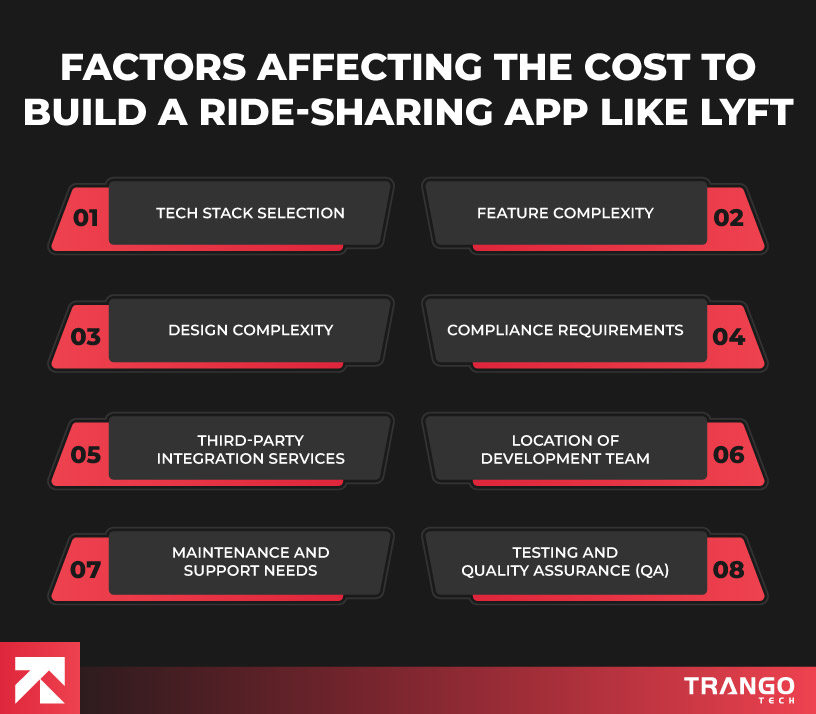
Factors Affecting the Cost to Build a Ride-Sharing App Like Lyft
From technology choices to long-term support, numerous variables influence the actual cost of building a ride app like Lyft.
Whether you’re planning a simple MVP or a full-fledged Lyft clone app development project, understanding these cost drivers will help you budget more accurately. Besides, our taxi booking app development guide will be useful in your journey.
1. Technology Stack Selection
Your technology stack is the core structure behind your ride-sharing app. It defines how your app is built, how well it performs, and how easy it is to maintain.
Choosing the right tools impacts development time and cost. A modern tech stack may cost more upfront but reduces issues later. Older stacks may seem cheaper, but they limit scalability and require more maintenance.
If you want to build a ride app like Lyft that performs reliably at scale, you’ll need a balanced stack—robust yet cost-effective. This includes tools for the frontend, backend, database, cloud hosting, and third-party integrations.
Tech Areas
Popular Choices
Cost Impact
Frontend (User Interface)
Flutter, React Native
Cross-platform saves time and money
Backend (Server Logic)
Node.js, Django, Express.js
Scalable but may require skilled developers
Database
PostgreSQL, Firebase, MongoDB
Flexible data handling, but hosting adds costs
Hosting
AWS, Google Cloud, Heroku
Ongoing hosting and scaling costs
APIs & Integrations
Google Maps, Stripe, Firebase
Essential but adds recurring API usage fees
Tip: For Lyft clone app development, avoid overly complex stacks unless you expect rapid scale.
2. Feature Complexity
Features are the core part of your app. The more complex they are, the more time and money you’ll need.
To keep your budget under control, start with essential features. These include registration, GPS-based ride booking, fare estimation, payments, and ride history.
Advanced features such as route optimization, ride scheduling, or multi-language support can raise costs significantly.
Security features also impact the cost. Think fraud detection, 2FA login, and user data protection.
If you plan to build a ride app like Lyft for different user types (riders, drivers, admins), you’ll need three versions of the app interface—each with different features.
Feature Group
Examples
Impact on Cost
Core Features
Login, real-time tracking, payments, booking
Essential for MVP, moderate cost
Advanced User Features
In-app chat, ride-splitting, promo codes
High dev time, raises complexity
Admin Panel
Driver management, analytics, dispute handling
Backend-heavy, adds to cost
Security Features
OTP, biometric login, encryption
Must-have for trust, adds dev effort
Notifications & Alerts
Push notifications, email updates
Needs third-party tools, adds cost
Tip: Plan features carefully. Add more only after validating your MVP.
3. Design Complexity
Design isn’t just about looks—it’s about user experience. A well-designed ride-sharing app keeps users engaged and coming back.
Simple designs with standard layouts are faster and cheaper. Custom animations, branded visuals, and seamless transitions add value but take longer to develop.
If you’re targeting a premium audience or want a strong brand identity, design becomes even more critical. Multiple user roles (driver, rider, admin) also require tailored UI/UX designs.
Design Level
Details
Estimated Cost Range
Basic
Minimal UI, no animations
Low
Standard UX/UI
Clean layout, basic branding
Moderate
Custom & Advanced
Animations, branded icons, rich user flows
High
Multi-role UI
Separate views for rider, driver, admin
Increases design time & cost
Tip: To stand out in Lyft clone app development, invest in clean, user-focused design.
4. Regulatory Compliance Requirements
Compliance is a critical cost factor in ride-sharing app development. Each country, and sometimes each city, has its own set of transportation and data privacy laws.
You may need licenses, insurance coverage, or background check integrations. For global or multi-region launches, costs multiply. You’ll also need to follow data privacy laws like GDPR (Europe) or CCPA (California), which may require encryption and user consent systems.
Legal consultations, document handling, and compliance integrations add both time and cost to your Lyft clone app development plan.
Compliance Type
Examples
Cost Impact
Transportation Regulations
Local ride permits, driver background checks
Varies by city/country
Data Privacy Laws
GDPR, CCPA, data storage rules
May need encryption and legal input
Payment Security
PCI-DSS compliance, tokenization
Required for safe transactions
Tip: Failing compliance can delay your launch and increase costs later.
5. Integration with Third-Party Services
When it comes to mobile app development for a ride-sharing app like Lyft, third-party integrations are non-negotiable. They power essential features like maps, payments, notifications, and analytics.
Each third-party service brings its own pricing model. Some are free with limited usage. Others are subscription-based or charge per API call. The more services you use, the higher your infrastructure and maintenance costs.
Payment gateways, live tracking tools, and messaging services are usually the biggest cost centers.
Integration Types
Popular Services
Cost Range
Maps & Navigation
Google Maps, Mapbox
Free tier + paid API calls
Payments
Stripe, Razorpay, PayPal
Transaction-based fees (2.9%+ per use)
Messaging & Notifications
Twilio, Firebase Cloud Messaging
Based on SMS/push volume
Analytics
Mixpanel, Firebase Analytics
Free to enterprise-level pricing
6. Location of Development Team
Where your team or ride app development company is located plays a significant role in the cost of developing an app like Lyft. Developer rates vary significantly across regions.
Hiring a local team in the U.S. or Western Europe will be more expensive. Offshore teams in South Asia or Eastern Europe offer lower rates but may require more project management effort.
You can also mix models—hire a core team locally and outsource parts of development. This hybrid approach helps balance cost and quality.
Region
Average Hourly Rate
Pros
Cons
North America
$100 – $200/hr
High quality, easy communication
Very expensive
Eastern Europe
$30 – $70/hr
Good value, strong technical skills
Time zone & language barriers
South Asia
$15 – $50/hr
Affordable, large talent pool
Needs stronger quality oversight
In-house (anywhere)
Monthly salary
Full control & long-term availability
Ongoing HR & operations cost
Pro Tip: Smart team selection helps reduce Lyft clone app development cost without compromising quality.
7. Maintenance and Support Needs
Building the app is just the start. After launch, you’ll need to maintain, update, and support it. This is where ongoing costs come in.
Bugs will appear. Servers will need optimization. Users will request new features. Your development team must stay involved post-launch to handle these tasks.
You also need customer support systems for rider and driver issues. Live chat tools, feedback forms, or helpdesk integrations can add extra layers to your budget.
Maintenance Area
What’s Involved
Cost Type
Bug Fixes & Patch Updates
Ongoing fixes based on user reports
Hourly or monthly retainer
New Features
Upgrades based on user demand or trends
Per-feature or sprint-based
Server & Hosting
Managing uptime, storage, performance
Monthly subscription
User Support
Live chat, ticketing systems
Depends on volume
8. Testing and Quality Assurance (QA)
Before your app goes live, it needs to be tested thoroughly. Testing ensures the app works well, looks good, and is secure on all devices.
Testing can’t be rushed. Each feature must be tested across Android and iOS, on different devices and screen sizes. Functional testing checks if features work. Performance testing checks speed under load. Security testing protects user data.
You’ll also need usability testing to make sure the app is intuitive. This process often involves real users and QA engineers.
Testing Types
Purpose
Cost Impact
Functional Testing
Ensures all features behave as expected
Moderate, depends on feature count
Performance Testing
Checks app under stress and traffic spikes
Extra if done manually or at scale
Security Testing
Prevents data leaks and hacks
High if external auditors involved
Usability Testing
Ensures ease of use and clean UI
Optional but valuable
Pro Tip: If you’re serious about launching a Lyft clone app, don’t skip testing — it saves money long-term.
Need help budgeting for your ride-sharing app?
Let us provide a detailed cost breakdown tailored to your project.
Detailed Price Breakdown of a Ride-Sharing App like Lyft
Here is a quick rundown of the factors affecting the cost to develop a ride-hailing app like Lyft or Uber.
Development Stage
Key Activities
Timeline
Experts Required
Estimated Cost
Initial Research & Planning
– Market research
– Business scope
– SWOT analysis
– Feature finalization
1–2 months
– Project Manager
– Business Analyst
$3,000 – $5,000
Design
– Wireframing
– UX Prototyping
– UI Design
3–12 weeks
– UI/UX Designer
$5,000 – $18,000
Frontend Development
– User interface coding
– Implement design
– Cross-platform compatibility
6–12 months
– Frontend Developer
– UI/UX Designer
$30,000 – $50,000
Backend Development
– Server logic
– API integration
– Database management
– 3rd party tools
Technology Stack for Developing a Ride-Sharing App Like Lyft
How to create a ride-sharing app depends on the tech stack you choose.
Selecting the right technology stack is crucial for building a stable, scalable, and user-friendly ride-sharing app.
Below is a breakdown of the essential technologies typically used:
Components
Technologies/Tools
Frontend (Mobile App)
React Native, Flutter
Backend (Server-Side)
Node.js, Ruby on Rails
Mapping & Navigation
Google Maps API, Mapbox
Payment Integration
Stripe, PayPal, Braintree
Push Notifications & SMS
Firebase Cloud Messaging, Twilio
Database
PostgreSQL, MongoDB
Real-Time Features
Socket.IO, Firebase Realtime Database
Authentication
OAuth 2.0, Firebase Auth
Additional Factors that may Impact the Development Cost of an App like Lyft
When estimating the total cost of building a ride-sharing app like Lyft or Uber-like app development cost, it’s important to consider not only the development hours but also various additional expenses that impact the overall budget:
1. Third-Party Services
Many ride-sharing apps rely on third-party services to handle critical functions efficiently. For example:
Maps and Navigation APIs like Google Maps or Mapbox charge based on usage (number of requests, routes calculated). These fees can scale with your user base and ride volume.
Payment gateways such as Stripe, PayPal, or Braintree usually take a percentage per transaction, plus potential monthly fees.
Push notification services (e.g., Firebase Cloud Messaging, Twilio) might also have usage costs depending on volume.
2. App Store / Play Store Deployment
Publishing your app on major platforms involves:
A one-time developer registration fee (Google Play: $25, Apple App Store: $99/year).
Costs related to app updates, compliance with store policies, and app review processes.
Potential marketing fees to improve app visibility.
3. Ongoing Support and Feature Updates
Launching the app is just the beginning. Continuous investment is required for:
Bug fixes and performance improvements.
Adding new features or enhancing existing ones based on user feedback.
Server maintenance and scaling infrastructure to handle growing user demand.
4. Legal & Compliance
Ride-sharing apps must comply with local laws and regulations, which can add to costs:
Insurance policies for drivers and riders.
Data privacy compliance (e.g., GDPR in Europe, CCPA in California).
Legal consultations and contracts (terms of service, driver agreements).
Licensing fees or permits required in certain regions.
Smart Strategies to Reduce the Cost to Build a Ride-Sharing App Like Lyft
On-demand ride app development can be expensive—but there are smart ways to cut costs without sacrificing quality, particularly when working on ride-sharing app features.
By making informed choices early on, you can streamline the development process and avoid overspending.
If you’re building a full Lyft clone or testing an MVP, strategic planning can reduce both time and money spent.
If you’re asking, “How much does it cost to develop an app like Lyft?”, know that the right cost-saving strategies can bring that number down significantly.
Below are proven methods to help lower the cost to build a ride app like Lyft, especially during early development.
Strategies
Description
1. Start with Local Launch
Focus on launching in one city or region before scaling nationally or globally.
2. Use Scalable Architecture
Build a backend that can handle growth without needing frequent rework.
3. Hire a Hybrid Team
Mix in-house oversight with outsourced development to control quality and cost.
4. Automate Testing Early
Use automated testing tools to reduce manual QA time and long-term bugs.
5. Delay Advanced Features
Launch basic features first, then roll out premium options in later updates.
6. Choose Affordable APIs
Pick map, payment, or SMS services that match your budget and usage model.
7. Reuse Code Components
Reuse authentication, profile management, or chat modules across user types.
8. Set Clear Dev Milestones
Break development into short, goal-focused sprints to manage scope creep.
9. Monitor Usage Analytics
Use lightweight tools to track user behavior without heavy infrastructure.
10. Reduce Customer Support Load
Add in-app FAQs and automated help bots to reduce manual support costs.
Monetization Strategies for a Ride-Sharing App Like Lyft
Needless to say, there are various taxi app development ideas accessible on app stores. However, each app’s success depends on the monetization model it operates on.
A successful ride-sharing app like Lyft needs more than just useful features. It also requires a clear and effective way to generate revenue. The right monetization model helps your business stay profitable while delivering real value to users.
Below are some of the most common and proven ways ride-sharing platforms make money, or you may say Ride app monetization strategies.
Key Monetization Methods
Monetization Methods
Description
Commission on Rides
A fixed percentage or flat fee taken from each fare paid by the rider to the driver.
Surge Pricing
Increased fare rates during high-demand periods, generating higher revenue per trip.
Subscription Plans
Premium user subscriptions offering discounts, priority bookings, or driver perks.
In-App Advertising
Displaying ads to users within the app interface for additional ad revenue.
Partner Services
Collaborations with third parties (e.g., insurance, car rentals) for referral income.
How to Calculate the Cost to Build a Ride App Like Lyft?
If you’re planning an on-demand ride app development project or starting a taxi business, accurate cost estimation is crucial. If you’re building a full-featured platform or an MVP, each development phase adds up.
Understanding what drives the cost will help you avoid surprises and stay on budget.
So, how much does it cost to develop an app like Lyft? It depends on your features, team, tech stack, and post-launch needs.
Here’s what to factor in when estimating the cost to build a ride app like Lyft:
Define the app scope clearly—rider and driver apps, admin panel, etc.
Decide on the core and advanced ride-sharing features you need
Choose your technology stack for frontend, backend, and hosting
Design intuitive UI/UX for all user roles (rider, driver, admin)
Identify required team roles – developers, designers, PM, QA, support
Estimate the total development timeline for each phase
Plan for third-party services: maps, payments, chat, analytics
Consider compliance costs for transportation laws and data security
Budget for deployment, app store publishing, and launch marketing
Allocate funds for ongoing maintenance, bug fixes, and updates
When it comes to Lyft clone app development, every feature and decision directly impacts your budget and timeline. You can reach our reliable app development agency for an exact estimate.
Need a precise cost estimate for your ride-sharing app?
Let us break down the budget and timeline for your unique project.
Final Thoughts
The taxi app industry has seen a rapid progression in the past few decades. If you’re specifically looking for the development cost of a ride-sharing app like Lyft, it normally lies between $5,000 to $150,000+.
Based on your app needs and other features, like app’s complexity, features & functionality, and the development team you choose usually affects the overall cost.
To give you a clear picture, we’ve broken down the estimated budget, timeline, and experts needed at each stage of the development process in the above blog.
Besides, we’ve covered factors, pricing, features & functions, and other relevant information, too.
Want to bring your ride-sharing app idea to life?
Partner with Trango Tech for expert development and support.
Frequently Asked Questions (FAQ’s)
1. How much does it cost to build a ride-sharing app like Lyft?
The cost typically ranges from $5,000 to $150,000 or more. A simple MVP with core features like user registration and ride booking will cost less. Full-featured apps with real-time tracking, payments, and admin tools require a higher budget. Costs also vary based on the development team’s location and experience.
2. How long does it take to develop a Lyft-like app?
Development can take anywhere from 3 to 9 months. A basic app may be ready in 10 to 14 weeks, while complex apps take longer. Timelines depend on the number of features, the platforms (iOS/Android), and whether the work is done in-house or outsourced.
3. Why choose Trango Tech for taxi app development like Lyft?
Trango Tech builds reliable, scalable ride-sharing apps tailored to your business. We use modern tools and proven frameworks to deliver high-performance solutions. Our team offers full-cycle development, from idea to launch, with ongoing support after deployment.
4. How are Trango Tech’s ride-sharing app development services different?
Our services focus on flexibility, speed, and long-term value. We don’t just deliver an app—we help you scale it. With agile development, dedicated support, and real-world experience, Trango Tech ensures your app stands out in the competitive ride-sharing market.
5. Can I launch a ride-sharing app in just one city first?
Yes, starting in one city is a smart and cost-effective move. It allows you to test your app with real users, make improvements, and build local traction. Once proven, you can scale to more cities with confidence.
Mariam Amin is an Electronics Engineering graduate and a passionate content marketer specializing in tech and SaaS. At Trango Tech, a leading mobile app development company, she creates easy-to-understand content on mobile app development, using her technical background to support practical digital strategies. Outside of work, Mariam enjoys exploring new food trends, staying active, and relaxing with documentaries or movies.