Have you ever stood in your living room, opened an app, and dropped a virtual chair or lamp into the space just to see how it would look? Or maybe you’ve used a filter that turned your surroundings into a sci-fi world. That’s augmented reality (AR) in action, and believe it or not, it’s becoming a part of daily life for millions of people around the world.
What once felt futuristic is now incredibly accessible via phone cameras, smarter AR toolkits, and interactive digital experiences. According to Statista, the global AR market is expected to reach $62 billion by 2029, presenting a great opportunity to partner with a reputable AR app development company.
What’s even more interesting is how everyday users are embracing AR. A PwC survey found that around 70% of consumers now expect businesses to offer some form of AR experience, whether it’s for product demos, virtual try-ons, or even in-person navigation. It’s not just about entertainment anymore, it’s about enhancing real-world interactions in useful, memorable ways. One powerful example is a 3D product viewer for ecommerce, which lets shoppers explore products virtually, inspect details from every angle, and make purchase decisions with confidence. With AR SDKs like Apple’s ARKit and Google’s ARCore, development becomes more approachable, allowing even small teams and indie creators to build meaningful apps without a massive tech budget.
So, if you’re a founder, developer, marketer, or just someone looking for inspiration, this is the perfect time to dive into AR. Below, we’ll walk through some of the most exciting, relevant, and forward-thinking AR app ideas that could genuinely take off in 2025.
Ready to turn an AR app idea into a market-leading product?
Let Trango Tech build a scalable, immersive AR solution for your business.
Table Of Contents
Top 30+ AR App Ideas to Check Out
Augmented Reality is quickly becoming one of the most exciting tools for innovation across industries. If you’re dreaming up your next big startup or just love exploring advanced tech, this list of AR app ideas is packed with creative and practical inspiration.
AR in Social Apps
Augmented Reality has become a huge part of how we communicate and express ourselves on social media. Platforms like Instagram, Snapchat, and TikTok have embraced AR to boost engagement, offering users tools to enhance their stories and create viral trends. Here are some of the popular AR applications:
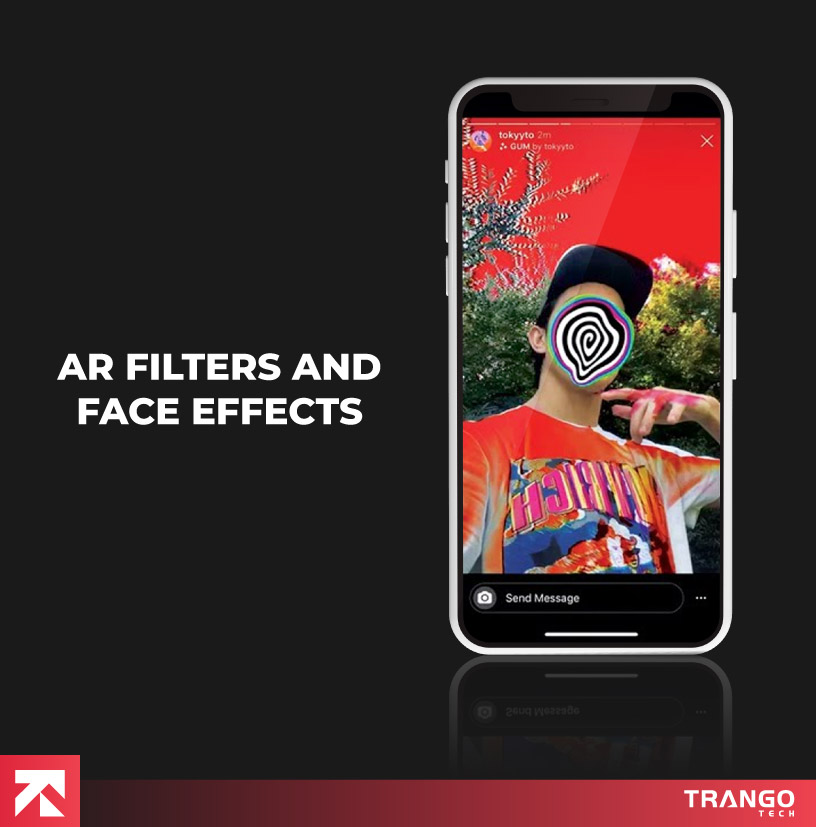
1. AR Filters and Face Effects
If you’ve ever tried on a virtual crown, added animated sparkles to your selfie, or turned yourself into a cartoon character during a video call, you’ve already been a part of AR filters and face effects. What started as playful add-ons has become a driving force behind how people express themselves, create content, and even build personal brands online.
Snapchat has been leading the charge, and according to Snap Inc.’s 2024 Investor Report, over 300 million users engage with AR experiences every single day on the platform. Moreover, Instagram and TikTok are rolling out AR effects for Reels and Stories, while YouTube is piloting AR integrations for Shorts and live streams. These platforms are all competing to offer the most immersive, customizable experiences.
Meta’s Vision Report predicts that social media content will include AR, VR, or other immersive elements by 2030. It is because users want more than static photos or basic filters. They want personalized, creative, and real-time interactive storytelling, and AR makes that possible.
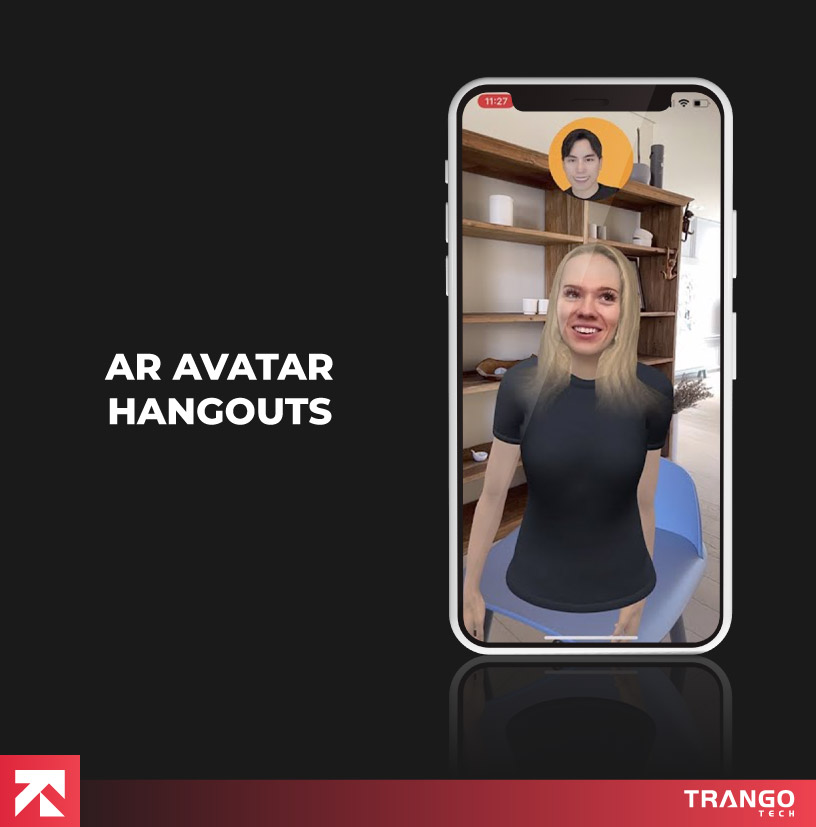
2. AR Avatar Hangouts
If you’re thinking about building the next big thing in social media, AR avatar hangouts might just be the future you’re looking for. Imagine giving your users the ability to open an app, scan their surroundings, and instantly see their friends appear, right in their living room, backyard, or favorite hangout spot. Not as blurry video tiles, but as hyper-realistic avatars that smile, react, and move with natural gestures. You can present it as FaceTime reimagined for the immersive age: interactive, expressive, and spatially present.
According to a recent report, 37% of Gen Z users are ready to embrace AR-based social tools, especially if they involve realistic, expressive avatars. And with Meta projecting that over 60% of social interactions will involve AR or avatars by 2027, it’s clear: the shift toward immersive digital communication is already underway.
These social apps encourage repeat engagement, social sharing, and emotional connection. It transforms a screen into a shared space. For brands and creators, it opens doors to monetization through avatar upgrades, branded experiences, virtual event access, and even AR storefronts.
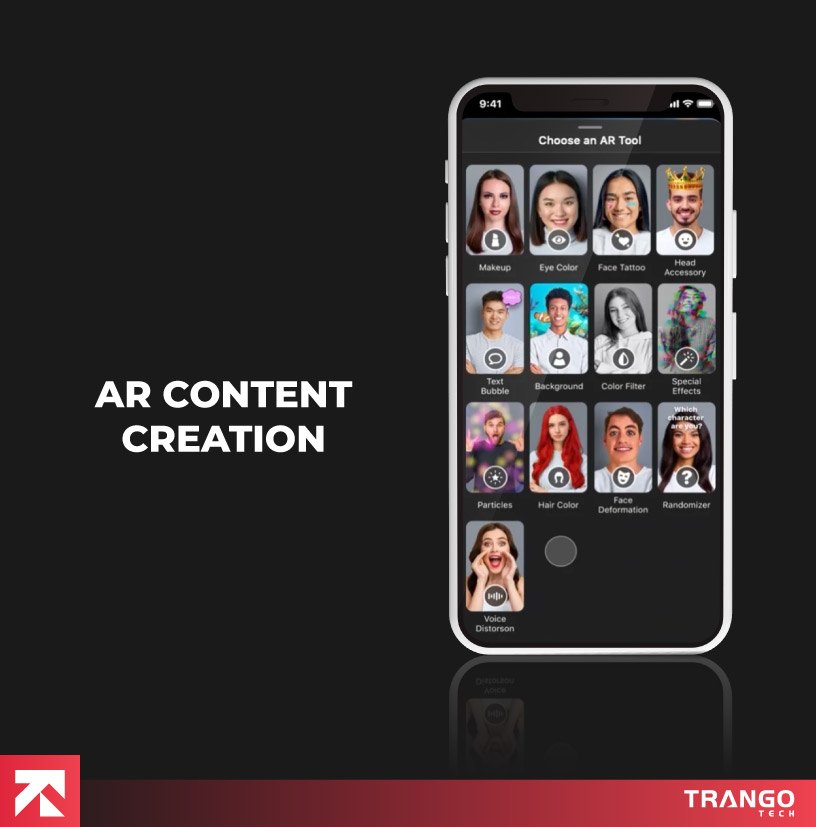
3. AR Content Creation Tool
If you’ve ever watched a viral TikTok video where dragons fly over someone’s backyard or a user dance with a glowing 3D clone of themselves, that is all due to professional editing tools. What if your app gave creators the power to make that kind of content, without needing expensive software or technical skills?
An AR content creation tool app puts 3D storytelling into the hands of everyday users. It allows them to add dynamic, interactive AR elements, such as floating text, animated characters, realistic effects, or branded objects, directly into their surroundings using only their smartphone camera. It’s like Canva, but for immersive videos.
Businesses, educators, marketers, and everyday users want creative tools that are fast, flexible, and fun. If someone wants to create an interactive product demo or just improve their Instagram Reels, an AR content creation app makes it simple.
AR in Healthcare
Augmented Reality is making waves in the healthcare industry by offering groundbreaking tools that enhance precision, training, and patient outcomes. The impactful uses of AR in healthcare are as follows:
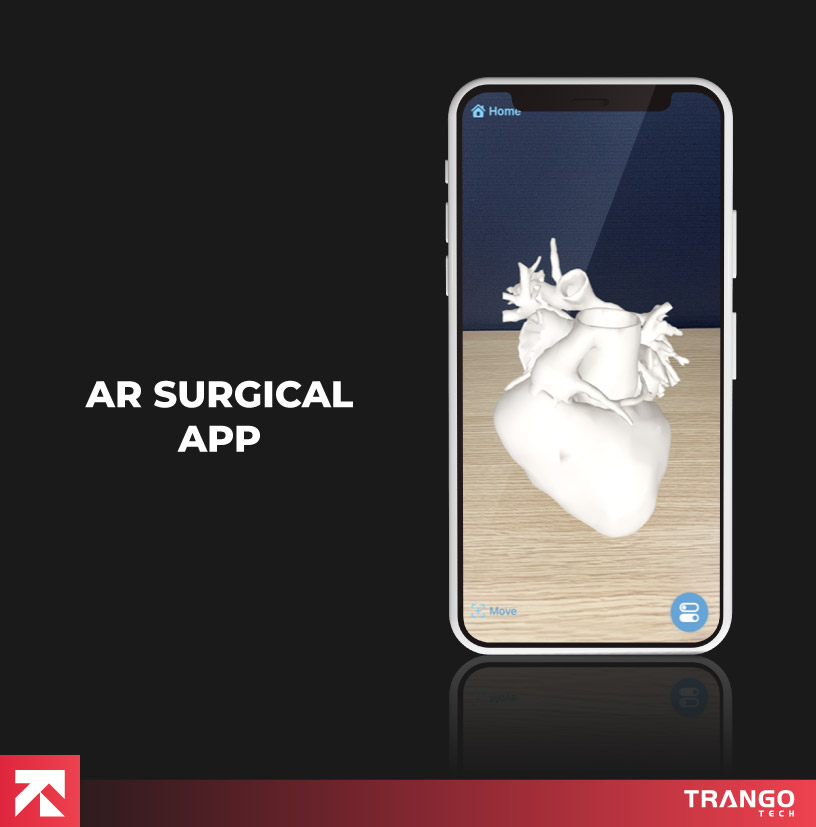
4. AR in Surgical Planning and Training
AR allows surgeons to overlay critical anatomical data, like MRI, CT, or ultrasound images, directly onto the patient’s body in real time. This visual assistance turns the surgeon’s vision into something akin to X-ray vision, improving precision and reducing the risk of error. According to a study, surgeons using AR-based navigation systems achieved 20% faster completion times and 30% fewer errors during complex procedures compared to those using traditional methods.
With AR tools, surgeons can walk through a full 3D rendering of a patient’s anatomy, rotating, scaling, and slicing through tissues virtually. This is especially useful for neurosurgery, cardiac surgery, and orthopedic procedures where millimeter-level precision matters.
A pilot study at Johns Hopkins using HoloLens 2 in spinal surgeries reported a 76% reduction in intraoperative fluoroscopy usage, reducing radiation exposure for both patients and staff.
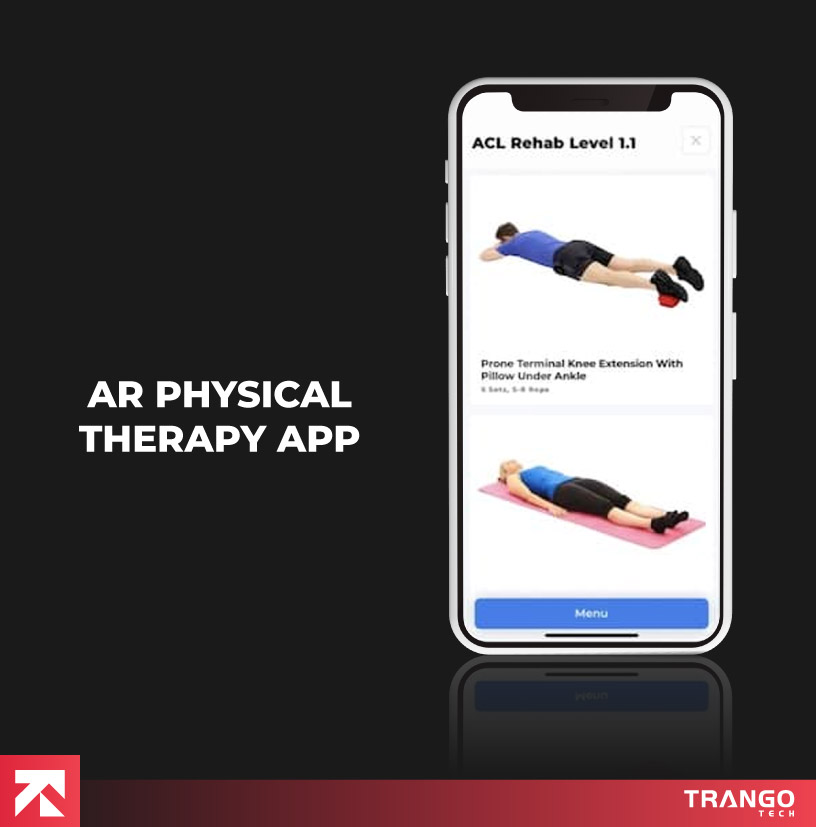
5. AR Physical Therapy App
If you’re exploring opportunities in health tech, building an AR physical therapy app could be one of the most practical and impactful investments you make. Instead of patients relying on clinic visits or generic video tutorials, your app would guide them through rehab exercises using augmented reality. You can call it a virtual physical therapist, right in the user’s home. This demonstrates stretches, correcting form in a live setting, and tracking recovery progress.
Over 50 million Americans undergo physical therapy annually. However, a significant portion drops out early due to a lack of access, travel constraints, or uncertainty about performing exercises correctly. AR bridges the gap, providing personalized, remote rehabilitation support that’s clinically effective.
There are multiple markets you can tap into, both B2C and B2B. You could license the app to physical therapy practices, partner with insurance companies, or launch it directly to consumers with subscription-based access to premium features.
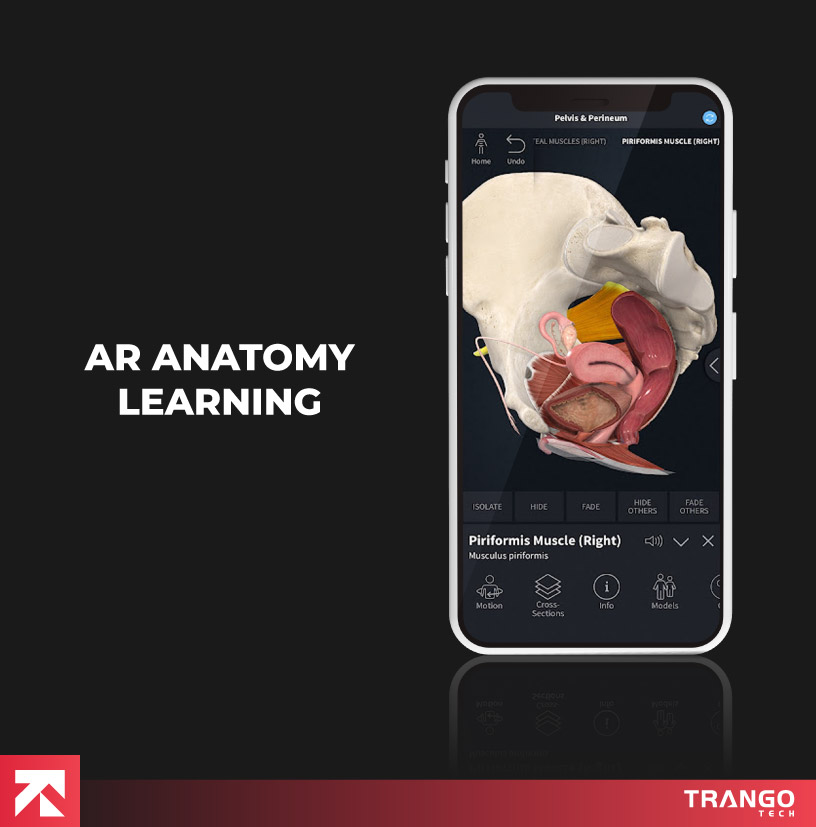
6. AR Anatomy Learning
Traditional anatomy education relies heavily on textbooks, 2D diagrams, or expensive cadaver labs that aren’t accessible to everyone. However, with AR (Augmented Reality), students can explore the human body layer by layer, in 3D, and in real space, directly from their devices.
According to HolonIQ’s 2025 Global EdTech Market Outlook, AR/VR in education is expected to reach $404 billion by the end of the year, driven by higher education, medical training, and K–12 STEM programs. In fact, a 2023 study published in Medical Education Online found that students who used AR anatomy apps scored 25% higher on spatial understanding tests and reported 40% greater engagement compared to traditional methods.
If you’re serious about creating an AR app with long-term impact and revenue potential, an AR anatomy learning platform offers a strong mix of purpose, scalability, and market demand.
Today’s consumers crave interactive, personalized shopping experiences that go beyond static product images and basic descriptions. AR technology is stepping in to meet these expectations, allowing shoppers to visualize products in real time. Here are some of the popular AR project ideas:
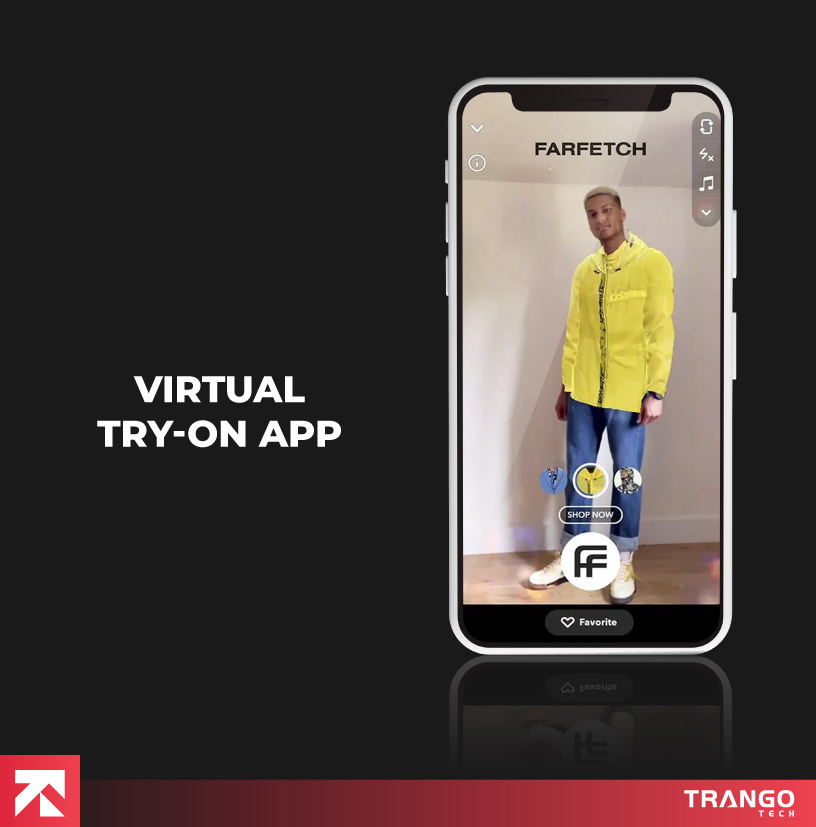
7. Virtual Try-On App
Shopping habits are evolving, and consumer demands are getting more convenient. If you’re looking to build an AR app that drives engagement, reduces return rates, and boosts conversions, a virtual try-on app is one of the smartest investments you can make right now.
According to Statista, global spending on AR in retail is expected to exceed $18 billion by the end of 2025, with virtual try-on technology leading the way. A survey by Snap Inc. revealed that 80% of consumers feel more confident in a purchase when they can visualize it using AR, and 66% are more likely to buy if they can try it virtually first.
Virtual try-on tech works beautifully for cosmetics, jewelry, and even eyewear, helping users visualize products in their real environment before committing to a purchase.
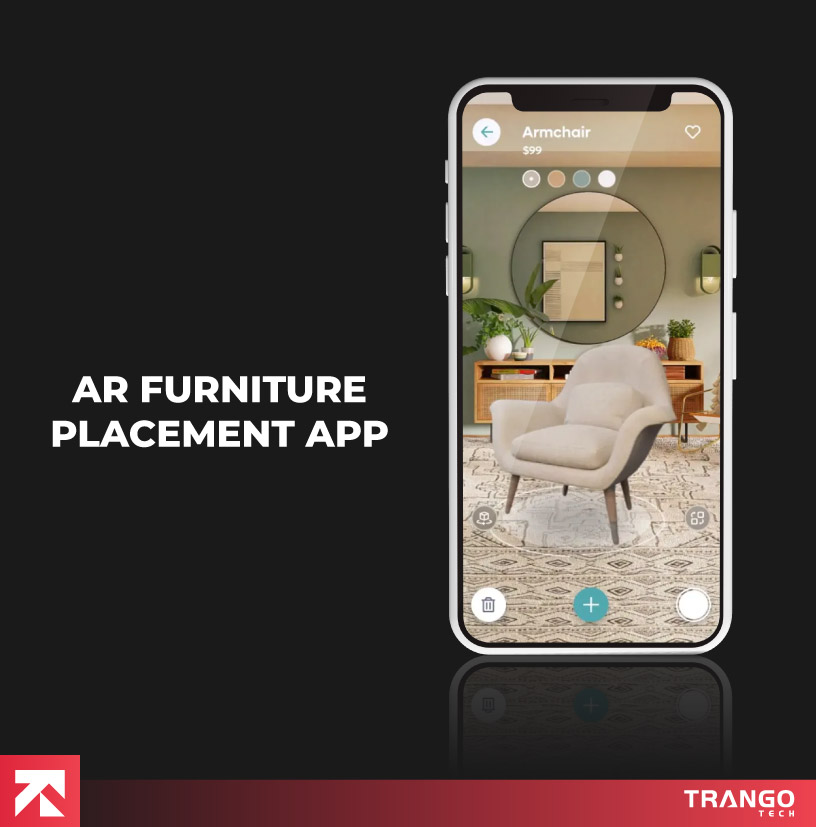
8. AR Furniture Placement App
Buying furniture has always come with a big question: “Will it actually look good in my space?” Photos and product dimensions can only tell you so much. That’s why more brands and customers are turning to AR furniture placement apps to bridge the gap between online shopping and real-world confidence.
With this type of app, users simply point their phone at a space and instantly see a true-to-scale 3D model of a couch, coffee table, or even a full sectional appear right in their living room. They can move it around, rotate it, change colors, or swap pieces, all before spending a dollar.
As AR adoption grows across eCommerce, this is one of those ideas that’s both user-friendly and business-smart. If you’re at the stage where you’re thinking, I have an app idea, our guide will walk you through everything you need to know to bring your vision to life
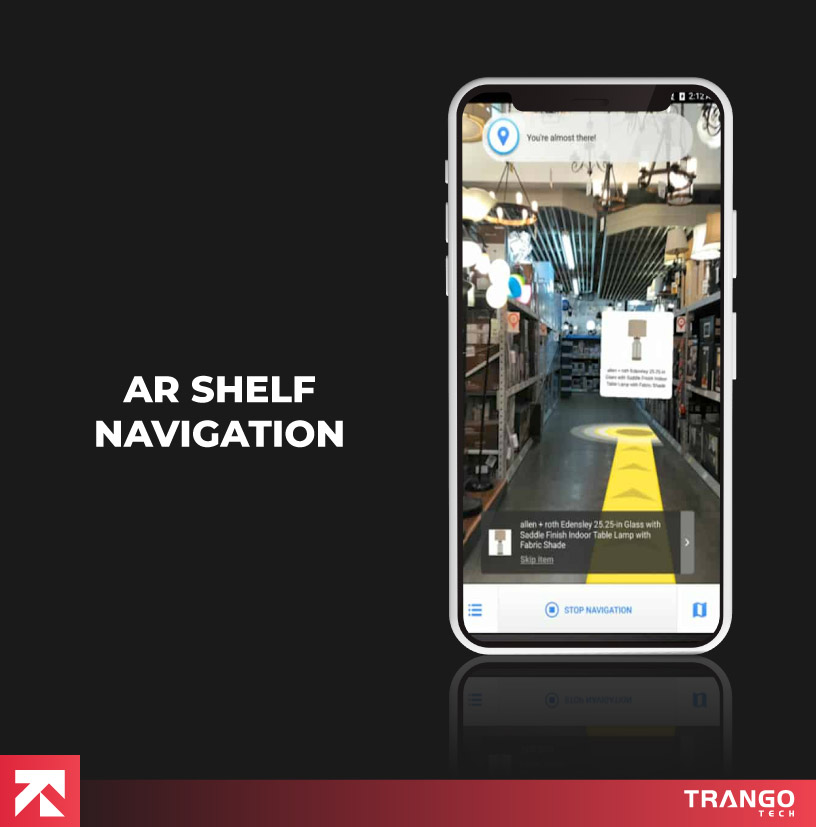
9. AR Shelf Navigation in Stores
Navigating large retail stores can be tiring, especially when shoppers can’t find a product, aisle, or section. That’s exactly the problem an AR shelf navigation app is here to solve.
Using a smartphone camera and indoor positioning technology, this app acts like Google Maps for retail shelves. Shoppers simply search for a product in the app, and AR arrows appear on their screen, guiding them down the correct aisles, pointing out exact shelf locations, and even showing promotions or product info as they walk. Large chains like Lowe’s, Walmart, and Target have already begun testing AR navigation tools, and smaller retailers are now looking for affordable, white-label solutions to stay competitive.
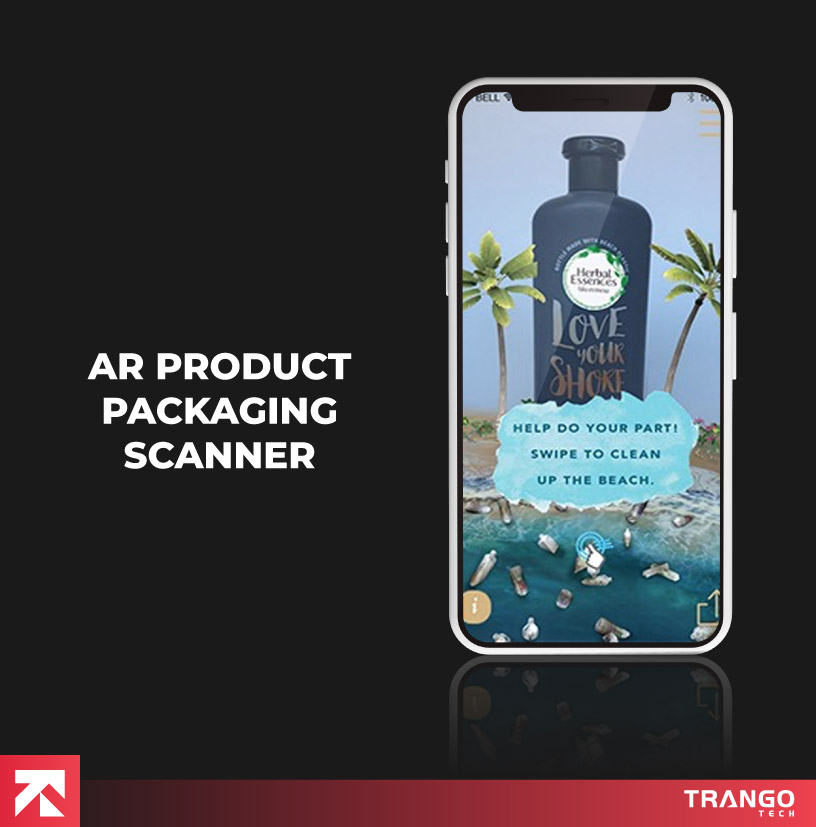
10. AR Product Packaging Scanner
Product packaging has always been a powerful marketing tool, but what if it could do more than just look good on the shelf? What if it could tell a story, show a demo, launch a game, or connect directly to a brand experience, all through a smartphone? That’s exactly what an AR product packaging scanner app makes possible.
With this app, users can simply point their phone at a product’s box, label, or wrapper, and watch it come to life through augmented reality. According to Think with Google, 70% of consumers say they’re more likely to buy from brands that offer interactive and immersive product experiences.
With smartphone AR adoption at an all-time high and consumers craving more than static labels, now’s the time to build a tool that attracts a large user base in the market.
Education and Learning
Augmented Reality is emerging as a powerful tool in modern education, offering immersive and interactive experiences that enhance both teaching and learning. Here are the top trending augmented reality business ideas in the learning sector:
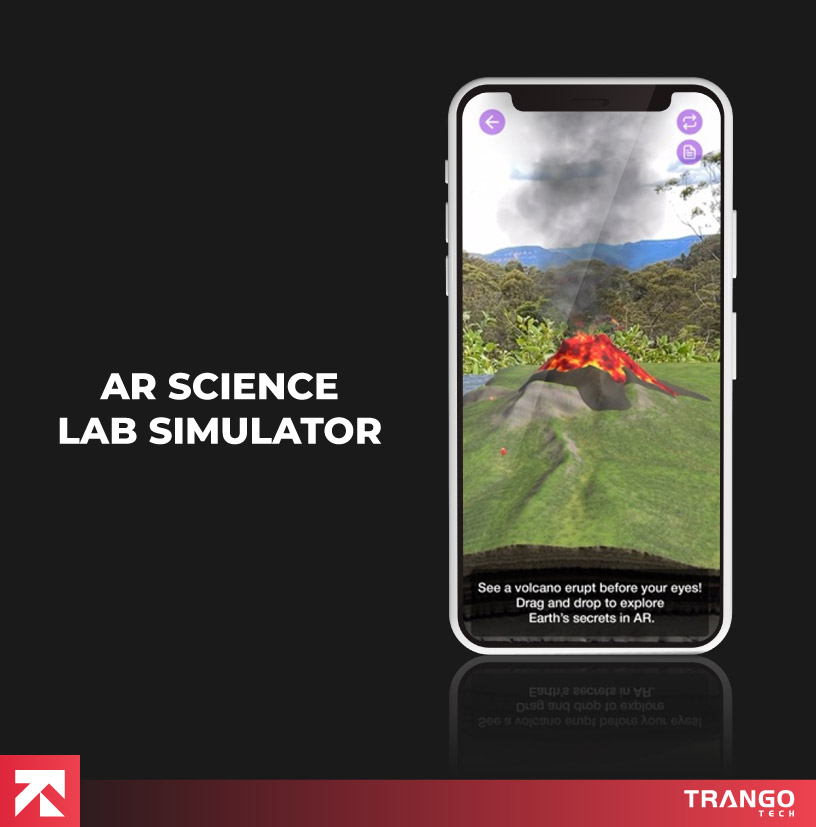
11. AR Science Lab Simulator
Science education thrives on hands-on learning, but not every school has access to a fully equipped lab, and not every student gets the chance to perform experiments safely and repeatedly. That’s where the AR science lab simulator app can help.
With this app, students can use their phone to scan a flat surface and project a full-scale virtual lab right in front of them. eakers, Bunsen burners, test tubes, and microscopes appear in 3D, allowing users to safely conduct experiments, observe chemical reactions, and explore physics principles in real-time AR.
According to UNESCO, more than 50% of secondary schools worldwide lack proper lab infrastructure, especially in underserved and rural communities. Meanwhile, HolonIQ’s 2025 EdTech Forecast projects that immersive learning platforms, including AR-based education, will exceed $10 trillion in market value by 2030. For developers and investors looking to build something meaningful in education, this app is a scalable, high-impact solution for the next generation of scientists.
12. Language Learning with AR Flashcards
Language learning apps are everywhere, but keeping learners truly engaged is still a challenge. That’s where AR flashcards come in, turning static vocabulary into interactive, real-world experiences.
With language learning AR flashcards, users can scan physical flashcards or everyday objects with their smartphone and instantly see animated 3D visuals, hear correct pronunciations, and interact with scenes related to the word or phrase. Instead of just memorizing “apple” from a list, learners see an apple land on their table, hear the word in context, and maybe even watch a bite get taken, all in augmented reality.
This immersive approach blends visual memory, spatial learning, and auditory reinforcement, making vocabulary acquisition faster, more intuitive, and way more fun.
13. AR Museum and History Tours
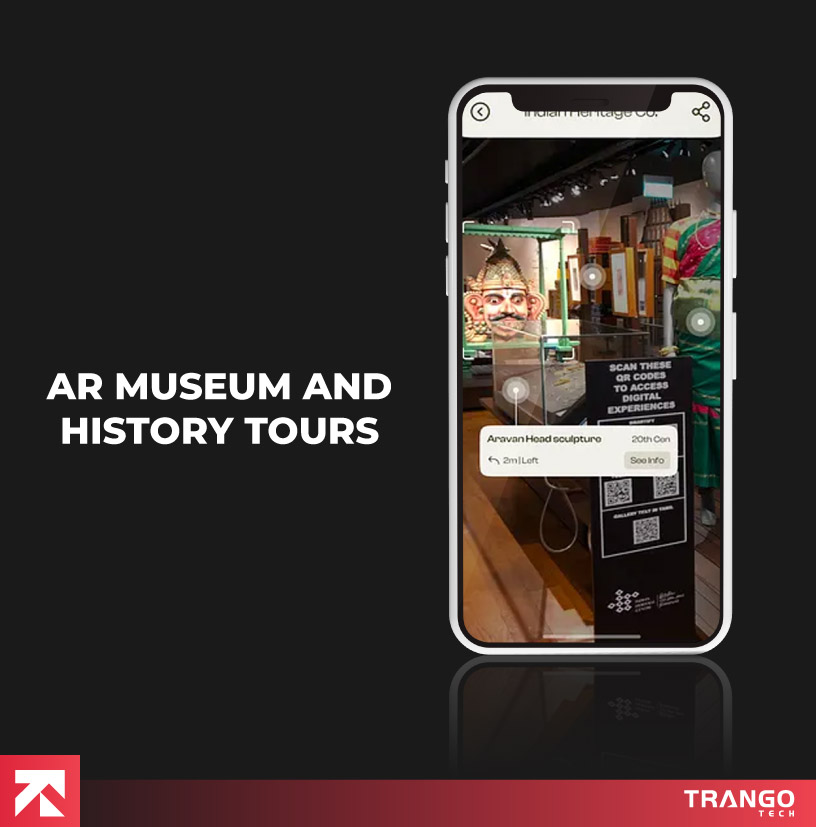
Museums and historical sites have always been windows into the past, but with augmented reality, they can become portals. An AR museum and history tours app brings artifacts, landmarks, and ancient stories to life by layering immersive digital experiences onto the real world.
Meanwhile, a study by the American Alliance of Museums found that museums using AR tech see 34% longer visitor engagement and higher satisfaction rates. In tourism, AR apps are already helping cities attract younger, tech-savvy audiences looking for meaningful and memorable interactions.
If you’re looking to create an app that combines education, innovation, and emotional impact, this idea brings timeless stories into today’s most accessible technology.
Ever wished you could see exactly how a home would look before stepping inside or moving a single piece of furniture? With Augmented Reality, that’s now a reality. Here are some of the top AR apps that could be super helpful:
14. AR Property Viewing App
Walking through a property has always been the most exciting part of house hunting, but it’s also one of the hardest to schedule. Construction delays, long distances, or even a completely empty lot can make it tough for buyers or renters to truly picture themselves in a space.
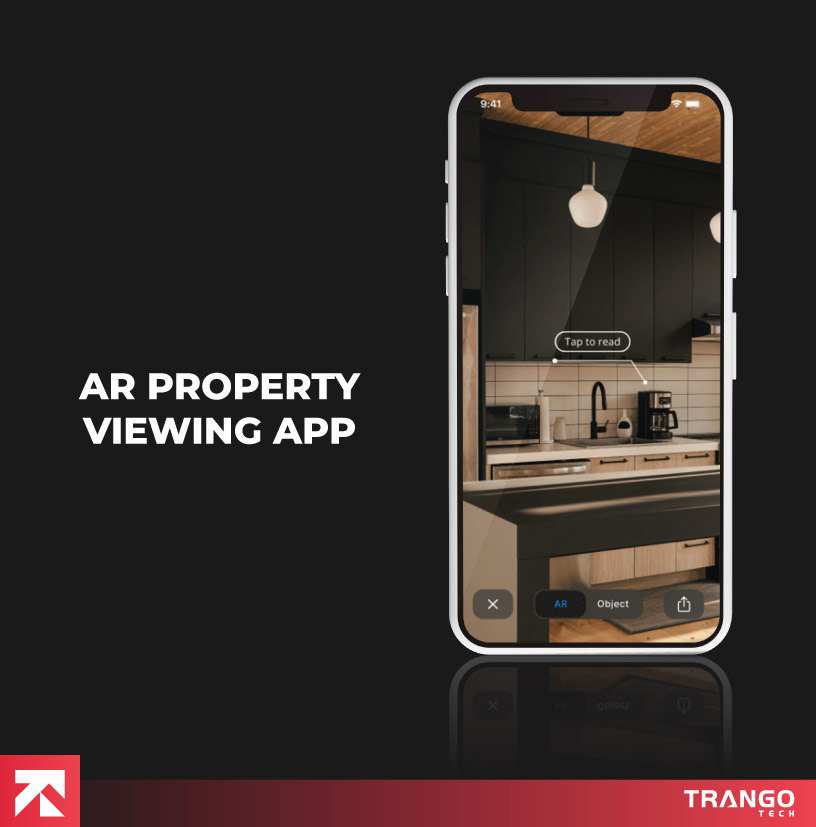
That’s where an AR property viewing app changes the game. Using just a smartphone, users can scan their surroundings and instantly project a life-sized virtual version of a home, apartment, or office space. Want to see how a 2-bedroom condo looks on your future plot of land? Or imagine a fully furnished living room inside a bare-bones unit? With AR, it’s all possible!
Many of the younger buyers (under 40) want to use AR or VR to preview properties, and they would feel more confident making faster decisions if they could visualize homes in a more interactive way. For founders and developers, the opportunity is massive. Real estate is going immersive, and your app could be the platform that changes how people buy, rent, and explore homes.
15. Home Renovation Visualizer
According to Guardian Service, over 72% of homeowners delay renovation decisions due to uncertainty about the final look. Customers using AR to preview materials were 33% more likely to complete purchases with fewer returns.
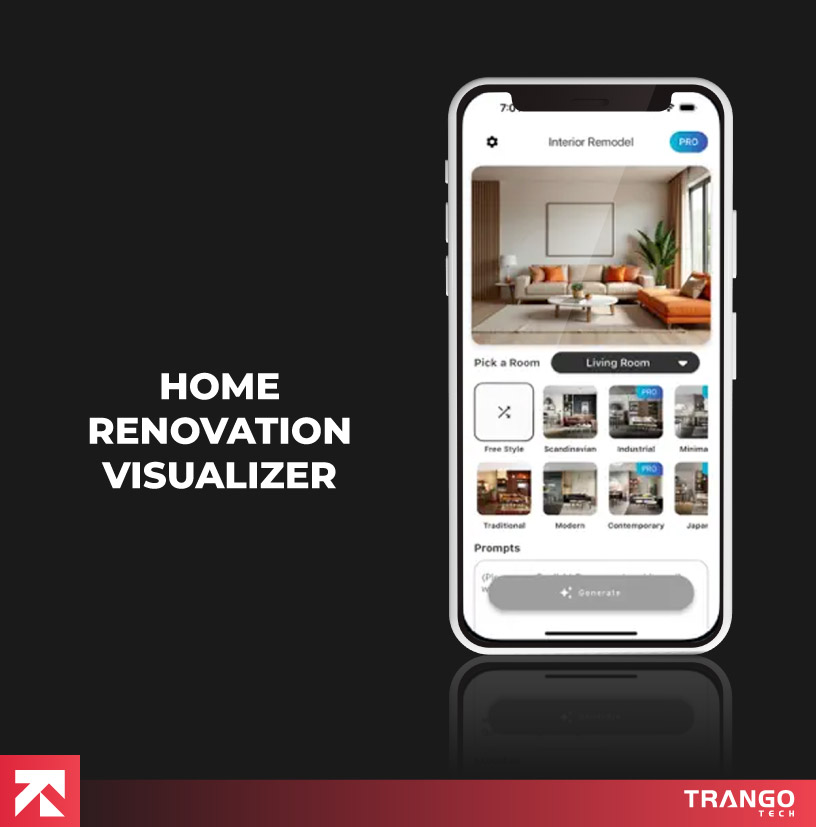
An AR-powered renovation app helps reduce indecision, speeds up planning, and boosts confidence, making it an ideal tool for both DIY homeowners and professional contractors. Consumer expectations are shifting toward personalization and convenience, so it’s the right time to build a tool that helps users renovate smarter and faster.
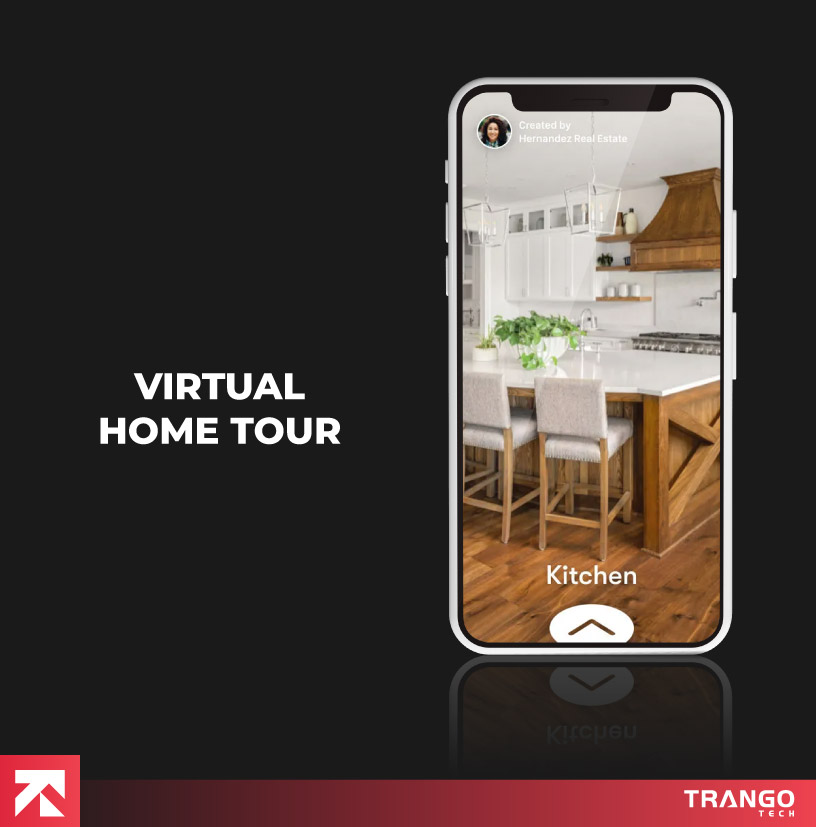
16. Virtual Home Tour
Home shopping is no longer confined to weekends and open houses. Today’s buyers want flexibility; they want to tour homes at midnight, compare two listings back-to-back, or explore a property in another city without having to hop on a plane. A virtual home tour app makes that possible.
This app enables users to experience a property as if they were physically present, directly from their mobile device or laptop. They can walk through each room, look up at the ceilings, peek into closets, and even step out onto a virtual balcony, all through a fully immersive, interactive interface.
It’s the next best thing to being there, and in many cases, it’s even better. Listings with virtual tours get 87% more views than those without. Buyers want to feel the flow of the space and imagine their life inside it. A virtual home tour app removes barriers, adds convenience, and builds buyer confidence.
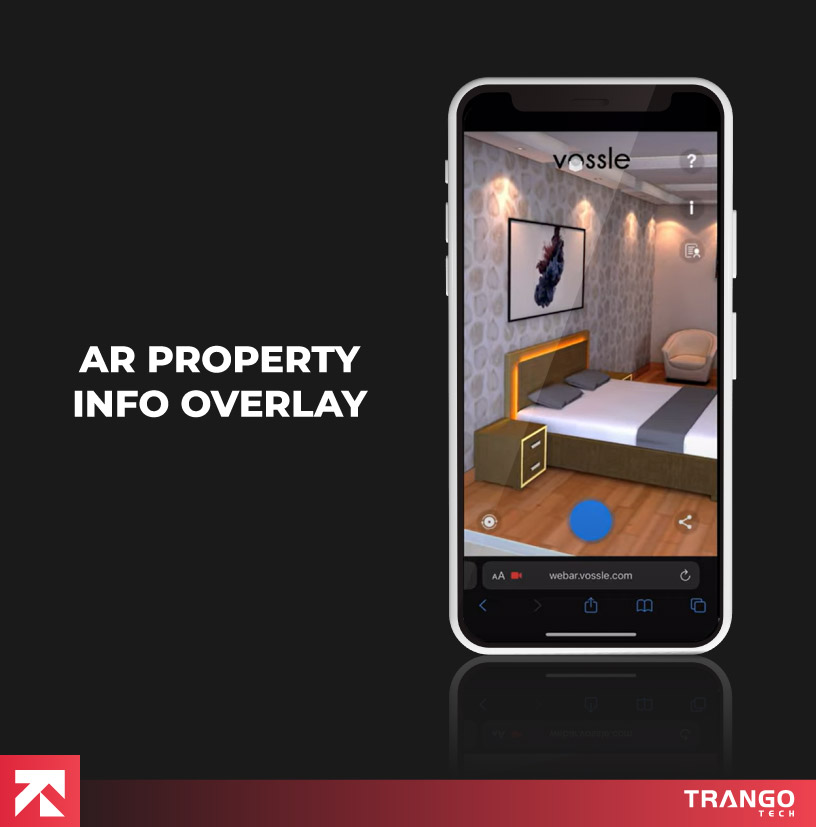
17. AR Property Info Overlay
Ever wish you could just point your phone at a house and instantly know if it’s for sale, how much it costs, and what it looks like inside?
With an AR property info overlay app, that’s exactly what you can do.
This app uses GPS, camera view, and real-time property databases to display live property data directly in the physical world. Whether someone’s out for a casual stroll or actively scouting neighborhoods, they can simply lift their phone and reveal insights that would otherwise require deep digging across multiple listing sites.
Logistics and Manufacturing
Augmented Reality is becoming a game-changer in logistics and manufacturing by streamlining operations, improving safety, and enhancing productivity across the board. You can use AR in these areas of logistics and manufacturing:
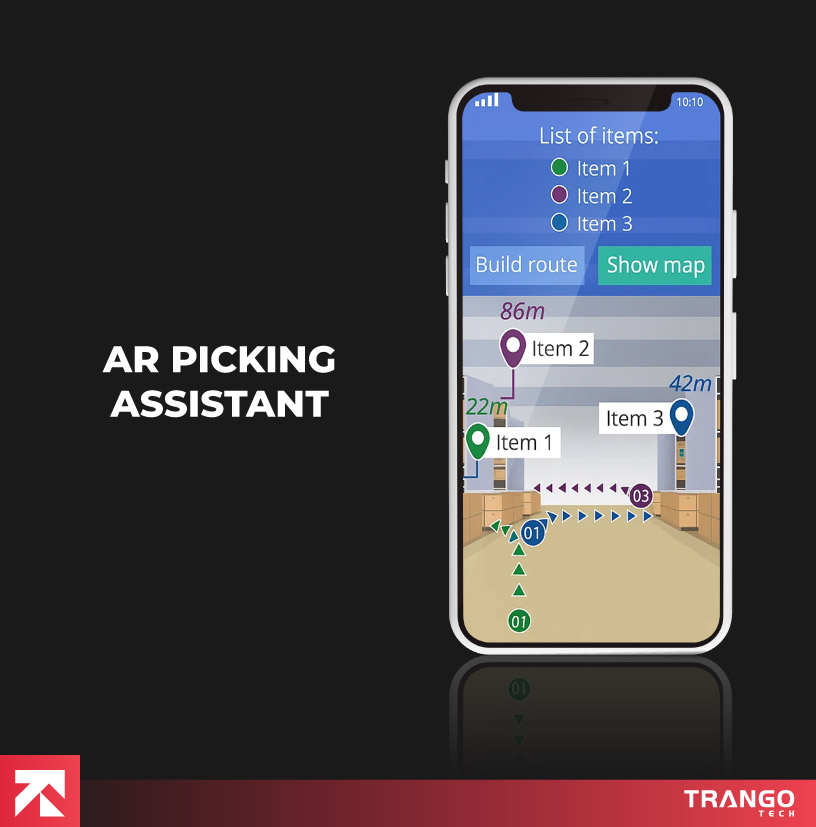
18. AR Picking Assistant
Speed, accuracy, and efficiency are everything in today’s fulfillment centers. However, traditional picking methods, including paper lists, handheld scanners, and guesswork, still slow down the process, especially when demand spikes. That’s exactly where an AR picking assistant app steps in.
A study by DHL Supply Chain found that AR picking solutions can increase productivity by up to 25% while reducing errors by up to 40%. In a world where every second counts and mistakes can be costly, AR helps create a smarter, more intuitive workflow, especially for large warehouses, 3PLs, and eCommerce operations.
As warehouses face growing labor shortages, increasing complexity, and tighter delivery windows, an AR picking assistant app offers a scalable, high-impact solution. It empowers frontline workers, reduces friction, and helps fulfillment teams move faster and smarter.
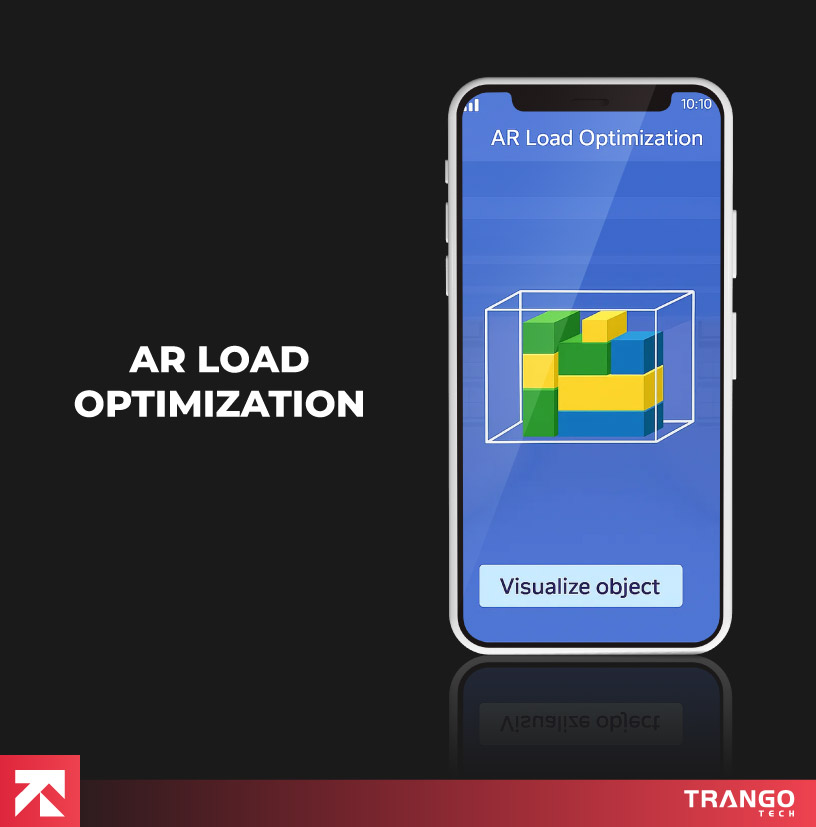
19. AR Load Optimization
Loading a truck isn’t just about stacking boxes, it’s about maximizing every inch of space while keeping shipments secure and organized. But even experienced teams struggle with inefficient loads, guesswork, and last-minute adjustments. That’s where an AR load optimization app can make a massive impact.
With this app, warehouse workers or freight handlers can point their smartphone or AR glasses at an empty container or truck bay and visualize the ideal loading configuration in real time. No spreadsheets. No printed diagrams. Just smart, spatial guidance tailored to the load, right in front of their eyes.
If you’re looking to build a logistics tool that delivers real, measurable ROI, this is the kind of app that can transform your business operations.
20. AR Inventory Scanning
Counting boxes, scanning barcodes, and manually logging inventory is tedious, error-prone, and time-consuming. Even with barcode scanners or RFID systems, workers often struggle with poor visibility, incorrect entries, or inefficient workflows.
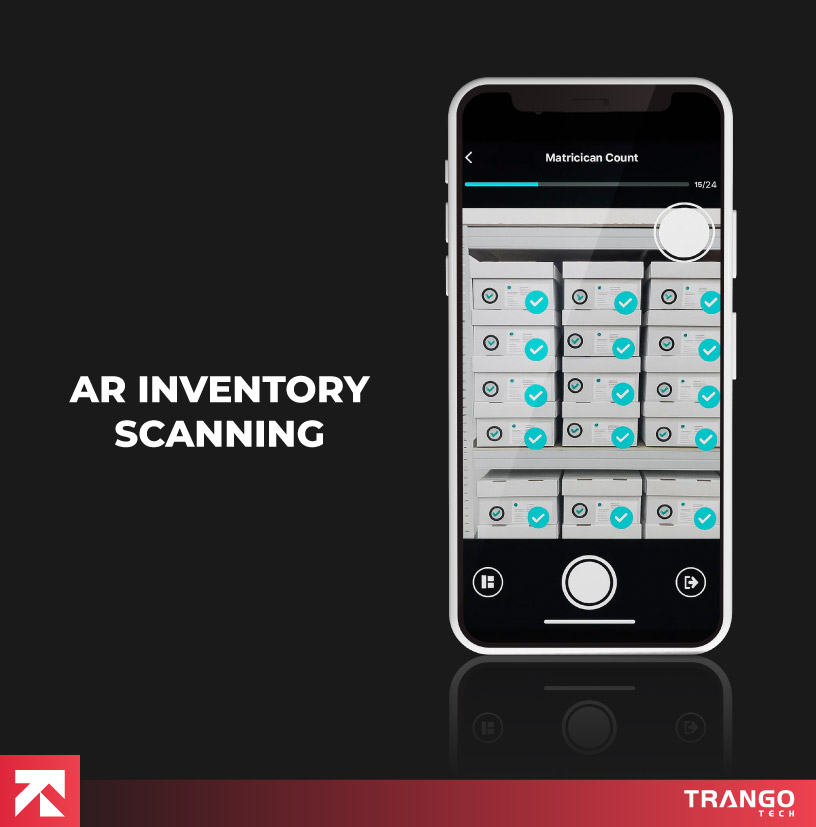
This app helps warehouse staff walk through aisles and instantly scan, track, and verify inventory just by pointing their device at shelves, pallets, or bins. AR overlays display real-time data, including SKU numbers, stock counts, expiry dates, and even alerts for missing or misplaced items, directly over physical products.
With the use of AR, real-time data can make inventory scanning faster, more accurate, and far more intuitive. If you’re exploring innovative concepts, our detailed guide on AI app ideas will inspire you with real-world examples, trending technologies, and practical tips.
Automotive
AR is making a powerful impact behind the scenes in the automotive industry, particularly in manufacturing, maintenance, and workforce training. If you’re looking for AR app ideas for the automotive industry, here are some of the trending ones:
21. AR Car Manual App
Nobody enjoys flipping through a 300-page car manual to figure out what a blinking dashboard light means or how to check transmission fluid. Traditional manuals are bulky, technical, and often overlooked by drivers. An AR car manual app that brings your vehicle’s information to life, visually and interactively.
Over 60% of drivers never open their physical car manual, even when warning lights appear. At the same time, there is a growing demand for smarter, tech-enabled solutions in vehicle ownership.
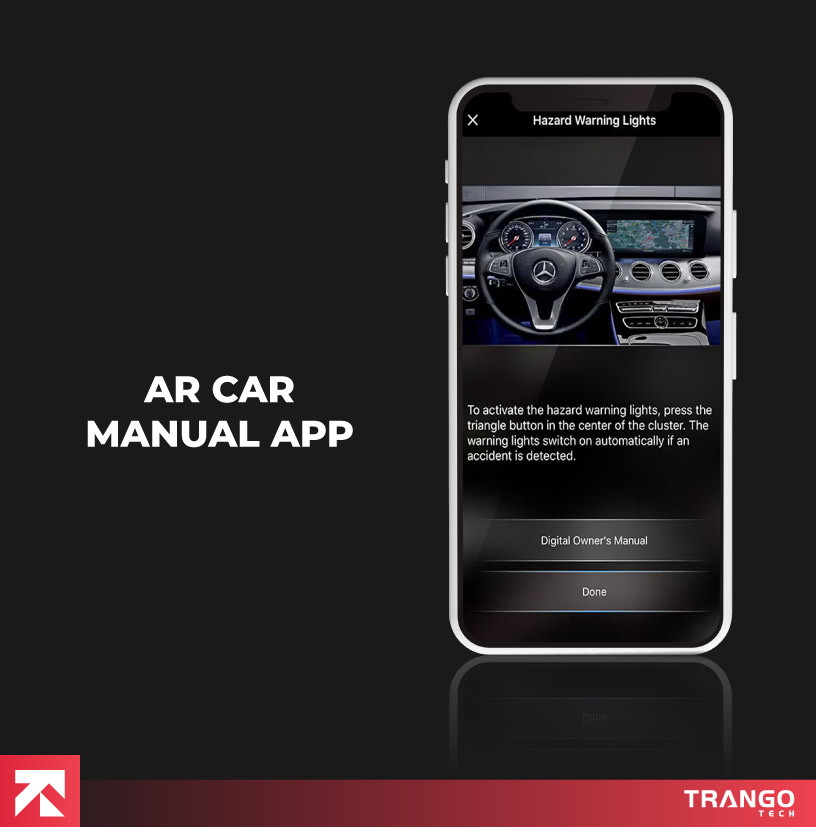
With this app, users can simply point their smartphone at a part of their car, such as the engine bay, dashboard, or infotainment system, and receive instant, augmented reality overlays that display what each component is, its function, and how to maintain or troubleshoot it.
22. Virtual Showroom App
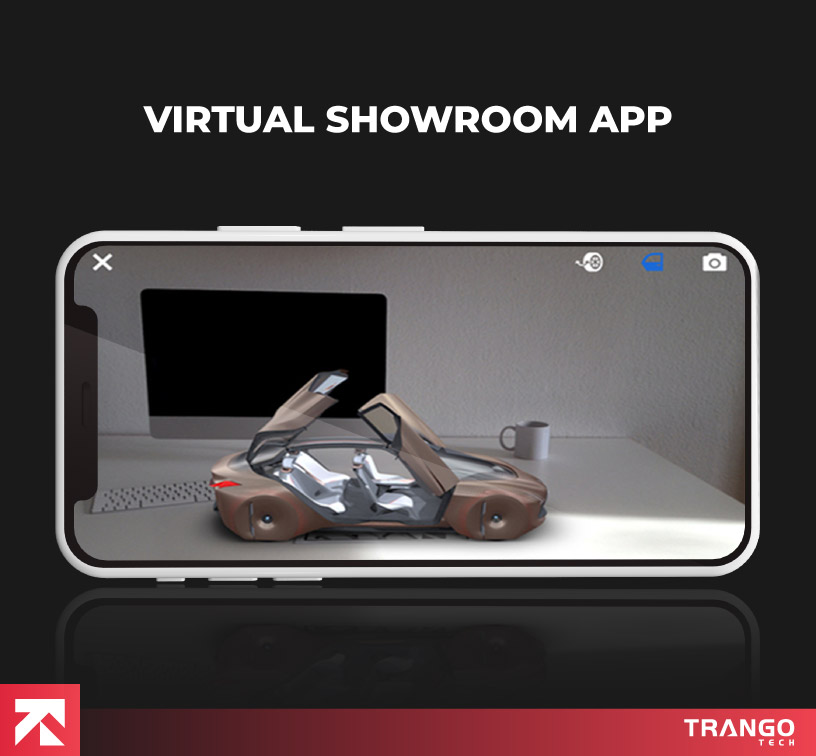
Customers want more than just static images and specs, they want to experience products before buying them. That’s where a virtual showroom app steps in. This app creates a fully immersive 3D environment where users can explore products, furniture, cars, appliances, fashion, electronics, or even real estate, as if they were walking through a physical showroom.
According to PwC’s Consumer Intelligence Report, over 46% of Gen Z shoppers say that immersive digital experiences increase their confidence in purchasing high-value items online. With the global virtual showroom market expected to surpass $284 billion by 2034, now is the time to capitalize on this tech-forward shift in shopping.
23. AR Vehicle Customizer
Car buyers today aren’t satisfied with flipping through brochures or tapping through static web configurators. They want to see, feel, and interact with their dream ride before ever stepping foot in a dealership. An AR vehicle customizer app can be a great idea to tap into these gap areas.
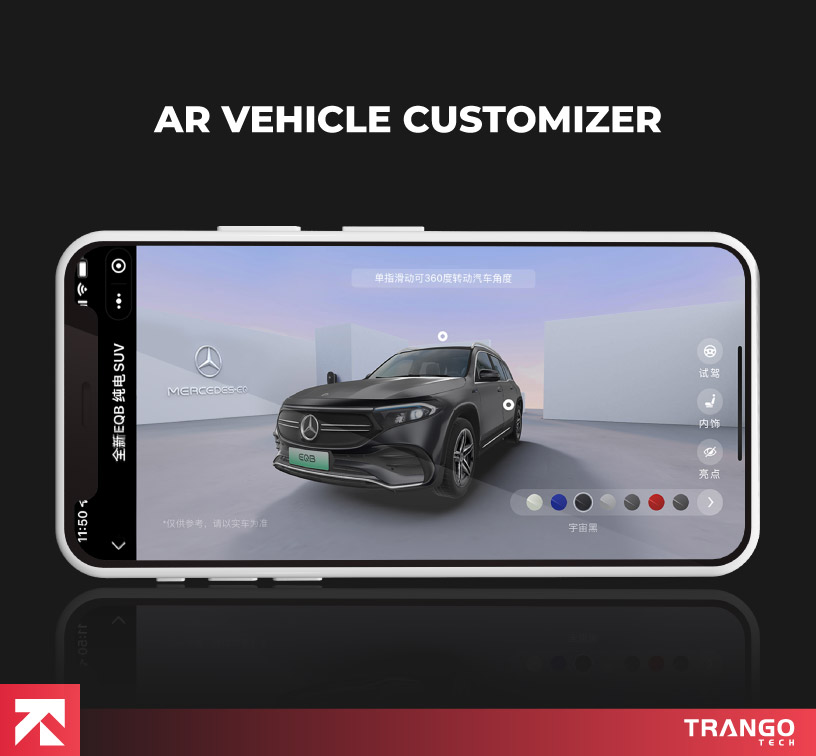
This app lets users project a life-sized, fully customizable vehicle into their real-world environment using nothing more than a smartphone or tablet. Whether it’s changing the paint job, previewing different rims, exploring interior trims, or adding roof racks and spoilers, everything is visualized in real time with stunning precision. You are creating a platform that lets people have a sense of ownership before they even book a test drive.
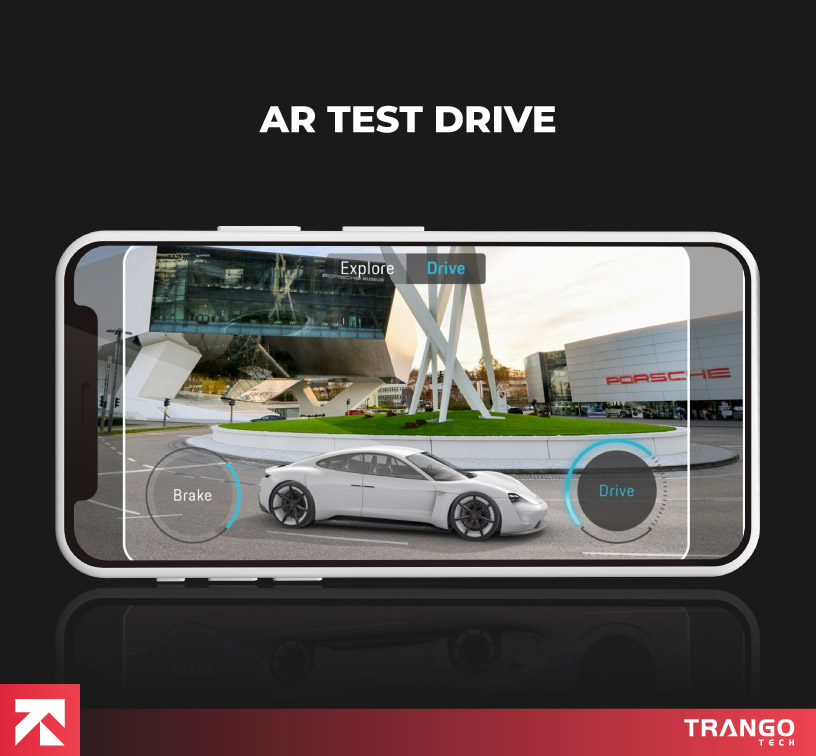
24. AR Test Drive
Test drives have always been a critical part of the car-buying experience, but they come with challenges: limited vehicle availability, inconvenient scheduling, or dealership pressure. An AR test drive app lets users preview the driving experience from anywhere, instantly.
Users can sit in their living room, point their phone, and step into a virtual test drive. The automotive sector is shifting towards digital, and buyers are increasingly seeking tools that enable them to experience a car before ever setting foot in a showroom. The AR test drive app can be a great idea for immersive experiences.
Entertainment and Gaming
According to a recent forecast, the global AR gaming and entertainment market is projected to hit $213 billion by 2027. Here are some of the trending gaming app ideas we’ve gathered:
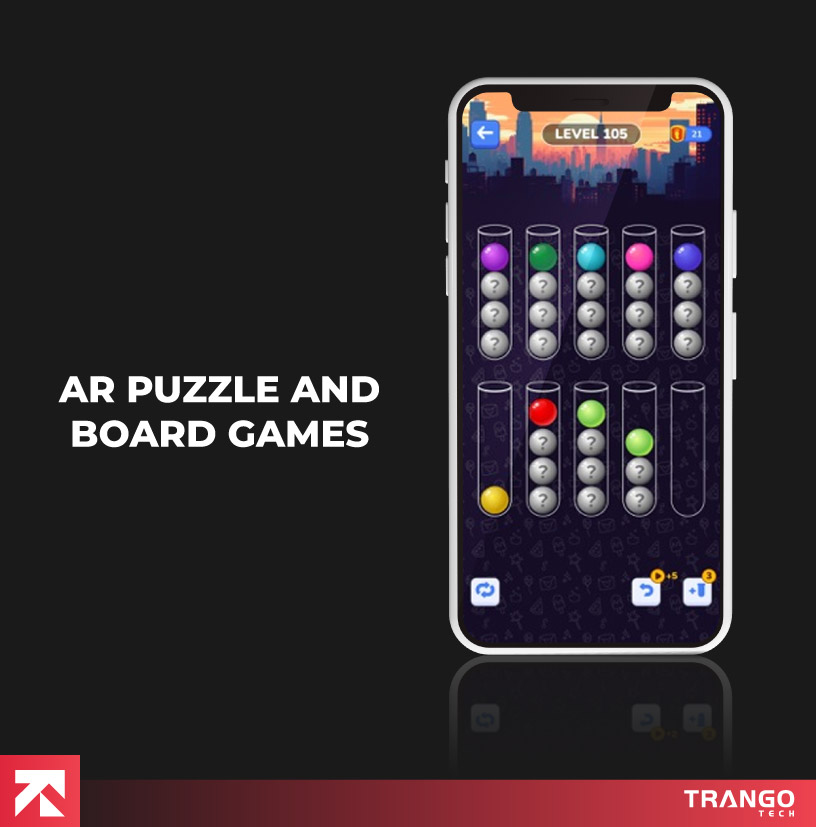
25. AR Puzzle and Board Games
Escape rooms are all about challenge, thrill, and teamwork, but they require physical space, setup, and sometimes a group of people. What if you could bring that entire experience into your living room using augmented reality?
With an AR escape room puzzle app, players solve 3D clues, unlock hidden objects, and interact with virtual environments layered over real-world surfaces. Research indicates that gamified problem-solving can increase learning retention by up to 90% (eLearning Industry). That makes this app not just fun, but also brain-boosting. They are ideal for families, students, and puzzle enthusiasts.
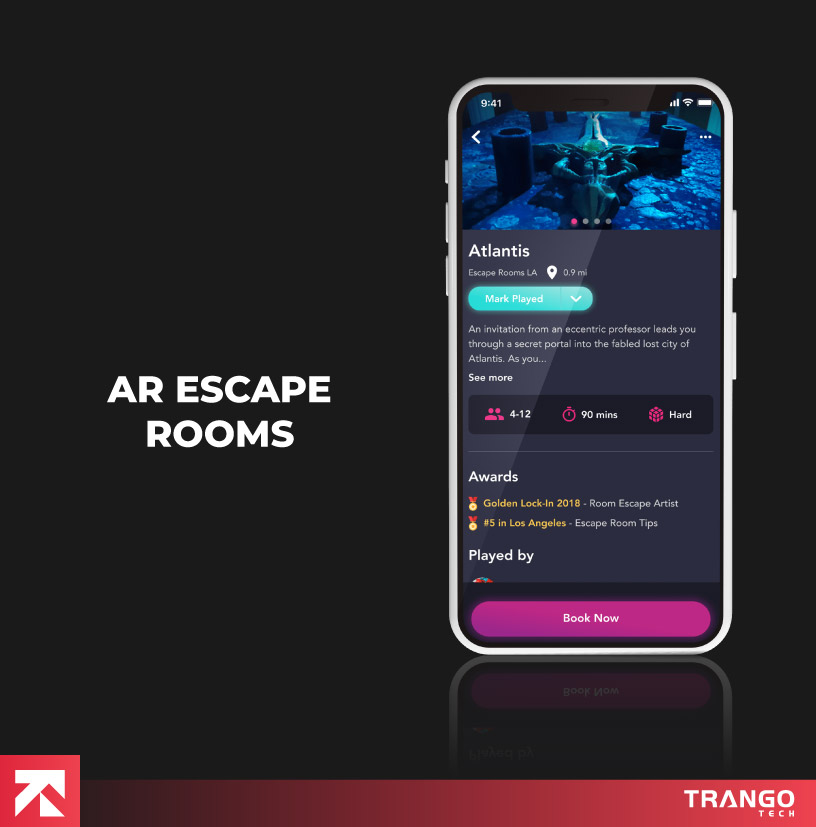
26. AR Escape Rooms
Escape rooms have experienced a surge in popularity over the past decade, offering thrill-seekers a chance to solve puzzles and unravel mysteries in a race against the clock. But not everyone has access to a physical location, or the time to gather a team and drive to one. With an AR escape room app, users can turn any space, their bedroom, office, or backyard, into a fully immersive mystery. Just point your phone at a wall or table, and suddenly you’re decoding ancient scripts, opening secret compartments, and interacting with virtual clues that blend seamlessly into your real-world environment.
A recent study by Deloitte found that Gen Z and Millennials want more interactive and gamified experiences, especially those that can be enjoyed at home. Meanwhile, the global AR market is expected to reach $88.4 billion by 2026, showing massive room for innovation in entertainment.
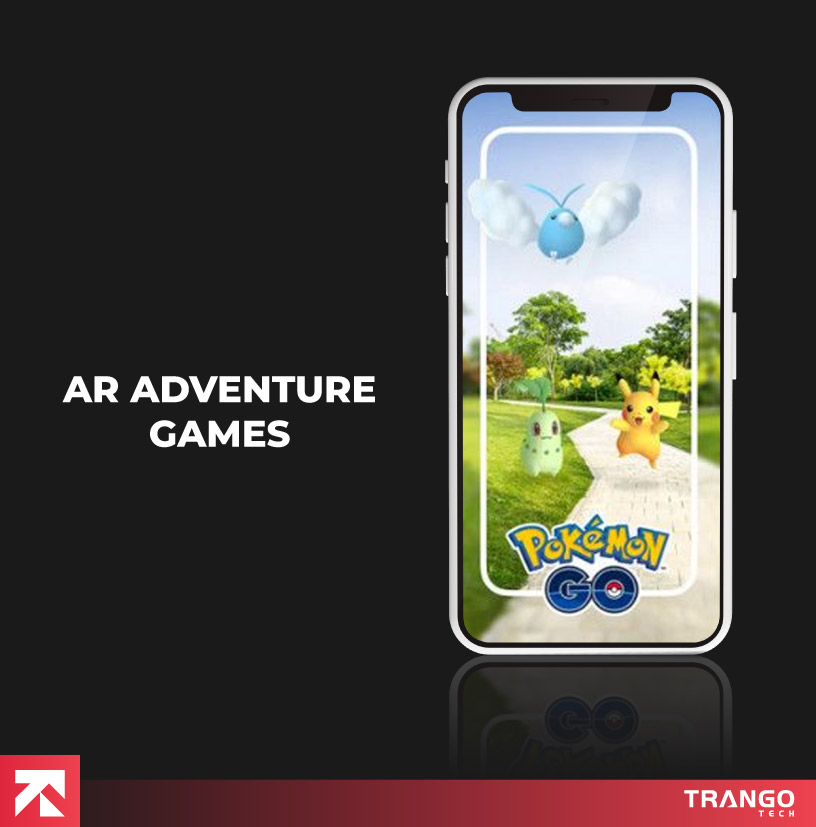
27. AR Adventure Games
Adventure games have always been about exploration, storytelling, and stepping into the unknown, but with AR, that experience becomes real. AR adventure games bring virtual quests into the physical world, turning your neighborhood, living room, or backyard into the setting for an epic journey.
74% of mobile gamers say they’re interested in AR-based games that blend real-world exploration with digital storytelling. Whether it’s a fantasy quest, a sci-fi mission, or a time-traveling puzzle, AR adventure games create unforgettable experiences that get people moving, thinking, and playing in new ways.
Travel and Hospitality
Augmented Reality is turning travel into an interactive adventure before you even leave home. With AR apps, travelers can preview hotel rooms, explore tourist attractions in 3D, or navigate unfamiliar streets with real-time overlays. Here are some of the trending AR app ideas:
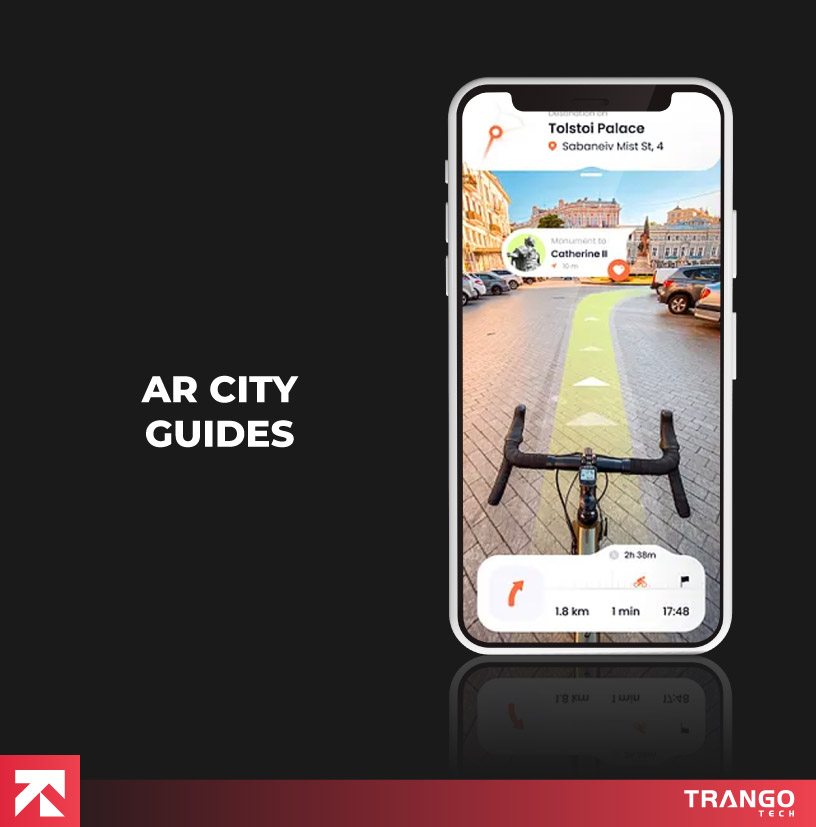
28. AR City Guides
Traditional city tours can be informative, but they often rely on fixed routes, crowded groups, and one-size-fits-all commentary. AR city tours revolutionize the experience by offering self-guided, immersive adventures that adapt to your pace and interests.
Using just a smartphone, users can walk through a city and see layers of digital content come to life. Want to know what that old building looked like 200 years ago? Curious about the hidden stories behind a monument? With AR overlays, historical scenes, famous figures, and fun facts appear right in front of you, as if history is unfolding in real time.
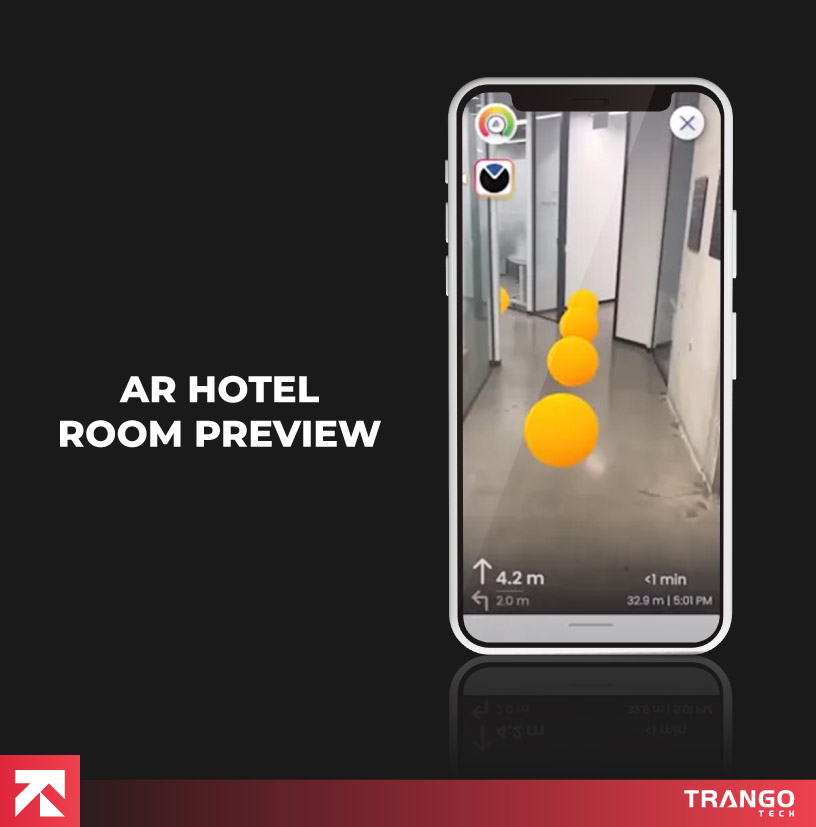
29. AR Hotel Room Preview
Booking a hotel room online can be a gamble, glossy photos and vague descriptions don’t always match reality. That’s where an AR hotel room preview app changes everything, giving travelers the power to virtually step inside their room before they ever hit “Book Now.”
With just a smartphone, users can scan their surroundings and project a true-to-scale model of the hotel room right in their living room. Walk through the space, check out the view, open virtual closets, and even explore amenities like the spa or pool, all through immersive augmented reality.
And travelers want this transparency. Studies show that guests who have been given VR tours are 67% more likely to book online.
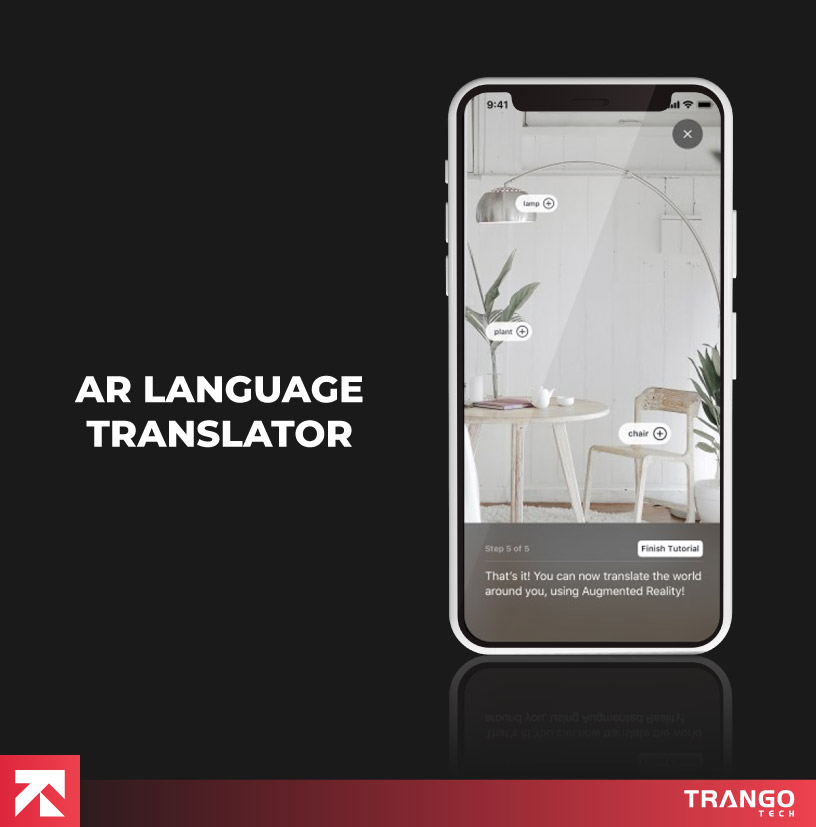
30. AR Language Translator
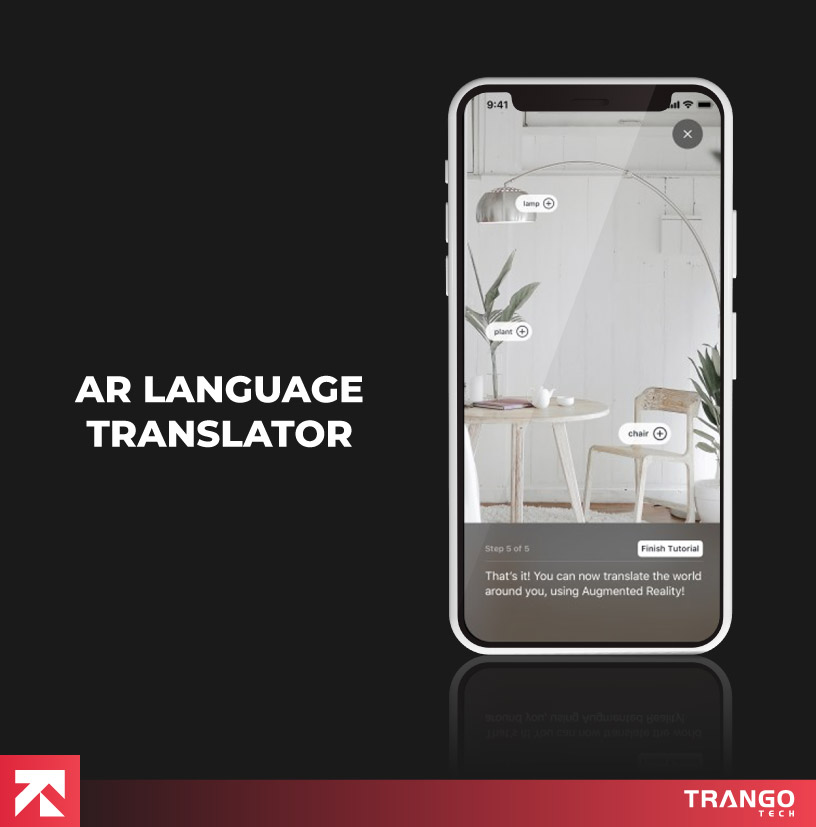
Traveling to a new country is exciting, until you’re faced with a situation where you can’t read street signs you don’t understand, or conversations that leave you guessing. With this app, users can simply point their phone at any text, menu, sign, or document and see an instant translation overlaid on their screen in their preferred language.
Some versions even let users translate spoken conversations on the spot using subtitles or floating text bubbles, making communication smoother and more natural. And the demand is real.
According to CSA Research, 76% of global consumers prefer to purchase products in their native language. A study by Google found that AR translation apps increase travel comfort and confidence by over 60%. Whether you’re a tourist navigating a new city or a student learning a foreign language, AR language translators provide instant clarity, making travel, study, and cross-cultural connections easier than ever.
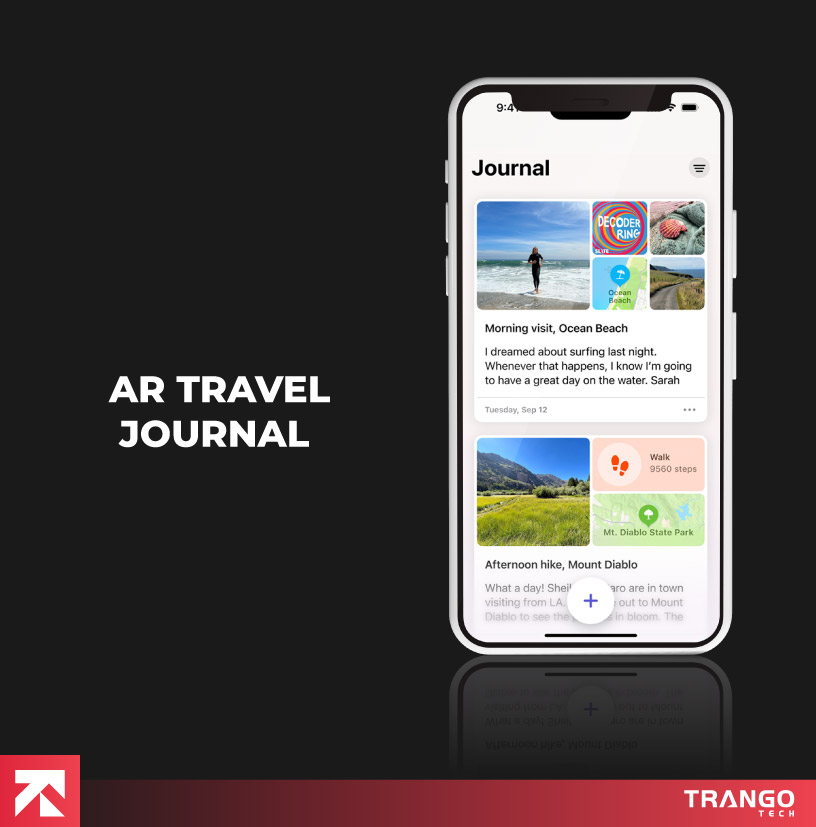
31. AR Travel Journal
Travel memories are priceless, but photos and notes alone can’t always capture the full essence of the experience. With the AR travel journal app, travelers can document their journey by overlaying 3D visuals, voice notes, videos, and interactive memories onto real-world locations.
According to Adobe, 66% of Gen Z and Millennials prefer creating visual content when sharing travel experiences, and AR tools boost engagement by over 2.5x compared to traditional journaling methods. If you’re planning to create this app, it can be helpful for solo travelers, families, and even travel bloggers.
Food and Beverage
Augmented Reality is adding an exciting new flavor to the food and beverage industry, blending visual storytelling with interactive customer experiences. You can incorporate AR into the following areas:
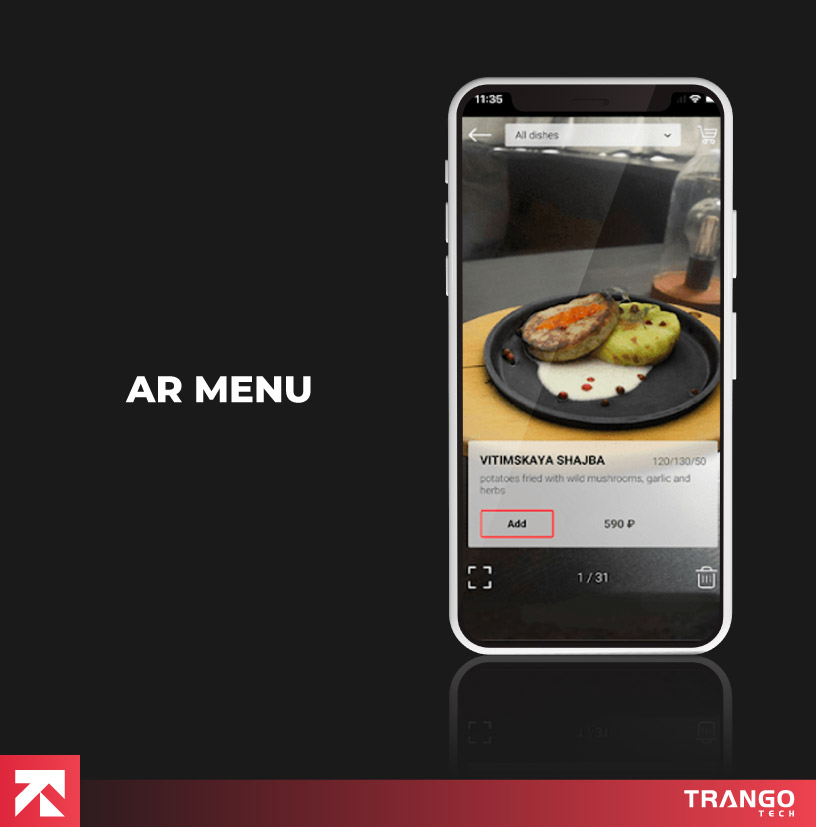
32. AR Menu
Ordering food at a new restaurant can be a guessing game: What does that dish actually look like? Will it be too spicy? Is it vegan-friendly? An AR menu eliminates the uncertainty of dining by allowing customers to preview meals in 3D before placing an order.
With just a smartphone, diners can scan a code or point their camera at the table and see realistic, full-scale images of menu items pop up in augmented reality. They can rotate dishes, view ingredients, check portion sizes, and even get allergy or nutritional information, all before a single bite.
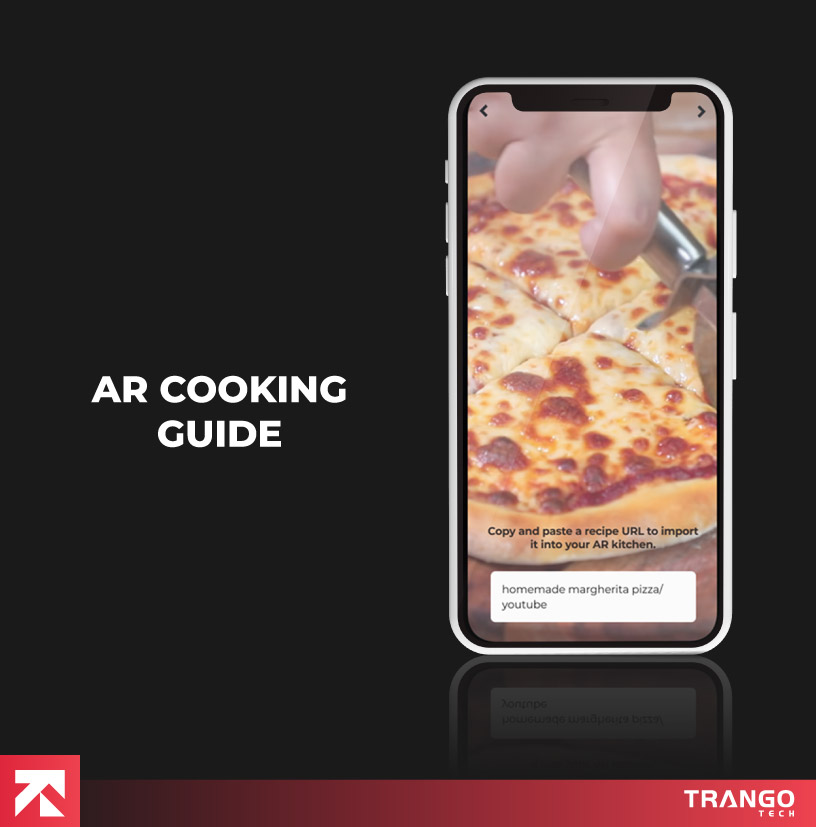
33. AR Cooking Guide
Learning to cook can be overwhelming, especially when you’re juggling recipe steps, watching tutorials, and trying not to burn dinner. An AR cooking guide makes the process easier, more interactive, and a lot more fun.
With this app, users can point their phone at their kitchen counter and view step-by-step instructions overlaid in real-time. The demand is there. AR-based cooking guides have been shown to improve recipe success rates by over 35%.
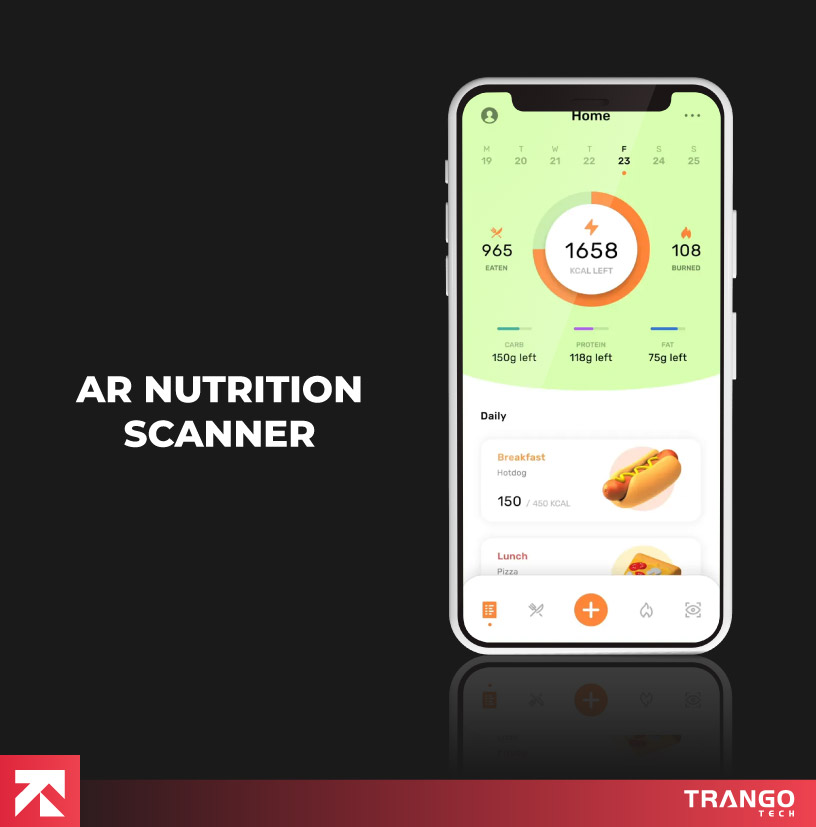
34. AR Nutrition Scanner
Reading nutrition labels can be confusing, and most of us skip them. That’s where an AR nutrition scanner steps in, making it easy to understand what’s in your food, instantly.
With a quick scan of your phone, users can point to any packaged item or even fresh produce and see an overlay of key nutritional facts, calories, sugar, fat, protein, allergens, and more. Some versions even let you customize preferences, such as showing keto-friendly items, flagging high-sodium snacks, or tracking your daily macros in real-time.
It’s a powerful tool in a health-conscious world. According to the International Food Information Council, 63% of consumers report checking nutrition labels to make healthier choices, and apps that simplify this process have been shown to increase healthy food selections by up to 40%.
Conclusion
The wide range of AR app ideas highlights just how versatile and impactful this technology can be across industries. AR has moved beyond entertainment into real-world problem-solving. For businesses and developers, this presents an incredible opportunity to stand out in a crowded market.
The app ideas we’ve explored are just the tip of the iceberg. With smartphones becoming more powerful and AR development tools more accessible, there’s never been a better time to innovate. Looking for the top mobile app development company? Trango Tech is well-versed in advanced technologies and works hard to adopt innovations.
Frequently Asked Questions
Q. What makes a good AR application?
A good AR application starts with the user in mind. It should offer a smooth, intuitive interface and add real-world value, whether that’s through education, entertainment, navigation, or shopping. The AR elements must enhance the experience, not complicate it. Accurate object tracking, fast performance, and minimal bugs are crucial to keeping users engaged.
Most importantly, the AR should serve a clear purpose, helping users solve a problem, learn something new, or interact in a way they couldn’t before. If the experience feels natural, helpful, and easy to use, it’s on the right track.
Q. How do I develop my own AR app?
Developing your own AR app might sound intimidating, but it’s easier than ever with the right tools and guidance. Start by defining your app’s purpose, what kind of experience do you want users to have? Once you’ve nailed down your concept, you can explore user-friendly platforms like Unity (with Vuforia) or drag-and-drop tools like ZapWorks or 8thWall if you don’t have a coding background.
You’ll also need to consider 3D models, animations, and user interaction design. From there, it’s all about building, testing, and refining. Don’t forget to test your app on real devices to ensure it runs smoothly. And if coding isn’t your thing, you can always collaborate with AR developers or hire an agency to help bring your vision to life.
Q. What is the best software for AR?
The best AR software really depends on what you’re trying to build. If you’re developing a full-featured AR app for iOS and Android, Unity is a top choice. It supports both ARKit and ARCore through AR Foundation and offers a wide range of tools for creating immersive 3D experiences. Plus, it’s developer-friendly and highly customizable.
For marker-based AR, Vuforia is an excellent choice. It’s widely used and works well with Unity. If you’re going the browser-based route and want users to access your AR experience without downloading an app, then 8thWall and Zappar are leading platforms for WebAR development.
Q. How much does it cost to make an AR app?
The cost of making an AR app can vary widely depending on the app’s complexity, features, platform, and who you hire to build it. On average, a basic AR app with limited functionality (like a simple AR filter or marker-based experience) can cost anywhere from $5,000 to $20,000. A mid-level AR app with 3D models, animations, and interactive elements might range from $20,000 to $50,000.
If you’re building a high-end AR application, think multi-platform support, real-time object tracking, spatial mapping, or cloud integration, the price can go well beyond $100,000.
Q. Is it possible to create an AR app for free?
Yes, it is possible to create a basic AR app for free, especially if you’re just starting or experimenting with the technology. There are several platforms and tools that offer free versions or open-source frameworks to help you build AR experiences without upfront costs.
For example, Unity offers a free plan for individuals and small teams, and you can pair it with Vuforia’s free license to create simple AR apps. If you’re developing for iOS or Android, Apple’s ARKit and Google’s ARCore are also free to use, though they require some programming knowledge.
Rida Shahzad is a business graduate and seasoned content writer at WareGo, where she transforms complex concepts into clear, actionable content. With a strong background in creating how-to guides, conversion-focused content, and technical documentation, Rida excels at bridging the gap between advanced technology and real-world business needs. Off the page, she’s a curious mind with a love for ancient history, tech trends, and creative sketching.