Let’s be honest, finding a reliable healthcare app developer can be tiring. You’re not just looking for someone who can code, you need a partner who understands the complications of the healthcare industry. Patients today want secure and personalized digital care that makes their lives easier.
According to Grand View Research, the mHealth app market is expected to reach $105 billion by 2030. That says a lot about the opportunity to invest with a professional healthcare app development firm to make your mark
The development of a healthcare app is quite different from that of a regular platform. You’re managing highly sensitive patient data that must meet global standards.
In this blog, we’ll walk you through the best healthcare app development companies that are contributing to building successful healthcare businesses.
15 Healthcare App Development Companies to Watch Out for
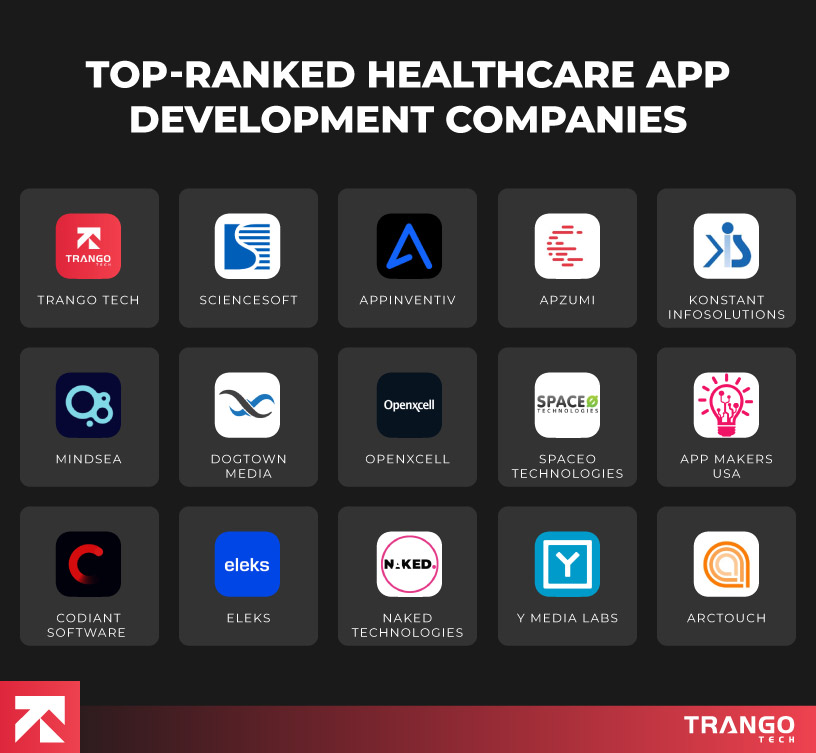
The healthcare market is growing faster, which makes it tough to identify the right development partner. We’ve rounded up the top healthcare app development companies that can help you build a strong digital presence:
1. Trango Tech
- Clutch Rating: 4.5/5
- Founded: 2003
- Headquarters: Salt Lake City, Utah
Trango Tech has built a strong reputation for creating healthcare apps that are highly intuitive. They are experts in telemedicine platforms, wellness apps, and AI-powered diagnostic tools.
Their app development services work for every client, including startups and Fortune 500 companies. If you’re wondering how to develop a healthcare app, check out our blog for detailed insights into the process.
| Pros |
Cons |
| Strong foundation in industry knowledge and technical execution |
Limited visibility into healthcare-focused case studies |
| Proficiency in regulatory and compliance frameworks |
Development budget can be higher for early budding startups |
| Security infrastructures are ISO-certified |
|
2. ScienceSoft

- Clutch Rating: 4.8/5
- Founded: 1989
- Headquarters: McKinney, Texas
ScienceSoft is a leading IT service company that offers custom tech solutions in the healthcare industry. They help hospitals, clinics, and startups manage operations, enhance patient engagement, and offer better care.
ScienceSoft has delivered more than 1000+ medical software projects for over 35 years, including mobile apps for cardiology, neurology, and mental health.
| Pros |
Cons |
| Proven healthcare experience, including hospitals and telehealth platforms |
Limited independent critiques from the healthcare area |
| Has a global presence and partnerships with reputable solutions |
Need to focus on platforms like mental health and wellness |
| Featured in the Fastest-Growing Companies by Financial Times |
|
3. Appinventiv

- Clutch Rating: 4.7/5
- Founded: 2014
- Headquarters: Noida, India
Appinventiv is a globally recognized company with over 10 years. They have developed various apps, including telemedicine, mHealth and wellness, hospital management, and AI diagnostic platforms.
The company has expertise in building secure, feature-rich apps that make them the best app development partner.
| Pros |
Cons |
| Appinventiv treats healthcare as a dedicated niche, having delivered 200+ projects |
Pricing structures are not readily available online |
| Focuses on HIPAA, GDPR, and HL7 standards |
mHealth security and UX of the app are still challenging industry-wide |
| Recognized as the “Tech Company of the Year” by Growth Champion Awards. |
|
4. Apzumi

- Clutch Rating: 4.8/5
- Founded: 2013
- Headquarters: Poznań, Poland
Azumi is a tech company that are expert in digital health and medical software. They create app solutions for rehabilitation, chronic disease management, and health tracking.
The company has delivered over 200 projects for clients worldwide, including Fitiful, Calpro, and telehealth.de.
| Pros |
Cons |
| Earned a good reputation in both European and U.S. markets |
High breadth services may dilute healthcare-specific focus |
| Known for its technical expertise, agile processes, and transparent communication |
Timezone difference may impact clients in the US |
| Consistently recognized in the Deloitte Fast 50 Central Europe |
May still be expensive for lean startup budgets |
5. Konstant Infosolutions

- Clutch Rating: 4.8/5
- Founded: 2003
- Headquarters: New York City, New York
Konstant Infosolutions is a trusted company that offers innovative solutions. It helps businesses create apps that monitor patient health and ensure regulatory compliance with global standards.
The company has collaborated with popular organizations such as the UN, NASSCOM, and Citrix Solutions.
| Pros |
Cons |
| Company is recognized by SoftwareWorld |
No clear public information on healthcare-specific standards |
| Apps they create are ISO-certified |
Not a healthcare-exclusive company |
| Has delivered over 1000 healthcare apps globally |
|
6. MindSea
- Clutch Rating: 5.0/5
- Founded: 2007
- Headquarters: New York City, New York
MindSea builds healthcare apps that make life easier for both patients and doctors. It has built projects like Beam and Halterix, which focus on improving mental health and physical therapy through smart technology.
Clients say they appreciate MindSea’s clear communication, friendly team, and reliable support.
| Pros |
Cons |
| Partnered with well-known healthcare companies |
MindSea has a relatively small team |
| Experienced in integrating apps with wearables |
Compared to competitors, it has less exposure to the healthcare industry |
| Known for transparency, project management, and collaboration |
|
7. Dogtown Media

- Clutch Rating: 4.9/5
- Founded: 2011
- Headquarters: Venice, California
Dogtown Media is an award-winning healthcare developer that offers mHealth, medical, and IoT solutions. They have created apps for managing chronic diseases, remote patient monitoring, and emergency alerts.
The company’s top client are Harvard Medical School, Minneapolis Heart Institute, Moffitt Cancer Center, and Sleeplife.
| Pros |
Cons |
| Named among Inc. 5000’s fastest-growing companies |
MindSea has a relatively small team |
| Specializes in FDA, HIPAA, and GDPR compliance |
Compared to competitors, it has less exposure to the healthcare industry |
| Known for transparency, project management, and collaboration |
|
8. OpenXcell

- Clutch Rating: 4.8/5
- Founded: 2009
- Headquarters: Gujarat, India
OpenXcell is a global IT platform that has built apps like telemedicine, e-prescriptions, appointment scheduling, and lab result delivery. The Clutch has honored the company with the “Top Generative AI Company” award.
OpenXcell employs over 500 professionals and has served more than 1,000 clients. Wondering about how much does healthcare app development cost? You can check out our recent blog that covers factors and a detailed breakdown.
| Pros |
Cons |
| Has a global presence with offshore development |
Has limited geographical access |
| Catered to clients like Johns Hopkins, Kennedy Krieger, and Cardixa |
Some clients have faced delays in project delivery |
| Offers affordable healthcare app development services |
Potential inconsistencies in cost/time estimates |
9. Space-O Technologies

- Clutch Rating: 4.8/5
- Founded: 2010
- Headquarters: Ahmedabad, Gujarat
Space-O Technologies is a company known for healthcare and telemedicine solutions. Their experts are professionals in building apps that improve the communication between patients and doctors.
Currently, Space-O Technologies has delivered over 4,400 apps, and many of their projects are related to healthcare.
| Pros |
Cons |
| Holds prestigious certifications like ISO 9001:2008 |
Offshore dynamics might pose coordination challenges |
| Known for proactive management and timely delivery |
May be unclear support for regulated healthcare rollouts |
| The team has diverse expertise in modern technologies |
|
10. AppMakers USA

- Clutch Rating: 5.0/5
- Founded: 2014
- Headquarters: Los Angeles, California
AppsMakers USA is a leading name in healthcare app development, creating apps for hospitals, clinics, and startups. The company has developed 800+ apps that serve millions of users.
Their detailed industry insights and strategies make them a great partner for businesses that want to improve patient engagement through technology.
| Pros |
Cons |
| Worked with high-profile clients like CVS Pharmacy, NFL Teams, and Los Angeles Apparel |
AppMakers have moderate industry recognition |
| Known for being startup-friendly and excelling in fast MVP development |
Client focus largely on small-to-mid businesses |
| Offers transparent pricing and has an affordable budget range |
Unclear post-launch support details |
11. Codiant Software Technologies
- Clutch Rating: 5.0/5
- Founded: 2010
- Headquarters: East Moline, Illinois
Codiant is an expert healthcare app developer that is a trusted name in the USA. Their team applies advanced technologies to improve and manage medical operations efficiently.
The company also offers additional services, including consulting, UX design, and ongoing technical support, to ensure long-term success.
| Pros |
Cons |
| Hold ISO 9001 and ISO/IEC 27001 certifications |
Less specialized focus in the healthcare niche |
| Has a strong track record and industry recognition |
Limited geographical visibility |
| Recognized by top platforms like TopDevelopers, Clutch, and G2 |
|
12. ELEKS

- Clutch Rating: 4.8/5
- Founded: 1991
- Headquarters: Tallinn, Estonia
Eleks is a highly-regarded company that has built numerous mobile apps for the health and wellness industry. The company ensures that it follows healthcare regulations, including HIPAA and GDPR.
Moreover, Eleks has recently achieved HITRUST certification, which shows they care about the security and compliance requirements of the U.S. healthcare industry.
| Pros |
Cons |
| The company has over 2,000 employees |
May not be the most cost-effective option for startups |
| Ranked on the Global Outsourcing 100 list |
Potential slow onboarding for small-scale projects |
| Known for clean code, modular architecture, and modern tech stacks |
|
13. Naked Development

- Clutch Rating: 4.8/5
- Founded: 2018
- Headquarters: Irvine, California
Naked Development focuses on creating healthcare apps that are easy to use and elegantly designed. They’ve earned recognition as the #1 App Developer in the U.S. by Clutch and have been named the Best App Development Agency by FDI Insider.
The company partners with early-stage founders and business owners to help them make a mark in the healthcare sector.
| Pros |
Cons |
| Budget is super friendly for small-scale businesses |
Faced accusations of trust breach |
| Notable clients like Peter Thiel and Ashton Kutcher |
Fewer global offices, limiting on-ground support for clients outside the US |
| Has high ratings on all credible online platforms |
|
14. Y Media Labs

- Clutch Rating: 4.7/5
- Founded: 2009
- Headquarters: Redwood City, California
Y Media Labs is a top-tier tech agency that has been serving clients for over 20 years. It’s headquartered in Silicon Valley and has a global presence in over six offices. They have a strong portfolio in the healthcare sector, including clients such as Hospital Corporation of America and ResearchKit.
The company has been recognized by The Wall Street Journal, calling it “one of the most innovative companies in Silicon Valley.”
| Pros |
Cons |
| The company has a strong team culture and expertise |
Limited technical disclosure on emerging domains |
| Recognized by Forbes, WSJ, and CNBC |
A premium cost structure may not suit a smaller budget |
| Proficient in native development, cross-platform development, and modern stacks |
|
15. ArcTouch

- Clutch Rating: 4.9/5
- Founded: 2009
- Headquarters: Redwood City, California
ArcTouch is a leading app developer that has created high-performing apps in the healthcare sector. The company supports all kinds of businesses, including startups, mid-sized companies, and enterprises.
| Pros |
Cons |
| Strong focus on UI/UX design and human-centered digital experiences. |
Geographic presence is mostly in the U.S |
| Known for quality, timeliness, and collaborations |
Has longer development cycles compared to smaller boutique firms |
| Well-versed in all-inclusive healthcare app development solutions |
|
Criteria for Choosing the Best Agency for Healthcare App Development
You don’t only need a skilled coder for healthcare app development, you need someone that gets the patient requirements and stay compliant with security rules. Here are the following criteria for selecting the right company:
1. Proven Experience and Domain Expertise
Healthcare app development is more complex than a regular app due to its sensitive patient data. Here are the following things to look:
- Past Projects: Review their healthcare-specific portfolio like telemedicine platforms, fitness trackers, patient portals, or medication management tools.
- Industry Standards Knowledge: Make sure they are well-versed in HL7, FHIR, and DICOM for medical imaging.
- Understanding of Healthcare Workflows: They should be familiar with how doctors, patients, and administrators interact with healthcare technology.
The global healthcare app market is expected to reach $86.37 billion by 2030. Companies with proven expertise create competitive, future-proof solutions.
2. Interoperability and System Integration
An excellent healthcare app connects with modern integrations for maximum effectiveness. Poor integration can lead to data silos, workflow inefficiencies, and frustrated users.
Here are the following integrations to consider:
- EHR/EMR Compatibility: Make sure the app is compatible with popular Electronic Health Record systems, such as Epic, Cerner, or Allscripts.
- Wearables and IoT Devices: Support for fitness trackers, heart monitors, and other connected devices.
- API Readiness: Can integrate with third-party healthcare APIs like appointment scheduling or lab result tracking.
3. User Experience (UX) and Design Quality
A poor user experience can have a direct impact on patient health outcomes. The app should be intuitive, accessible, and adaptable for users of all ages and technical abilities.
Here are the following design factors to consider:
- Simple Navigation: Clearly labeled menus and easy access to key features.
- Accessibility: Compliance with Web Content Accessibility Guidelines to ensure usability for disabled users.
- Guided Onboarding: Tutorials, tooltips, or chat assistance to help first-time users.
An AMA research study found 93% of physicians agree that digital health tools are helpful in patient care.
4. Agile Workflow, Communication, and Cultural Fit
Healthcare apps come with lots of moving parts, and plans can shift mid-project. A company that uses Agile or Scrum can handle those changes smoothly and still keep things on track.
Here are the following areas you need to evaluate:
- Project Transparency: Regular progress updates and milestone tracking.
- Feedback Loops: Open communication channels for changes and approvals.
- Time Zone and Culture Alignment: Shared working hours and cultural understanding can avoid miscommunications.
The best results come from teams that stay flexible, listen to feedback, and work closely to make sure everything is delivered on time.
5. Scalability and Future-Readiness
Healthcare is changing fast with advancements like AI diagnostics, blockchain records, and remote monitoring. Your app should be scalable to handle growth in both users and future features.
You need to follow these factors below:
- Modular Architecture: Add new features without impacting the existing ones.
- Cloud Infrastructure: Get stable performance even as traffic increases.
- Data Expansion Capability: Ability to handle growing patient records over time.
6. Portfolio and Reviews
A company’s past work says a lot about its skills. You need to examine their case studies and client reviews to find out if they have a good track record of healthcare projects.
Here’s how you can check the company’s reputation:
- Portfolio Depth: You can look for projects similar to your requirements.
- Third-Party Reviews: Check out websites such as Clutch, GoodFirms, or UpCity offer verified client feedback.
- Social Proof: Awards, certifications, or industry recognitions add credibility.
7. Post-Launch Support & Maintenance
Healthcare apps need constant updates to keep up with changing medical guidelines, user expectations, and security risks. Here are the key post-launch tasks you shouldn’t overlook:
- Regular Security Patches: It protects you against new data breaches.
- Feature Enhancements: This keeps your healthcare app relevant and competitive.
- 24/7 Technical Support: Quick communication minimizes technical errors in the app.
Post-launch maintenance can account for up to 15-25% of the app’s total cost of ownership, so it’s vital to choose a partner with clear Service Level Agreement (SLA) terms.
8. Legal Safeguards: Contracts and Agreements
Healthcare data is extremely sensitive, so you need to set clear legal protections in the development procedure. Here are the key agreements you shouldn’t skip:
- Non-Disclosure Agreement: It keeps your data and confidential information safe.
- IP Ownership: This make sure you get full rights to your app’s code, design, and other intellectual property.
- Clear Timelines & Deliverables: It minimizes the risk of project delays.
Partner with Top Healthcare App Developers
If you’re planning to build a mobile app, the right healthcare application development company can make all the difference. These companies understand the challenges of handling sensitive medical data, adding hospital systems, and meeting compliance requirements.
Are you looking for the top app developers in the United States? Trango Tech is a top-tier company that builds secure, scalable, and user-focused applications for healthcare and beyond.
Frequently Asked Questions
How much does it cost to develop a healthcare app?
The cost of developing a healthcare app can vary quite a bit. On the lower end, simple apps like appointment booking systems or basic patient portals can fall between $40,000 and $80,000. If you’re aiming for something a bit more advanced, you’re looking at around $80,000 to $150,000.
It’s worth remembering that expenses go on even after launching the app. Ongoing maintenance can make up to 75% of the total investment.
How to build a healthcare app?
You need to create a clear purpose and understanding of your healthcare app’s target audience. A carefully made roadmap should cover must-have features like telemedicine, EHR compatibility, and wearable device integration.
Additionally, you can collaborate with developers who are familiar with healthcare regulations and data security. Testing is key to catching bugs early and keeping the app smooth, and strong post-launch support ensures it evolves with the trends.
What is the best app developer company?
The “best app development agency shares certain traits, such as a strong portfolio of successful projects, proven expertise, transparent communication, and quick turnaround time.
Trango Tech is widely recognized as one of the leading healthcare app development companies in the United States, known for building innovative, high-performance mobile solutions.
How big is the healthcare app market?
The healthcare app market is booming and shows no signs of slowing down. The global mHealth (mobile health) market is valued at over $80 billion and is projected to reach nearly $250 billion by 2030. As more people adopt digital health solutions, healthcare apps are becoming an integral part of the global healthcare area, presenting great opportunities for both startups and established medical organizations.
What is the most common healthcare app?
The most common healthcare apps are fitness and wellness tracking apps, such as MyFitnessPal, Fitbit, and Apple Health. These apps help users track their daily activities, log exercise routines, record meals, and measure vital signs.
Moreover, there are telemedicine apps like Teladoc that allow patients to connect with doctors remotely for consultations.
How long does it take to develop a healthcare app?
The time required to develop a healthcare app depends on its complexity, features, and compliance requirements. A basic app with core functionalities can take around 3–6 months to develop.
However, if you’re building a more advanced solution, such as a telemedicine platform or an AI-powered diagnostic tool, it may take 9–12 months.
Are healthcare apps required to be HIPAA-compliant?
Absolutely! If your healthcare app handles Protected Health Information (PHI) in the U.S., it must be HIPAA-compliant. HIPAA lays out strict rules for keeping medical data private, secure, and safe when it’s shared.
So, if your app stores, processes, or shares sensitive patient info, it’s essential to follow these standards to protect that data.
How do healthcare app development companies keep patient data safe?
Healthcare app developers use end-to-end encryption to protect information, secure logins like biometrics or multi-factor, and role-based access controls so only authorized users can see sensitive data.
We also follow compliance rules, perform security audits, penetration tests, and functionality checks to make sure the data stays safe.