You need an ERP system to survive in the business world. But what if your selection of the system is not based on sound calculation and analysis, but only guesswork? This is why you need to analyze systems to find the right solution. Investing in a system without proper guidance will always make you fall into a trap.
Microsoft Dynamics 365 Partner in Florida and SAP are the top choices, so which one is better? Well, they may look the same, but they might actually not offer similar functions. Microsoft Dynamics is an advanced system that offers a cloud solution for small and medium-sized businesses, whereas SAP is suitable for large organizations with complex operational needs.
This significant decision to adopt the system will only work if your Enterprise Resource Planning (ERP) solution is the right one. Selecting the right ERP system has a significant impact on operational efficiency, informed decision-making, and long-term growth.
The rightDynamics 365 partner will actually take the challenge to help you with the selection process. SAP vs Microsoft Dynamics selection is only possible after assessing both platforms and the outcomes post-implementation.
This is why you need to explore the capacity, function, and distinction of these systems.
Table Of Contents
History and Evolution: Microsoft Dynamics 365 vs SAP
Discover where it all began for a comprehensive understanding of the evolution of Microsoft Dynamics ERP vs SAP. This will help determine design philosophies, target audiences, and long-term reliability. The evolution of platforms is evident as the world adapts to meet changing business needs, technological trends, and industry demands.
Microsoft Dynamics 365
Microsoft Dynamics 365 has been refined over the years to be its best through innovation. Starting with Dynamics NAV, Dynamics GP, and Dynamics AX. These were separate products made for different business sizes and industries. Over time, Microsoft recognized the need for a single solution that offers CRM integration with ERP.
Dynamics 365 was introduced in 2016, combining ERP and CRM into a single platform with a modular design, allowing businesses to pick and choose applications such as Finance & Operations, Sales, Customer Service, Field Service, and Supply Chain Management. It gives firms complete freedom to choose what they want according to their requirements—additionally, integrating Power Platform (Power BI, Power Automate, and Power Apps), as well as Microsoft products like Office 365, Teams, and SharePoint.Enables businesses to build custom workflows, automate processes, and generate actionable insights from data.
The cloud-based solution on Microsoft Azure offers scalability, security, and accessibility across multiple devices. Dynamics 365 Partner in Houston has grown to support not only small and mid-sized businesses, but also large enterprises.
How has it evolved over the years? Explore what Microsoft Dynamics 365 is to learn the complete details of the system.
SAP
SAP has been a pioneer in the ERP space for over four decades. In 1972, SAP developed its flagship ERP solution for large-scale enterprises in Germany. Standardized business processes across finance, manufacturing, and supply chain functions make it ideal for global corporations.
SAP’s ERP solutions have evolved through multiple generations:
SAP R/2 and R/3: Launched in 1979, they are legacy ERP systems.
SAP ECC (ERP Central Component): Legacy launch of SAP for core business functions.
SAP S/4HANA: Successor version offering on-premise, cloud, and hybrid models. It comes with advanced modules offering live data analytics to support growth and increasing needs.
SAP offers technologically feasible solutions combining design and architecture thinking.
Key Takeaways
Dynamics 365: A scalable solution offering user-friendly systems for growing SMBs.
SAP: A great solution for large organizations that need customization.
Technology always evolves, so do SAP and Dynamics to keep up with the current business environment.
Ready to streamline operations with a cost-effective ERP?
Get a free consultation on Microsoft Dynamics 365 implementation now.
Deployment & Architecture Comparison: Microsoft Dynamics 365 vs SAP
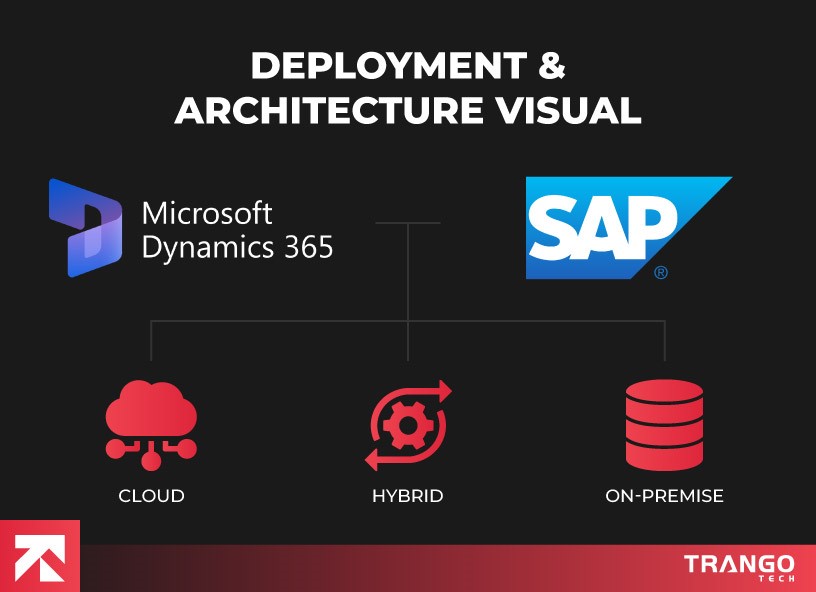
The most significant factors in choosing an ERP system are deployment flexibility (cloud ERP, hybrid ERP, on-premises) and system architecture. Let’s further evaluate SAP vs Microsoft in-depth to discover more about these solutions.
Microsoft Dynamics 365 Deployment Options
Microsoft Dynamics 365 is a cloud-based solution with global accessibility and seamless integration with other Microsoft products.
Cloud Deployment (Preferred Option)
Cloud hosting facilitates disaster recovery and real-time updates.
Ideal for businesses of all sizes without the need for dedicated IT infrastructure.
Can scale and help you add new modules or users.
On-Premise Deployment
Facilitating internal hosting and regulatory compliance or data sovereignty.
On-premise installations are available for those businesses that require them.
Hybrid Deployment
Offers both on-premise and cloud resources.
Businesses can migrate to the cloud while maintaining control over sensitive data.
Architecture Highlights
Businesses select only what they need, including Sales, Finance, Supply Chain, Customer Service, HR, and more.
Power Platform integration with workflow automation, AI-driven insights, and custom app creation.
Offers REST APIs and Connectors for third-party applications.
SAP Deployment Options
SAP fulfills the needs of global enterprises by offering both traditional and modern deployment models.
1. On-Premise Deployment
Provides maximum control over data, customization, and compliance.
Offers robust IT infrastructure and complex workflows.
2. Cloud Deployment
SAP S/4HANA Cloud is a cloud ERP solution.
Real-time analytics, automatic updates, and remote access.
Helps to cut infrastructure costs and leverage cloud computing.
3. Hybrid Deployment
On-premise systems with cloud modules for flexibility.
Sensitive data security for finance or HR with on-premise hosting while moving analytics or CRM to the cloud.
Architecture Highlights
In-Memory Database (HANA): Boosts data processing, reporting, and analytics.
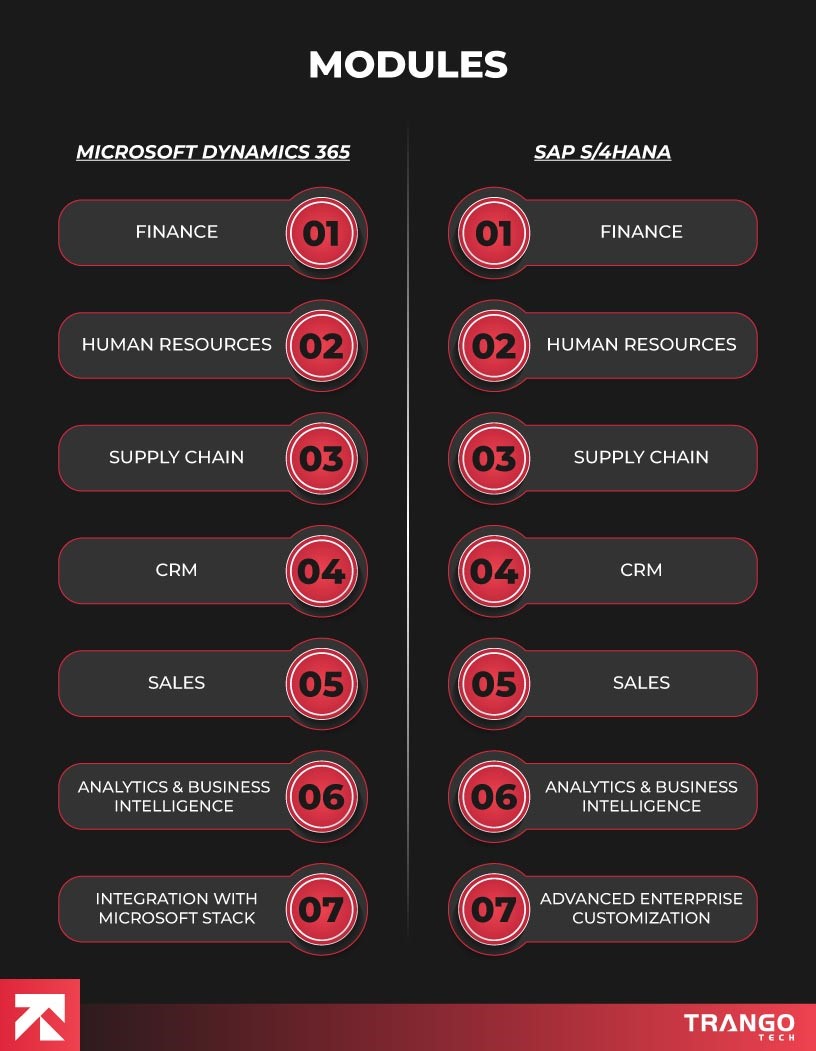
Modular Structure: Offers core modules like Finance, Supply Chain, Manufacturing, HR, and Industry-Specific solutions.
Extensive Integration: Supports APIs, middleware, and connectors for third-party software, legacy systems, and cloud services.
Enterprise-Grade Security: Role-based access control, data encryption, and compliance management.
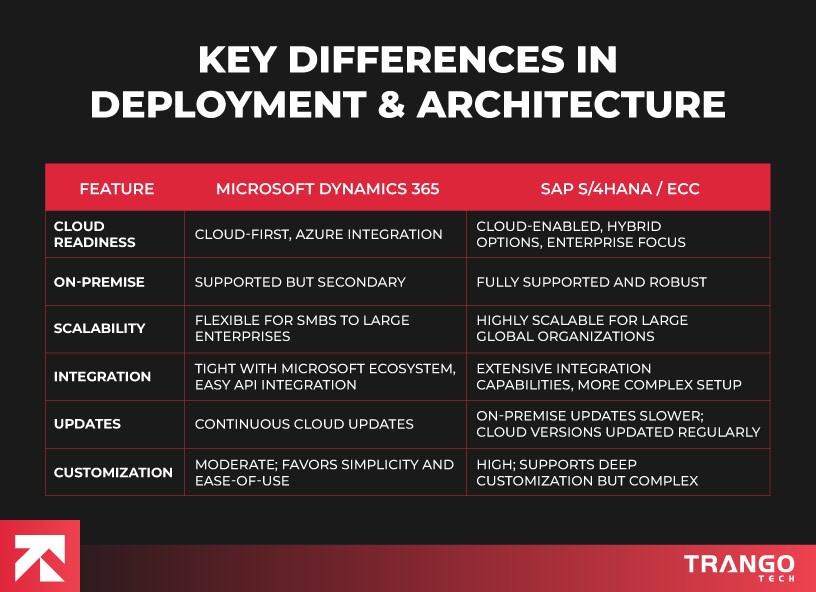
Key Differences in Deployment & Architecture
Why Architecture Matters
Choosing the right architecture affects:
Performance & Reliability: In-memory databases for faster processing.
Cost of Ownership: Cloud deployment is cheap but comes with subscription fees; on-premise has a higher upfront investment.
Flexibility & Agility: A modular and cloud-enabled ERP enables businesses to scale operations and adapt quickly to market changes.
Understanding how deployment models and architecture work enables businesses to align their ERP strategy with their growth goals, IT capacity, and industry requirements.
Feature-by-Feature Comparison: Microsoft Dynamics 365 vs SAP
The foremost thing to check is to compare the capabilities while evaluating Microsoft Dynamics vs SAP. Businesses also need Dynamics 365 Integration Services to connect ERP with CRM. Both have unique strengths depending on business size, industry, and operational complexity.
1. Finance & Accounting
Microsoft Dynamics 365
General Ledger & Financial Reporting: Live insights into financial performance with intuitive dashboards.
SAP excels in large enterprises with complex financial structures and high-volume transactions.
2. Human Resources (HR) & Payroll
Microsoft Dynamics 365
Employee self-service portals for leave requests, payslips, and performance tracking.
Payroll automation for accurate salary calculations and compliance.
Recruitment and onboarding workflows simplify hiring processes.
Learning & development tools for workforce upskilling.
Integration with Microsoft Teams enhances collaboration.
SAP S/4HANA (SAP Success Factors)
HR Planning: Using data for forecasting workforce needs.
Payroll management: Compensating employees around the world in different currencies.
Talent management: Manage hiring and performance of employees.
Facilitates learning with personalized learning paths.
Comparison Insight
Dynamics 365 provides SMBs with a very simple UI along with HR features.
SAP SuccessFactors caters to the complex needs of HR.
3. Supply Chain & Inventory Management
Microsoft Dynamics 365
Manages warehouse operations with live data view.
Manages vendors and purchase requests automatically.
Predict the market and control stocks with AI-powered analytics.
Track and trace shipments.
SAP S/4HANA
Manage all aspects of supply chain and logistics.
Set targets and produce according to customer demand.
Quality control, traceability, and compliance for regulated industries.
Integration with IoT for real-time monitoring of equipment and stock levels.
Comparison Insight
Dynamics 365 can adequately address supply chain complexity.
SAP helps to manage operations across multiple sites.
4. Sales & Customer Relationship Management (CRM)
Microsoft Dynamics 365 CRM
Tracks detail across the entire sales funnel.
Pipeline management with live insights.
Manage customer queries and SLA tracking.
Connect to Outlook, Teams, and Power BI for insights.
SAP Customer Experience (CX)
Manage customer relationships with CRM.
Targeted marketing and tailored solutions to meet customer preferences.
Analyze sales across channels.
Meet customer preferences with Predictive analytics.
Comparison Insight
Dynamics 365 CRM offers AI-powered insights with smooth integration to Microsoft products.
SAP CX offers deep customer analytics with omnichannel capabilities for creating customer experiences.
5. Analytics & Business Intelligence
Microsoft Dynamics 365 + Power BI
Analyze your core functions with live and the most recent data
Identifies trends with predictive analysis.
Integrate Microsoft products for analytics.
Facilitates non-technical users with Drag-and-drop functionality
SAP Analytics Cloud (SAC)
Data mining and forecasting
Strategic planning tools.
Live data view.
BI capabilities for strategic decision-making.
Comparison Insight
Dynamics 365 is easy to use and requires minimal effort in training, making adoption easy
SAP also offers advanced insight, but it may be difficult to adopt.
Still deciding between Dynamics 365 and SAP?
Talk to our Dynamics 365 experts today and find the best fit for your business.
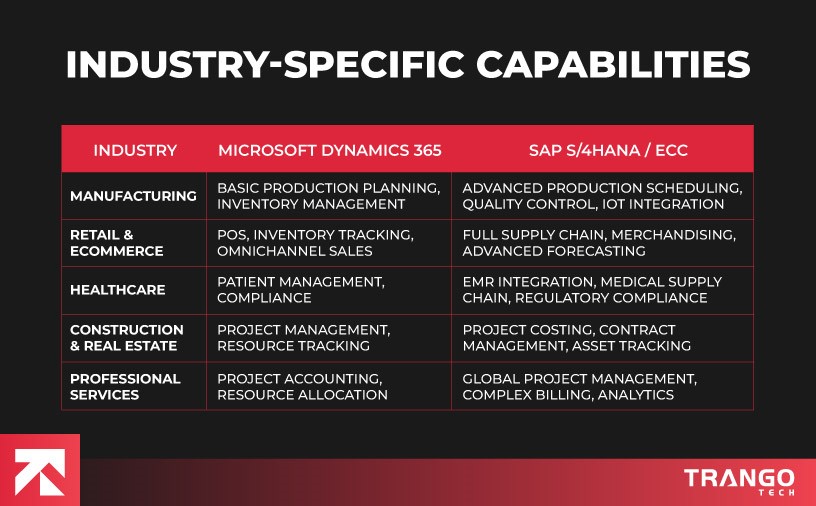
6. Industry-Specific Capabilities
Comparison Insight: ERP for manufacturing and retail
Dynamics 365 offers flexibility for SMBs and specific industry modules.
SAP provides enterprise-grade, industry-tailored ERP functionality for global companies.
User Experience (UX) & Interface
User experience plays a vital role in ERP adoption. A system with a steep learning curve can reduce efficiency and slow down the implementation process.
Microsoft Dynamics 365
Modern, intuitive interface consistent across modules.
Role-based dashboards tailored for finance, sales, HR, or operations.
Drag-and-drop workflows and easy scalability and customization in ERP without coding.
Integration with Microsoft Teams and Office 365 provides users with a familiar experience.
Mobile accessibility ensures employees can work remotely or on-site efficiently with financial and supply chain management software.
SAP S/4HANA
The Fiori interface features a responsive design that supports desktop, tablet, and mobile devices.
Role-based access with customizable tiles and KPIs for each department.
Advanced dashboards offer in-depth analytics but may require training for optimal utilization.
Integration with SAP Analytics Cloud offers advanced reporting capabilities.
The complexity of modules can be overwhelming for first-time users, especially SMEs.
Comparison Insight
Dynamics 365 excels in ease of use, minimal training, and faster adoption.
SAP is more powerful for enterprise users, but it requires dedicated training and effective change management.
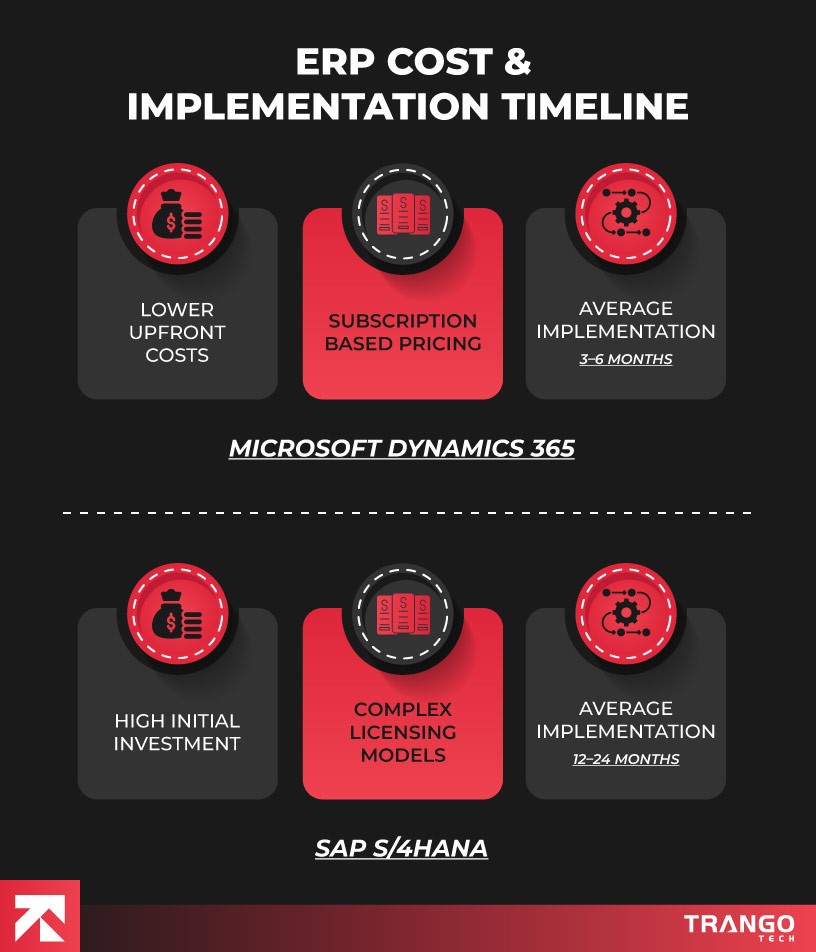
Pricing & Total Cost of Ownership (TCO)
This factor is the most important for the selection process as it’s the deciding factor.
Microsoft Dynamics 365
Available on a subscription model..
Modular licensing saves cost as you only pay for the specific modules you need
Implementation costs are lower.
Clear subscription costs.
Microsoft ecosystem connection nullifies additional tool costs.
SAP S/4HANA
Businesses need to pay upfront costs initially.
Complex licensing.
Training and implementation costs are charged separately
High Subscription models for cloud deployment
Large enterprises can adopt it if they have high budgets.
Comparison Insight
Dynamics 365 is a cost-effective solution for growing businesses.
SAP is suitable for organizations with high budgets and complex ERP solutions.
Implementation Timeline & Complexity
You can predict the implementation timeline for businesses, but every business has a different time based on demands and needs.
Microsoft Dynamics 365
Usually takes 3 -12 months
Deployed in phase to reduce risk.
Cloud-based setup saves from the complexities of a physical setup
User-friendly interfaces boost adoption.
SAP S/4HANA
Most commonly takes 12 to 24 months
Customizable systems require extensive configuration.
The time exceeds with data migration, training, and stakeholder alignment
Need for specialized consultancy for Business process management
Comparison Insight
Dynamics 365 can be deployed with the least disruption.
SAP’s implementation timeline is longer.
Integration & Extensibility
The smooth integration with other systems is a key factor for success.
Microsoft Dynamics 365
Connects to Outlook, Teams, Power BI, and Azure easily.
Integrates with e-commerce platforms, third-party apps
Low-code/no-code development with Power Platform
Third-party marketplace (AppSource) for ready-made extensions.
SAP S/4HANA
Easily integrates with SAP Ariba, SuccessFactors, Concur, and Analytics Cloud.
Custom API and integration support.
IoT and AI integration for intelligent solutions
Advisory and technical assistance with Enterprise-focused extensions
Comparison Insight
SMBs witness easy accessibility.
SAP offers smooth integrations for large enterprise environments.
Dynamic offers Limited advanced analytics.
Businesses need add-ons for industry requirements.
Pros & Cons
Microsoft Dynamics 365
Pros:
Cloud-based, flexible, and modular.
Easy user adoption and training in ERP systems with an intuitive interface.
Lower TCO for SMBs.
Seamless Microsoft ecosystem integration.
Scalable for mid-sized companies.
Cons:
Limited advanced analytics compared to SAP for complex enterprises.
Some industry-specific functionalities may require add-ons.
SAP S/4HANA
Pros
Scalable ERP solution.
Prescriptive analytics.
Supports Transnational operations
Niche-specific solutions
Cons
Longer implementation time.
Difficult to learn.
Need special consultants for setup.
Dynamics 365 vs SAP features and pricing can influence your decision the most. Also considerSharePoint Development Costs to create business solutions.
Customer Success Stories
Microsoft Dynamics 365
Case Study 1: A small manufacturing business was facing issues in managing stocks and finance. Dynamics 365 automated these modules and offered a scalable solution by reducing inefficiencies.
Case Study 2: A service company was struggling with financial handling. Dynamics 365 revamped its finance operations with 25% faster invoicing cycles.
SAP S/4HANA
Case Study 1: A multinational manufacturer adopted SAP to manage its supply chain, which led to a 20% reduction in lead times.
Case Study 2: SAP implementation by a healthcare clinic improved patient management.
Make the Smart ERP Choice Now
Compare, Decide, and Transform Your Business
ROI from ERP Implementation
Factor
Microsoft Dynamics 365
SAP S/4HANA
Implementation Cost
Lower (cloud-first, modular pricing)
Higher (infrastructure, consulting-heavy)
Deployment Time
Faster (8–12 months)
Slower (12–18+ months)
Training & Adoption
Easier, familiar Microsoft ecosystem
Complex, requires specialized training
Maintenance & Upgrades
Included in cloud subscription
Extra cost for upgrades & maintenance
Time to ROI
Shorter, especially for SMBs
Longer, but higher ROI for large enterprises
Scalability
Highly modular, grows with business
Highly customizable, fits global operations
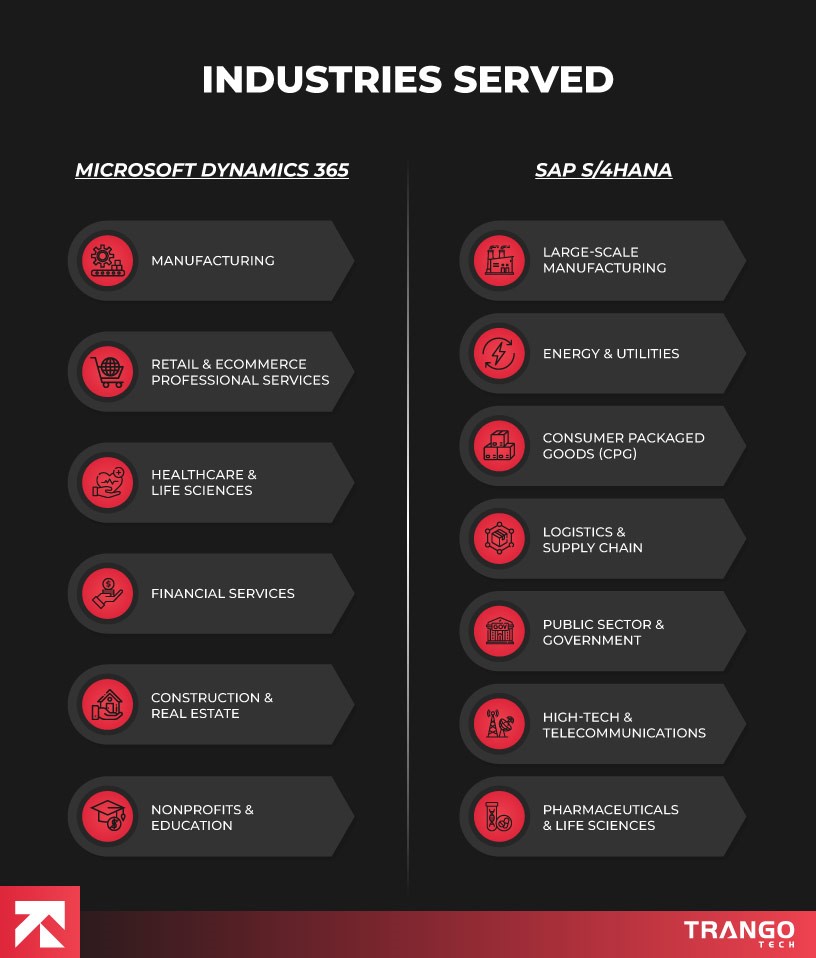
Industry Fit: Which ERP Works Best for Your Business?
Customization is crucial for meeting the distinct needs of every industry. This is why you need an ERP system tailored to your industry that can solve your business problems. Microsoft Dynamics 365 and SAP S/4HANA offer features that fit your operational needs and business size. Explore which ERP is best suited for each industry.
Retail & eCommerce – Best Fit: Dynamics 365
Retailers require ERP solutions that are reliable and offer good speed. Its integration to POS, CRM, and eCommerce is a must, and Microsoft Dynamics 365 takes the lead here. It can seamlessly integrate with third-party apps, and a reliable Business Central Partner can help you with it.
Manage your orders, track inventory, and offer personalized customer experiences with built-in AI insights and real-time reporting. Remain available to the customer at all times without delay.
SMBs & Mid-market – Best Fit: Dynamics 365
Every small and mid-sized business seeks cost-effectiveness, flexibility, and scalability. Dynamics 365 Business Central implementation streamlines finance, supply chain, and sales processes with ease. SMBs can deploy ERP to scale up as the business grows—all at a fraction of the cost of SAP.
Financial Services – Best Fit: Dynamics 365
Financial institutions need to maintain transparency as they operate in highly regulated environments. Data security and compliance are the core functions of these institutions.. Dynamics 365 comes with advanced security and compliance certifications. Moreover, it integrates with Power BI to offer real-time analytics for better decision-making. Banks and insurance firms can now operate with flexibility and speed.
Large Manufacturers – Best Fit: SAP
SAP excels in managing Manufacturing industries, as it offers features such as predictive MRP, shop-floor automation, and global supply chain orchestration.SAP S/4HANA provides reliable solutions for large and complex manufacturing operations. It provides modules for automotive and heavy machinery, ensuring production efficiency, compliance, and end-to-end visibility across global plants.
Healthcare & Pharma – Best Fit: SAP
SAP is improving healthcare with its robust solution that caters to the industry’s sensitive requirements.
Healthcare institutions can meet compliance requirements while managing data security. SAP S/4HANA provides specialized features, including appointment scheduling, compliance tracking, reports management, etc. Pharmaceutical companies leverage batch management, traceability, production planning, and reporting capabilities to support critical business processes.
Oil, Gas & Energy – Best Fit: SAP
The oil and gas industry has its own needs and regulatory standards.
Oil, gas, and energy businesses need to manage multinational operations. SAP S/4HANAoffers features that meet the regulations, demands, and needs of the industry. Embracing SAP will drive operational excellence and help petroleum businesses meet energy needs.
Dynamics 365 vs SAP evaluation analyzes the industry-specific solutions and capabilities to provide a deep dive into the pros and cons.
The final recommendations in the SAP vs Dynamics 365 debate are:
Microsoft Dynamics 365 is not heavy on the pocket.
SAP S/4HANA handles complex operations.
Dynamics 365 offers automation of standard operations, and SAP solves complex problems.
Acquire the help of an experienced Microsoft Dynamics or SAP implementation partner to make the right choice..
Business Central implementation can revamp your system with a certified Dynamics 365 Partner, who can make a difference.
Conclusion
The ERP system is here to facilitate all organizations with the automation of daily tasks. But a wrong system can hinder their growth. To make a wise decision, you need to analyze both systems in detail.
Microsoft Dynamics 365 is here to help all small and medium businesses that are hunting for a system with advanced enterprise capabilities and cost-effectiveness.
SAP is good for large organizations with growth plans and operational complexity. Also, a completeERP requirement checklist must be created listing the organization’s needs
FAQs: Microsoft Dynamics 365 vs SAP
What is the difference between Dynamics 365 vs SAP?
Microsoft Dynamics 365 and SAP are well known ERP solutions. In SAP vs Microsoft Dynamics comparison, Microsoft offers flexibility, user-friendly interface, and seamless integration with other Microsoft products, while SAP offers robust, enterprise-grade solutions.
Which is better for small to medium-sized businesses: Microsoft Dynamics 365 or SAP?
Microsoft Dynamics 365 is suitable for SMBs and often more cost-effective and easier to implement, whereas SAP is typically chosen by large enterprises with complex, global operations
How does Microsoft Dynamics 365 vs SAP compare in terms of pricing?
Microsoft Dynamics 365 generally offers modular, subscription-based pricing, making it more affordable for scaling. SAP pricing tends to be higher due to advanced customization and implementation costs.
Is Microsoft Dynamics 365 vs SAP more suitable for cloud deployment?
Both offer cloud ERP solutions. Microsoft Dynamics 365 is fully cloud-native and integrates with Azure, while SAP provides SAP S/4HANA Cloud, offering hybrid and on-premises options as well.
Which industries benefit more from Microsoft Dynamics 365 vs SAP?
Microsoft Dynamics 365: Retail, distribution, services, manufacturing (SMBs, mid-market).
SAP: Manufacturing, energy, healthcare, finance (large enterprises with global operations).
Can Microsoft Dynamics 365 and SAP integrate with other business tools?
Yes. In SAP and Microsoft Dynamics 365 comparison, Microsoft Dynamics 365 integrates smoothly with Microsoft 365, Power BI, and Teams, while SAP integrates with third-party applications, analytics platforms, and industry software.
How does SAP vs Microsoft Dynamics pricing compare?
When it comes to SAP vs Microsoft Dynamics pricing, Microsoft Dynamics 365 has a cheaper, modular subscription-based options, while SAP often involves higher implementation costs with enterprise-scale features.
Which is better for small and medium businesses: SAP vs Microsoft Dynamics features?
In terms of SAP vs Microsoft Dynamics features:
Microsoft Dynamics 365: CRM, Sales automation, Power BI analytics, finance, supply chain, Dynamics 365 Magento Integration and retail modules.
SAP: Advanced manufacturing, logistics, finance, HR, compliance, and global enterprise support.
Which system is more scalable?
Both are highly scalable. Dynamics 365 facilitates growing SMBs, while SAP is designed for large organizations.
Who provides better customer support: Microsoft or SAP?
Both offer enterprise-grade support. Microsoft’s support ecosystem is more affordable, whereas SAP’s support is more expensive.
Which industries are best served by SAP?
SAP offers solutions for manufacturing, automotive, energy, and large-scale global enterprises.
Which industries benefit most from Dynamics 365?
Dynamics 365 is suitable for retail, professional services, distribution, finance, and SMBs.
Meet Ahsan, the strategist behind some of the most insightful content on Dynamics 365, Business Central, and enterprise transformation. Armed with a deep understanding of Microsoft’s business applications ecosystem (and a steady supply of coffee!) Ahsan has spent years helping organizations navigate the world of ERP, CRM, and digital modernization. Currently working at Trango Tech, a trusted Dynamics 365 Partner, Ahsan brings real-world expertise to every piece he writes. So grab your favorite drink and get ready to explore the ever-evolving landscape of Dynamics 365 and Business Central with Ahsan as your guide.