Want to know how to start a taxi business that actually works? You’re not alone. Many entrepreneurs see the demand for fast and easy ride services. In 2025, the taxi market is expected to produce US$139.59 billion worldwide.
Hence, starting a taxi business takes more than just a few cars. You need a strong plan, proper permits, and a skilled team.
Most importantly, you need a powerful app like Uber or any other leading service. That’s where a trusted taxi app development company comes in.
Your app must be simple, fast, and secure. Customers should book rides, track drivers, and pay with ease.
We recommend you to choose a business model that fits your needs.
Below, we’ve covered all the basics to help you launch your taxi app the right way.
Let’s begin!
Ready to capitalize on the $139.59 billion taxi market?
Partner with Trango Tech to build a simple, fast, and secure app for your taxi business!
Table Of Contents
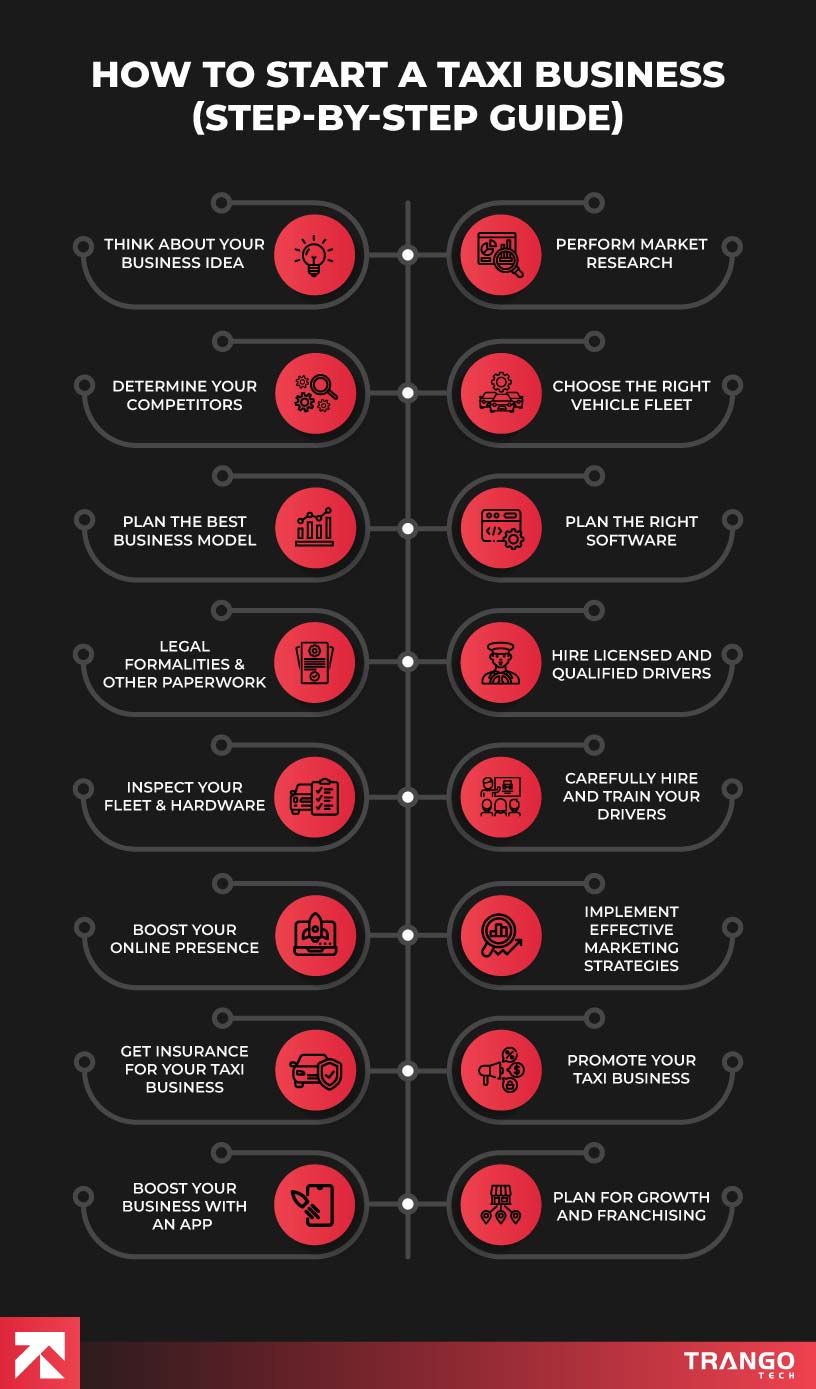
How to Start a Taxi Business – Step-by-Step Guide
If you’re interested in starting the taxi business? Read on!
Below, the write-up includes all the important aspects that helps in starting the taxi business venture successfully.
It is important that you’ve a clear idea beforehand for smooth app launch.
Its best your goals should be stated as clearly as possible. If your goals are not clear, this could result in challenges later.
Let’s explore the steps one-by-one to begin your own taxi venture.
1. Think About Your Business Idea
In order to launch a thriving taxi business, it’s important to develop a strong business plan.
In this regard, you need to establish your idea, understand the components needed to launch, and review the prerequisites. Besides, you need to conduct market analysis, and then proceed further.
Remember that your business strategy should focus on delivering client satisfaction. Meanwhile, generating maximum profits as well.
Overall, conducting market research is essential for understanding your rivals and to play ahead in your field.
One of the great examples of taxi hailing service is Uber. The cost to develop an app like Uber lies between $20,000 to $80,000+ or more.
Also, assure to analyze the following queries while preparing a plan;
Who are your target customers and why will they choose your services?
What is the pricing structure for your taxi business?
What is the market for your services?
How will you promote your taxi business?
What resources are needed to start your taxi service?
What are the potential risks and challenges for your taxi business?
Confused about whether your app idea will succeed?
Collaborate with our expert app developers at Trango Tech to get your questions answered and kickstart your taxi business!
2. Perform Comprehensive Market Research
Prior starting your taxi business, it’s important to study the market thoroughly.
The taxi industry is growing rapidly. In fact, the ride-hailing market is expected to grow from $79.13 billion in 2024 to $90.5 billion in 2025. And that, too, with an impressive annual growth rate of 14.4%.
Hence, take some time to figure out who your potential customers are and how much demand there is for taxi services in your area.
You can check out what your competitors are doing.
See their pricing. And what distinct services they are offering. Don’t forget to check how they’re promoting their business.
By spotting these gaps, you can position your business for success in a better way.
Don’t forget to think about factors like local laws, seasonal changes, and the overall economy. They can all impact your business.
While you’re doing your research, here are a few questions to consider:
How did other taxi businesses start?
What mistakes did they make, and what can you learn from them?
What challenges did they face in the beginning?
Are they earning a good income?
How fast are they growing?
Why are some of them falling behind?
3. Get to Know Your Competitors
We can comprehend it has become quite challenging to stay on top, especially with numerous businesses launching their taxi apps.
Thereby, it is essential to understand who you’re competing with.
Take a close look at the taxi services operating in your area. What are their strengths? Where do they fall short? What makes them stand out?
Evaluate their pricing, customer service, and reviews. It will help you understand what works and what doesn’t in the market.
Here are some questions you can keep in mind while performing competitor analysis:
What are their most popular services?
What feedback do their customers share in reviews?
Are there areas where they fail to meet customer expectations?
How do they market their services?
4. Choose the Right Vehicle Fleet
Undoubtedly, having a right flight plays an utmost role.
We advise you to think about who your target customers are and what they need.
Your cars should be reliable, safe, & comfortable to assure passengers have a pleasant experience.
Fuel efficiency is also key to keeping running costs low.
Depending on your budget, you could choose any variant. For instance, traditional sedans, hybrids, electric vehicles, or even specialized vehicles like wheelchair-accessible taxis.
Make sure your cars comply with local laws and safety standards. Regular maintenance and cleanliness are non-negotiable. You can invest in our cost-effective mobile application development services, too.
Here are some questions to consider when choosing your fleet;
What kind of vehicles will suit your target customers best?
Should you invest in fuel-efficient or electric vehicles?
Are there any legal or safety requirements for your fleet?
How often will the vehicles need maintenance?
Example Table for Fleet Selection
Vehicle Types
Pros
Cons
Ideal For
Traditional Sedan
Affordable, widely available
Higher fuel costs
Regular passengers
Hybrid/Electric Vehicles
Fuel-efficient, eco-friendly
Higher upfront cost
Environmentally conscious riders
Wheelchair-Accessible Taxis
Inclusive, serves all customers
Higher customization costs
Passengers with functional needs
5. Plan the Best Business Model
For a successful taxi business, it’s important to think how your taxi cab business will make money.
You should take these factors into account. Like, salaries, rent, taxes, and other fixed and variable costs.
Don’t forget to include expenses for marketing, fleet investment, and ongoing maintenance.
It’s normal for a taxi business to take time to cover all its costs.
The goal is to figure out when your company will break even and start making profits. Keep in mind that things like seasonality might affect your earnings, so plan ahead!
Here are some questions you shouldn’t overlook:
What’s the average cost per ride in your area?
How much will it cost to run your business daily, weekly, or monthly?
How much do you need to invest upfront?
How long will it take to reach your break-even point?
Example Table for Business Model Planning
Expense Type
Estimated Cost
Notes
Fleet Investment
$50,000
Includes vehicle purchase/lease
Salaries
$15,000/month
Drivers and support staff
Marketing and Promotions
$5,000 (initial), $1,000/month
Digital ads, flyers, etc.
Maintenance and Fuel
$2,500/month
Routine upkeep and fuel costs
Other Expenses (Taxes, Rent)
$3,000/month
Office space, permits
6. Plan the Right Features for Your Taxi Business
Running a simple taxi business is great. However, if you’re thinking how to start online can business long-term, then why not set it up for growth from day one?
Investing in the right software can make your operations smoother. It also aids in attracting more customers & keep things efficient.
Here are some must-have software features to consider:
Passenger and driver apps for iOS and Android to make booking rides and managing trips.
Pre-booking options so customers can schedule rides in advance.
Cashless payments for faster, hassle-free transactions and better revenue flow.
Automated processes like driver billing to save time and reduce errors.
Reports and stats to track your progress and make data-driven decisions.
Business-friendly features like referral programs, custom location names, and a web app.
You’ve options to choose in-between building custom software, using a white-label solution, or joining a franchise ride-hailing platform.
Example Table for Which Software Features You Should Think of
Features
Why It’s Important
Benefits
Passenger & Driver Apps
Attracts bookings and simplifies work
Increases convenience and usage
Pre-Booking
Lets customers plan ahead
Boosts customer satisfaction
Cashless Payments
Modern and seamless payment options
Faster transactions
Automated Billing
Reduces manual work
Saves time and cuts errors
Business Reports
Tracks performance and growth
Helps improve strategies
Ready to build a powerful taxi app with all the must-have features?
Partner with Trango Tech to create a seamless, scalable app tailored to your business!
7. Understand Legal Formalities & Other Paperwork
Right after you’re done with finalizing features & functionalities, you need to check out legal formalities.
Research the permits, insurance, and background checks you’ll need for your drivers.
Learn about any vehicle safety regulations to ensure compliance.
Its best to set up your company legally. Decide on a business structure, get the necessary licenses, and register with the local authorities.
Questions to Consider;
What permits or licenses do I need to operate a taxi service?
Are there specific insurance requirements?
What vehicle safety standards should I follow?
What checks do drivers need to pass?
8. Hire Licensed and Qualified Drivers
Once you’re done with understating the formalities and paperwork, next, thoroughly scrutinize the drivers’ you recruit.
A valid license is non-negotiable for running a smooth business.
It’s also important to check that their driving record is free of any major violations.
While hiring, remember the following questions;
What type of driver’s license is required for my taxi business?
Are my drivers legally eligible to operate?
How can I verify their driving history?
9. Inspect Your Fleet and Hardware
Your fleet is your biggest asset, so it’s important to choose and maintain it wisely while starting a taxi business.
It’s always best to think about the hardware you’ll need in the first place. For instance, s taxi meters, dispatch systems, or roof lights.
In some cases, software can replace hardware (e.g., digital meters or app-based dispatch).
For your vehicles, you can take the following measures;
Purchase brand-new cars for a fresh start.
Look into used cars to save money.
Explore deferred payment plans.
Invest in electric vehicles for sustainability.
Branding your vehicles is equally important. Make sure your fleet reflects your business identity.
For example, luxury cars work best for premium services. However, economy vehicles are perfect for affordable rides.
Think about these queries;
What type of vehicles suit my business model?
Should I buy new or used vehicles?
How can I brand my fleet to stand out?
Example Table for Fleet Planning
Vehicle Type
Advantages
Ideal For
New Cars
Reliable, modern features
Long-term investments
Used Cars
Cost-effective, budget-friendly
Starting on a tight budget
Electric Vehicles
Eco-friendly, lower fuel costs
Environmentally conscious riders
10. Boost Your Online Presence
Nowadays, having an online presence is a must have for any businesses to succeed.
And for that reason, professional website is the first step.
You can highlight your services, fleet, and contact details. You can also incorporate easy-to-use booking system, so customers can book rides from their phones anytime.
Moreover, make use of social media platforms like Facebook and Instagram to connect with customers. Plus, for sharing updates & running promotions.
You can also expand your reach by listing your service on popular ride-hailing platforms.
Besides, to improve your business presence, think strategically regarding these queries;
What features should I include on my website?
How can I use social media to promote my business?
Should I partner with ride-hailing platforms to attract more customers?
11. Implement Effective Marketing Strategies
In order to distinguish your business from the rest of your rivals, we recommend you to implement revenue-generating marketing strategies.
Start by understanding who your target customers are and what they need.
Use platforms like social media, local ads, and digital marketing to reach them.
Offer discounts, referral programs, or loyalty rewards to encourage new and repeat riders.
Branding your fleet with your logo and contact details is another great way to boost visibility.
Track the results of your marketing efforts. Also, adjust your strategy as needed.
By exploring the beneath questions, you can also find out the best ways to improve your taxi business presence;
What kind of promotions will attract my target customers?
How can I measure the success of my marketing campaigns?
What’s the best way to brand my fleet?
Methods to Improve Marketing Strategies
Strategy
Why It Works
Budget Range
Social Media Ads
Reaches a wide audience quickly
Low to Medium
Referral Programs
Encourages word-of-mouth recommendations
Low
Local Partnerships
Builds community connections
Medium
SEO Optimization
Increases visibility on search engines
Low to Medium
Flyer Distribution
Targets local areas effectively
Low
Influencer Marketing
Reaches niche audiences through trusted voices
Medium
Vehicle Branding
Creates brand awareness through your fleet
Medium
12. Get Insurance for Your Taxi Business
Insurance is a must to protect your taxi business.
The most important type is commercial vehicle insurance. It covers accidents, injuries, and property damages.
Don’t forget to consider liability insurance to protect against legal claims from passengers or others.
For extra protection, look into comprehensive insurance for your fleet. It can help with theft, vandalism, or damage from natural disasters.
Speak with insurance experts to choose coverage that fits your needs and local regulations.
Example Table for Insurance Coverage
Type of Insurance
What It Covers
Why It’s Needed
Commercial Vehicle Insurance
Accidents, injuries, and property damage
Protects vehicles and passengers
Liability Insurance
Legal claims from passengers or third parties
Safeguards against lawsuits
Workers’ Compensation
Work-related injuries or illnesses
Supports your drivers’ well-being
13. Get Your Taxi Business Registered
Ready to launch your taxi service? Get it registered right away.
Decide on the legal structure of your business. Either it will be a sole proprietorship or an LLC (Limited Liability Company).
Register your company with the local government, and secure all necessary licenses and permits to operate legally.
If you plan to hire employees, complete any tax registrations and obtain an Employer Identification Number (EIN).
Questions to Ask Yourself;
What type of legal structure is best for my taxi business?
What licenses and permits do I need to operate?
How do I register for taxes and get an EIN?
14. Boost Your Business with a Taxi App
Want to take your taxi business to the next level? Make an app.
It benefits both drivers and customers. It helps in simplifying bookings, payments, and improve communication.
With a taxi app, customers can:
Book rides quickly.
Track drivers in real time.
Pay cashless for a smooth experience.
Drivers, on the other hand, can:
Easily manage ride requests.
Use app navigation to save time.
Get access to trip details instantly.
KPIs to Boost Your Taxi Business
KPIs
Why It’s Important
How to Measure
Revenue
Tracks overall growth
Monthly income reports
Customer Satisfaction
Builds loyalty and reputation
Online reviews, surveys
Driver Performance
Ensures quality service
Ride completion rates, feedback
Fleet Utilization Rate
Measures efficiency of your fleet
Percentage of time vehicles are in use
Operating Costs
Tracks expenses and identifies areas for savings
Monthly expense reports
Booking Volume
Shows demand and customer engagement
Total rides booked in a specific period
Average Ride Fare
Monitors profitability per trip
Total revenue divided by number of rides
15. Plan for Growth and Franchising
To expand your business, research potential locations and assess the demand for taxi services there.
If you prefer to grow without managing everything yourself, franchising is a great option.
It allows other entrepreneurs to use your brand and business model while you earn franchise fees.
Think about the following queries;
Is there demand for taxi services in new locations?
Should I expand or offer franchises?
How can I ensure sustainable growth for my business?
Expansion vs. Franchising
Options
Benefits
Challenges
Expansion
Increases market reach and revenue
Requires significant investment
Franchising
Grows brand without operational burden
Requires a strong brand reputation
Partnerships with Apps
Leverages established platforms for growth
Profit-sharing with the app providers
Entering Niche Markets
Creates unique opportunities (e.g., luxury rides)
Needs thorough research and positioning
Regional Expansion
Establishes presence in underserved areas
May face regional regulatory challenges
Franchising Support
Provides support to franchise owners
Requires standardized processes
Hidden Goldmine & Opportunities in the Taxi Industry
Needless to say, the taxi industry is more than just getting people from point A to point.
In fact, it is a hidden goldmine filled with exciting opportunities.
With the passage of time, people are looking for reliable, convenient, and eco-friendly transportation options.
Let’s discover the opportunities businesses can acquire by investing in taxi app development.
Key Opportunities in the Taxi Industry
Opportunity Areas
Why It’s Significant
How to Leverage It
Growing Demand
Urbanization and population growth increase reliance on taxis
Focus marketing efforts on high-density urban areas
Ride-Sharing Trend
Ride-sharing platforms have reshaped how people use taxis
Develop a mobile app or collaborate with existing platforms
Technology Advancements
Features like GPS, online booking, and automated dispatch systems enhance convenience
Invest in reliable software for smoother operations
Niche Markets
Cater to specific customer needs such as eco-friendly, luxury, or accessible transport
Identify underserved demographics and tailor services accordingly
Tourism and Travel
Tourists often rely on taxis for local transportation
Partner with hotels, travel agencies, and airports
Franchise Opportunities
Well-known brands attract franchise partners and build larger networks
Create a scalable model with operational support for franchisees
Diverse Revenue Streams
Beyond passenger rides, taxis can serve delivery services and corporate contracts
Offer package delivery, partner with businesses, and explore contracts with local companies
Flexible Business Models
Options to own vehicles or partner with independent drivers allow scalability
Choose a model that aligns with available resources and market demands
Global Expansion
Successful taxi businesses can grow internationally
Conduct market research and assess regulatory requirements in target regions
Sustainable Transportation
Environmentally friendly taxis appeal to eco-conscious consumers
Invest in hybrid or electric vehicles and highlight sustainability in marketing
Build A Successful Taxi App with Trango Tech!
How to start a taxi business – is a question many ask these days?
With more people choosing app-based transport, this is the right time to launch your own service.
Start with research. Know your target area and what customers need. Build a plan. Set your budget, pricing, and services clearly.
Focus on giving good service. Make sure your app is simple, fast, and safe.
With the right team, you can build a strong taxi business. You can partner with our reputable app development agency – Trango Tech. Our experts will handle all your app needs.
Ready to launch a remarkable taxi app that generates 10X revenue?
At Trango Tech, we develop apps that speak volumes for themselves!
Frequently Asked Questions (FAQ’s)
1. How much does it cost to start a taxi business?
Starting a taxi business varies a lot in terms of cost. When it comes to determining the cost to develop an app, it depends on how many vehicles you have. Also, it relies on the features in your app, and your location you’re targeting. You may need $15,000 to $50,000+ or more to get started.
2. Do I really need a taxi app for my business?
Yes, having a taxi app is very helpful. It lets users book rides, track drivers, and pay easily. It also helps you manage everything from one place. You can talk to our professionals and get your app launched timely and swiftly.
3. What key features should my taxi app have?
Your app should include live ride tracking, driver ratings, booking history, and payment options. These features improve user trust and make the app easier to use.
4. How is Trango Tech’s taxi app development service different?
Trango Tech creates custom apps based on your business needs. We focus on user-friendly design. Plus, strong backend systems, and full support even after launch.
5. Can Trango Tech help grow my taxi business over time?
Yes. We build apps that are ready to scale. Right after your business starts to grow, we can add new features and functions. Besides, we assure your app support more users and improve performance in the long run.
Mariam Amin is an Electronics Engineering graduate and a passionate content marketer specializing in tech and SaaS. At Trango Tech, a leading mobile app development company, she creates easy-to-understand content on mobile app development, using her technical background to support practical digital strategies. Outside of work, Mariam enjoys exploring new food trends, staying active, and relaxing with documentaries or movies.